
Viral launch videos for moon-shot founders 🌸
Flowjam partners with AI founders and startups aiming for the moon, to create story-driven launch videos to build hype and show the world what they're building.

Full PortfolioBlog
Flowjam works with some of the most successful AI founders in the world after only launching in 2023.
Copyright 2026. Flowjam Ltd.
Copyright 2026. Flowjam Ltd.
AI Video for Schools: What to Make First and Where FERPA Draws the Line
Schools can use AI video for announcements and translations. Student footage can be a FERPA education record, and public schools need accurate captions.

A teacher films a student melting down in class, then asks an AI tool to turn the clip into a behavior-plan summary for the parent meeting. Under FERPA that clip became an education record the moment it was used for an official purpose about that student, and the AI vendor now holds it.
Most of what a school would make with AI video never gets near that line, and that's the part districts should be doing far more of. A school sends families more notices than almost any local organization, in more languages, and most of them go out as a PDF nobody opens. AI video is the cheapest way we know to fix that.
What a school should make with AI video first
Start where the script already exists and no student appears. Our order, by how much front-office time each one gives back:
Translated family notices come first. Enrollment steps, the attendance policy, how to set up the parent portal. Write it once in English, have a staff member who speaks the language check the translation, and send the same video in every home language your district tracks. The AI video translation tools roundup compares the dubbing options.
Operational updates come second: snow days, bus-route changes, a new pickup procedure. A 40-second clip from the principal beats a three-paragraph email, and with an approved avatar of the principal it can go out the same morning.
Staff onboarding and compliance training come third, because a district reshoots the same orientation every August. Our AI training video generator guide covers that workflow.
Classroom content comes last, and only when the teacher drives it. A flipped-lesson intro or a weekly class update is a good use. A tool that writes and presents the lesson for the teacher isn't, and we'd skip it.
If a video needs a specific student to make sense, it moves to a different pile. That pile is where the FERPA rule applies, and it's short enough to go through test by test.
The four tests in the FERPA video FAQ
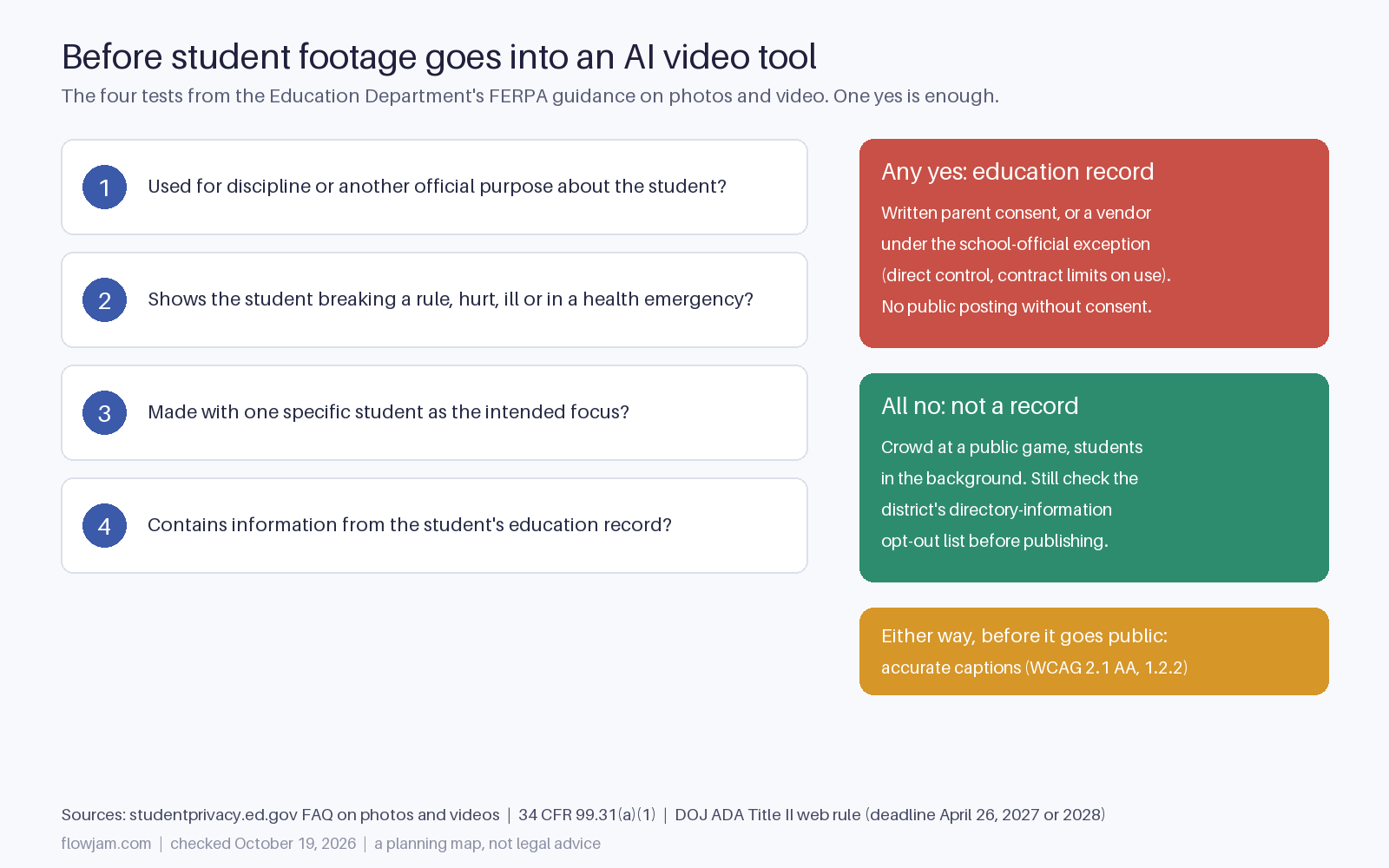
The Department's Student Privacy Policy Office answers one question in its FAQ on photos and videos: when is footage of a student an education record? Its answer is footage that is directly related to a student and kept by the school or someone acting for it.
FERPA never defines "directly related", so the FAQ gives factors instead. Footage is directly related if the school uses it for discipline or another official purpose involving the student. The same goes if it shows a student breaking a law or getting hurt, attacked, ill or having a health emergency. A clip made with one specific student as the intended focus counts too. So does any clip that carries information from the student's education record.
Then it says what doesn't count. A student whose image is "incidental or captured only as part of the background" isn't covered. Neither is a student taking part in school activities open to the public, where no one individual is the focus. Its own example is a basketball game, where the close-up is about the players and not about the fans in the stands.
What the tests mean for an AI video tool
Read those four tests against how schools actually use AI video and two piles appear.
The first pile never touches the tests. It's everything in the list above: notices, updates, training and translations. These videos are made from a script, not from a student.
The second pile is footage built around one student. That includes IEP progress clips, behavior documentation, a highlight reel of one athlete, or a recording of a counseling session turned into notes. Uploading any of it to an AI tool is a disclosure of an education record. That's allowed in two ways: written consent from the parent, or the vendor qualifying as a "school official".
The school-official route comes from 34 CFR 99.31(a)(1). A vendor can qualify if it does work the school would otherwise do with its own staff and stays under the school's "direct control" over how the records are used and kept. It also has to stay within FERPA's limits on passing records on. In practice that means a signed data agreement.
- The vendor uses the footage only to make the school's videos.
- No training of the vendor's models on student footage or voices.
- Deletion on the school's request and at contract end, with written confirmation.
- No passing the footage to another company without the school's approval.
- A named district account, not a teacher's personal sign-up.
Many states already publish a model student data privacy agreement, and the clauses above map onto most of them. A free tool a teacher signed up for with a personal email has none of this, which is why we'd keep student footage off it entirely.
Where the FAQ stops
The guidance was written for cameras, not generators, and it leaves two gaps a school has to fill with judgment.
The first gap is generated students. An AI avatar of a child who doesn't exist isn't anyone's education record, so FERPA has nothing to say. We'd still keep them out of school marketing. A brochure kid who doesn't attend the school misleads the families choosing it, and a generated face built from real class photos is a step closer to a real student than most people realize.
The second gap is the public-facing highlight video. Photos sit on the list of examples of directory information in 34 CFR 99.3, and directory information can go out without consent unless a parent has opted out. So a spirit-week montage where nobody is the focus is usually fine. Running an AI edit over it doesn't change that. But check the opt-out list before publishing, because an AI reframe can turn a background face into the focus of a vertical crop.
Captions on school videos are now a deadline
The other rule a public school can't skip comes from the Justice Department. Its 2024 ADA Title II rule requires state and local government web content, school districts included, to meet WCAG 2.1 Level AA. The DOJ fact sheet names video captions as one of those requirements.
In April 2026 the Department pushed the compliance dates back a year. Districts in places with 50,000 or more people now have until April 26, 2027, and smaller ones until April 26, 2028. Old social media posts and properly archived content are exempt. New videos aren't.
WCAG's success criterion 1.2.2 asks for captions on prerecorded video, and Level AA adds audio description for anything shown but not said. AI makes captions cheap, but raw auto-captions mangle student names, school names and acronyms. We'd treat them as a draft that a person corrects before the video is published. That's the step districts skip, and it's the one an accessibility complaint will catch.
Can a teacher use an AI avatar of themselves?
Yes, and for weekly class updates or flipped-lesson intros it's one of the better uses. The teacher records the training footage, approves each script and gets a written agreement about what happens to the avatar when they leave the district. The video says on screen that it's AI-generated. Our AI avatar tools roundup covers how the main tools handle consent and deletion.
The version we wouldn't build is an avatar that answers students' questions in that teacher's face. Parents can't tell which answers the teacher wrote and which the tool improvised, and a school shouldn't ask them to.
For the production side, our guide to making AI videos walks from script to export. If your comms team would rather start from templates with the caption review and AI label built in, Flowjam makes those.
One question the FAQ doesn't settle is whether an AI tool's transcript of a classroom recording becomes its own education record once it names a student. Our reading of the factors says yes. Plan as if it does until the Department says otherwise.
AP
About the author
Adam Petty
Founder, Flowjam
Adam is the founder of Flowjam, where he helps startups turn ideas into launch videos, product demos, and ads with AI video. He writes about AI video production, creative workflows, and go-to-market for early-stage teams.
Frequently asked questions
Can schools use AI-generated video?
Yes. No federal law bans it. Announcements, explainers, staff training and translated family notices made from a script carry no student-privacy issue. Footage built around one identifiable student is where FERPA applies.
When is a student video an education record under FERPA?
Under the Education Department's FAQ, footage is an education record when it is directly related to a student and kept by the school or someone acting for it. Directly related includes footage used for discipline or another official purpose, footage showing a student breaking a law, injured or in a health emergency, footage made with one student as the intended focus, or footage containing information from the student's record.
Can a school upload student footage to an AI video tool?
Only with written parent consent or if the vendor qualifies as a school official under 34 CFR 99.31(a)(1), meaning it does work the school would otherwise do, stays under the school's direct control over use and storage, and follows FERPA's redisclosure limits. In practice that means a signed data agreement that bars model training and reuse.
Do school videos need captions?
Public schools do. The DOJ's 2024 ADA Title II rule requires WCAG 2.1 Level AA for web content, which includes captions on prerecorded video. After an April 2026 extension, districts in places of 50,000 or more people must comply by April 26, 2027, and smaller ones by April 26, 2028.
Are AI auto-captions good enough for ADA compliance?
Not on their own in our view. WCAG expects captions that accurately convey the dialogue, and raw auto-captions often get names, acronyms and school terms wrong. Treat them as a draft that a person corrects before publishing.
Can a teacher make an AI avatar of themselves for class videos?
Yes, with the teacher's written consent, approved scripts, an on-screen AI label and an agreement about what happens to the avatar if they leave. Avoid avatars that answer student questions on the teacher's behalf.
Can schools use AI-generated students in marketing videos?
FERPA doesn't cover students who don't exist, but we'd avoid it. A generated student misleads families choosing the school, and real enrolled students with a signed media release are the honest option.





Launch videos for
moon-shot founders.

About
We're a video production studio partnering with AI founders and startups. We make launch videos to show the world what you're building.
London / San Francisco
Made with love from London / San Francisco. Collaborating with clients worldwide.
Contact
Adam Petty
Founder
adam@flowjam.com
Founder
adam@flowjam.com