

Full PortfolioBlogDone-for-you Paid Ads
Flowjam works with some of the most successful AI founders in the world after only launching in 2023.
Copyright 2025. Flowjam Inc.
Copyright 2025. Flowjam Inc.
Indie Hacker SaaS Ideas 2026: 12 Boring Niches That Print Money
12 indie-hacker SaaS ideas for 2026 - boring, specific niches solo founders can build fast and grow to $5k-$50k MRR, with the pain, revenue potential, and build difficulty for each.

the short answer
The best indie-hacker SaaS ideas in 2026 are narrow tools people already pay for: developer uptime monitors, AI PR reviewers, creator scheduling and repurposing tools, and automated standup or status-report bots. They win by being boring, specific, and painful. The micro-SaaS market is heading from $15.7B to a projected $59.6B by 2030 (micro-SaaS market reports), with solo founders hitting $5k–$50k MRR. Here are 12 to build fast.By the Flowjam team · Updated August 2026
Last Updated: June 30, 2026
The best indie hacker SaaS ideas in 2026 aren't clever, they're boring, specific, and painful. Payment recovery. Compliance paperwork. Workflow glue between two tools nobody else connects. That's where solo founders are quietly hitting $5K-$50K MRR.
Below are 12 validated SaaS ideas you can launch fast, each with the niche, the pain, realistic revenue potential (anchored to real comparable products), build difficulty, and how to validate it in 30 days. Plus the framework for picking one and the stack to ship it in weeks.
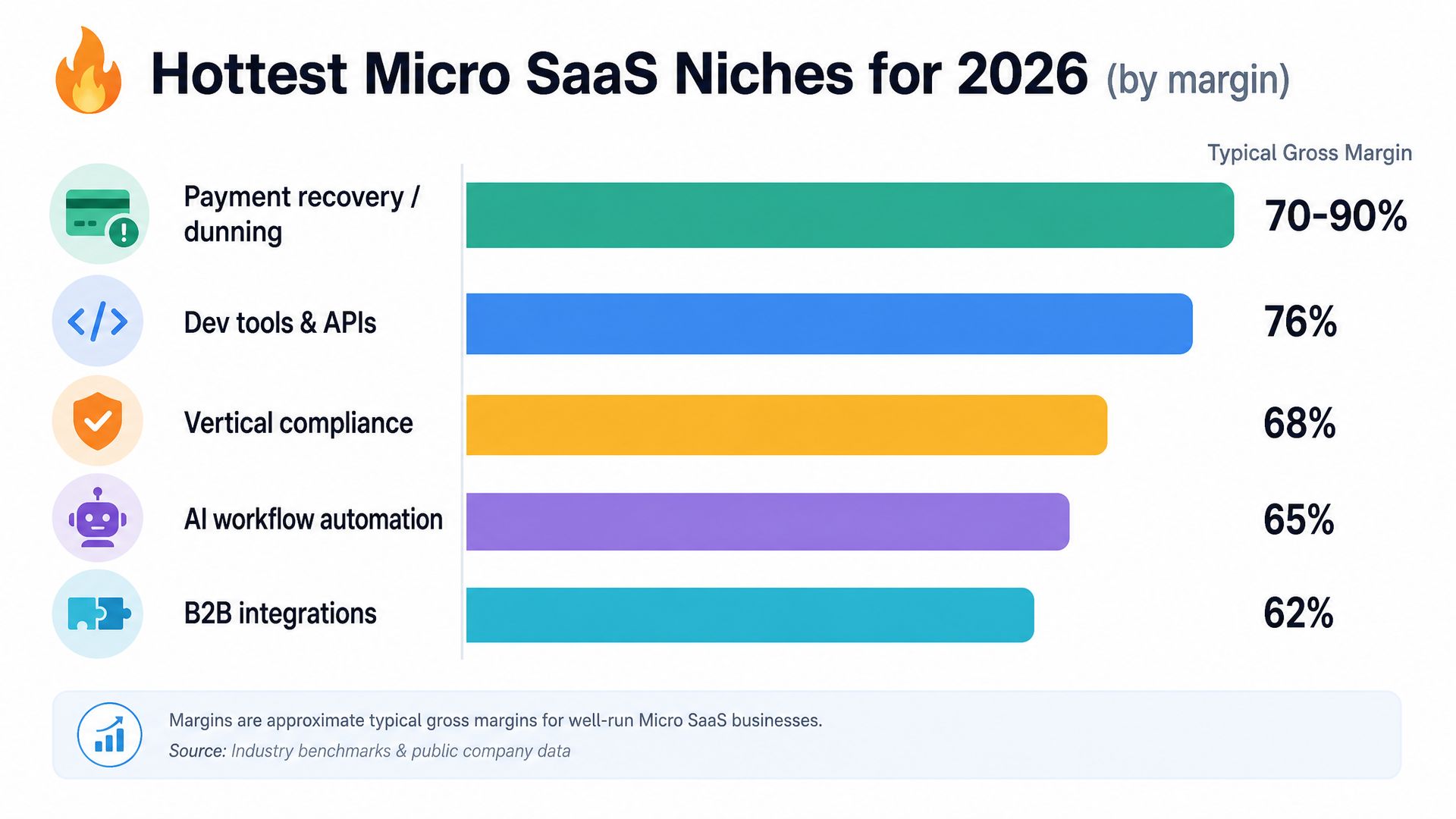
Table of Contents
- How to Pick an Idea That Makes Money
- 12 Indie Hacker SaaS Ideas for 2026
- Validate It in 30 Days
- The 2026 Build-Fast Stack
- Why Most Indie SaaS Fails
- Frequently Asked Questions
How to Pick an Idea That Makes Money
The single factor that predicts success isn't how clever the idea is, it's whether it solves a real, recurring, painful problem for a specific niche. Founders fail when they build something they think is cool. They win when they build something a defined group already pays to solve badly.
Three filters for any idea on this list:
- Recurring pain — the problem shows up every week, not once. That's what justifies a subscription.
- A reachable niche — you can name the exact person and find 100 of them in one community.
- Willingness to pay — it touches money, time, or risk. "Nice to have" doesn't convert.
12 Indie Hacker SaaS Ideas for 2026
| Idea | Niche / Pain | Revenue Potential | Build |
|---|---|---|---|
| Payment-recovery / dunning tool | SaaS losing revenue to failed cards | $20K-$360K ARR | Medium |
| Vertical compliance checker | Healthcare/legal/finance ops | $30K-$500K ARR | Medium |
| AI content repurposer | Creators/agencies with 1 asset → 10 posts | $30K-$500K ARR | Medium |
| Niche B2B integration | Two popular tools nobody connects | $20K-$300K ARR | Low-Med |
| Testimonial / social-proof tool | SaaS & agencies needing proof | $30K-$1M ARR | Medium |
| Meeting-notes / call summarizer | Sales & consulting teams | $25K-$300K ARR | Medium |
| Niche job board | One specific role/industry | $40K-$500K ARR | Low |
| Client portal for agencies | Freelancers/agencies + approvals | $30K-$400K ARR | Medium |
| SEO / GEO audit generator | SMBs & marketers | $20K-$250K ARR | Low-Med |
| Appointment scheduling for a niche | Salons/clinics/trades | $35K-$450K ARR | Medium |
| AI thumbnail / creative generator | YouTubers & marketers | $20K-$300K ARR | Low-Med |
| Churn / retention analytics | Early SaaS without a data team | $25K-$400K ARR | Medium |
How these 12 were chosen: each niche has at least one solo or tiny-team product with publicly reported revenue, a recurring painful problem, and positioning a new entrant can still copy. Revenue is anchored to real comparables, payment recovery → Churnkey-class tools; testimonials → Senja ($83K MRR); thumbnails → Pikzels ($25K MRR); analytics → Fathom ($3.2M ARR). These are proven ceilings, not guarantees; your outcome depends on execution and distribution.
Ideas that look good but quietly fail (skip these): generic "AI chatbot for X" wrappers (no moat, a weekend to clone), another all-purpose project manager (you can't out-feature Notion/Linear), and anything free-to-nice-to-have with no money/time/risk attached. If a developer can replicate your core in a weekend by calling the same API, it isn't a business, it's a feature.
The three highest-conviction picks for 2026:
1. Payment recovery / dunning. The best risk-adjusted idea on the list: 70-90% margins, ROI-based pricing (you take a cut of revenue you save), and near-zero "will they pay?" risk, it literally makes the customer money. Churnkey-class tools prove the ceiling.
2. Vertical compliance. Boring, painful, and sticky. A tool that keeps a healthcare, legal, or finance team compliant is impossible to churn out of. Regulation is a moat competitors can't wish away.
3. Niche B2B integration. The lowest build cost here: connect two popular tools whose users complain about the gap. You inherit both products' audiences and there's often zero direct competition.
Picked one? Don't build yet, validate first.
The 30-day sprint below is how the winners de-risk before writing code. Then the 12-week SaaS launch playbook → takes you from validated idea to first paying users.
Validate It in 30 Days
Don't build first. Prove demand in a month:
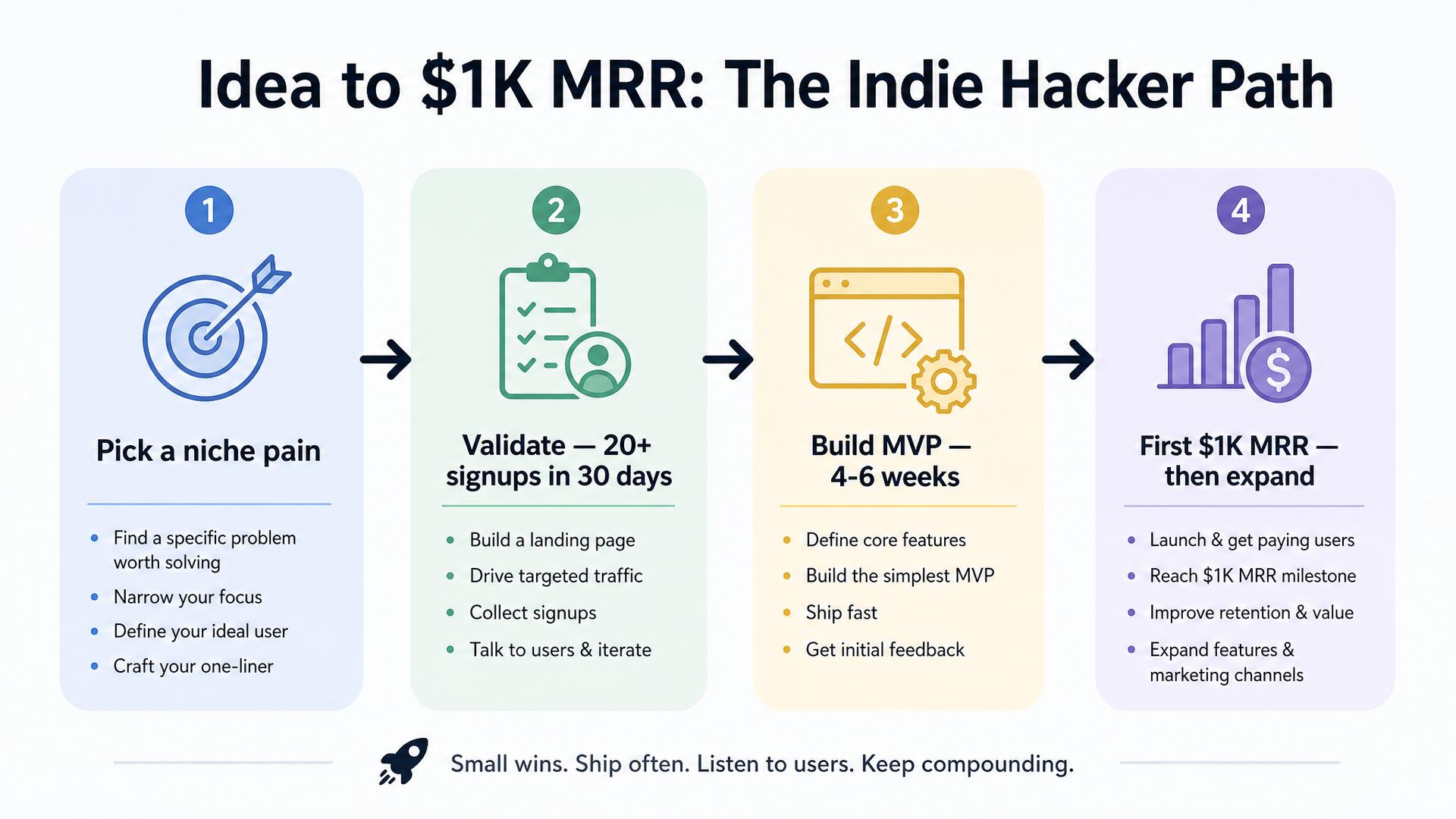
- Week 1 — interviews. Find your niche in 3 communities. Run 10-20 problem interviews. Confirm the pain is real and recurring.
- Week 2 — landing page. One clear value prop, one email capture. Drive targeted traffic. The bar: 20+ genuine signups. Can't hit 20? The idea (or the positioning) needs work, better to learn now.
- Week 3 — pre-sell. Offer discounted beta access with a real payment link. A few people paying before the product exists is the only validation that counts.
- Week 4 — scope the MVP. Build only the one feature your pre-payers need. Ship in 4-6 weeks, aim for $1K MRR before adding anything.
The 2026 Build-Fast Stack
You can ship a real SaaS for under $1,000 and in weeks, not months. The standard indie stack:
- Frontend: Next.js (React) or Nuxt (Vue)
- Backend/DB: Supabase or PlanetScale
- Payments: Stripe
- Hosting: Vercel or Railway
- Email: Resend or Postmark
The real unlock is AI-assisted building. Cursor, Claude, and v0 cut build time by 70%+, what took three months in 2023 takes about two weeks in 2026. Code is no longer the bottleneck; picking a real problem and getting to a payment is.
Why Most Indie SaaS Fails
- Building before validating. Months of code for a problem nobody will pay to solve. Pre-sell first.
- Choosing "cool" over "painful." Clever ideas don't convert; boring recurring pains do.
- Targeting everyone. "Analytics for indie founders" beats "analytics." A narrow niche is easier to reach, rank for, and sell to.
- Free-to-nice-to-have pricing. If it doesn't touch money, time, or risk, people won't pay. Price for value, not features.
- Expanding scope too early. Get to $1K MRR on one feature before you add a second.
Frequently Asked Questions
What is the best SaaS idea for an indie hacker in 2026?
The best risk-adjusted idea is a payment-recovery / dunning tool: 70-90% margins, ROI-based pricing (you take a cut of the revenue you recover), and almost no "will they pay?" risk because it directly makes the customer money. Vertical compliance tools and niche B2B integrations are close behind.
How do I validate a SaaS idea before building?
In 30 days: run 10-20 problem interviews, put up a landing page and aim for 20+ genuine signups, then pre-sell discounted beta access with a real payment link. A few people paying before the product exists is the only validation that counts. If you can't get 20 signups, refine the idea.
How much does it cost to build a micro SaaS in 2026?
Usually under $1,000 before first revenue. A modern stack (Next.js, Supabase, Stripe, Vercel, Resend) runs $30-150/month, and AI coding tools cut build time by 70%+. The constraint is validation and distribution, not budget or code.
How long does it take to launch an indie SaaS?
Winners ship an MVP in 4-6 weeks and target their first $1K MRR before expanding scope. With AI-assisted development, what took three months in 2023 now takes about two weeks, so most of the calendar goes to validation and getting the first users, not coding.
Do I need to be a developer to build a SaaS?
No. No-code tools (Bubble, Webflow, Airtable) plus AI coding assistants let non-technical founders ship. Technical skill speeds iteration, but roughly 40% of successful micro SaaS founders are non-technical. The scarce skill is picking a real problem and reaching the niche.
What are the most profitable micro SaaS niches in 2026?
Payment recovery/dunning (70-90% margins), dev tools and APIs (~76% margins), vertical compliance (healthcare/legal/finance), AI content and workflow automation, and B2B integrations connecting niche software ecosystems. The AI SaaS market alone is growing ~38% annually.
Want proof these work? See our 27 micro SaaS examples with verified revenue, then use the 12-week SaaS launch playbook and waitlist landing page examples to get your first users.



Launch videos for
moon-shot founders.

About
We're a video production studio partnering with AI founders and startups. We make launch videos to show the world what you're building.
London, UK
Made with love from London. Collaborating with clients worldwide.
Contact
Adam Petty
Founder
adam@flowjam.com
Founder
adam@flowjam.com