
Viral launch videos for moon-shot founders 
Flowjam partners with AI founders and startups aiming for the moon, to create story-driven launch videos to build hype and show the world what they're building.

Full PortfolioBlog
Flowjam works with some of the most successful AI founders in the world after only launching in 2023.
Copyright 2026. Flowjam Ltd.
Copyright 2026. Flowjam Ltd.
How to Launch on X: The Launch-Day Playbook for Startups
How to launch a product on X: the native launch video, the one-line post, the first hour in the replies, reposters booked two weeks out, and what to skip.

Most advice on launching on X sells you two things: a magic posting window and a rota of creators to rent. Both help a little. Neither saves a launch whose video doesn't explain the product with the sound off in three seconds, and that is where most launches actually die.
A launch on X is one post doing four jobs: show the product working in a muted video, say what it does in one line, pull replies in the first hour, and give everyone who reposts it something worth passing on. This is the playbook behind the launch videos we make at Flowjam, covering the post, the video, the first hour and the week after.
What a launch on X actually is
Launching on X means announcing a new product, feature or company from the founder's account, usually with a short native video, then working the replies and reposts hard for the first hour so the post keeps getting shown. It is not a thread of twelve tweets, and it is not a link to your blog post. It is one post people can understand in the time it takes to scroll past it.
That shapes everything else. If the video and the first line can't stand alone, no amount of reposting fixes it. If they can, the rest of this page is about getting them in front of enough people in the first hour.
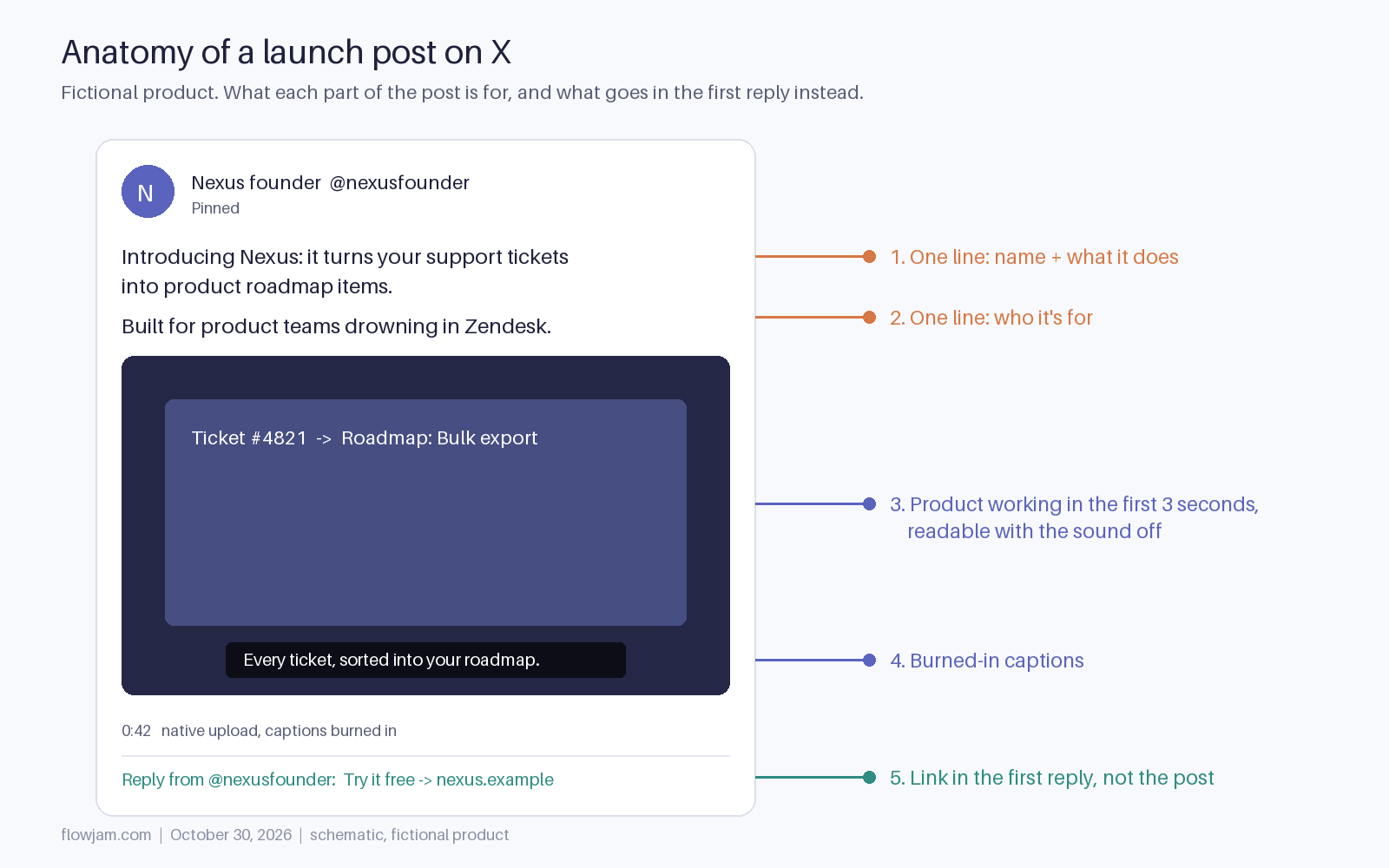
The launch post: one line, one video, the link in the replies
The post that works is boring on purpose. A first line that names the product and what it does ("Introducing Nexus: it turns your support tickets into product roadmap items"), one more line on who it's for, and the video. That's it.
Three decisions matter more than the wording:
- Upload the video natively. A YouTube or Vimeo link shows up as a card that people have to click. A native upload autoplays in the feed, and in a feed autoplay is the whole game.
- Put the link in the first reply, not the post. Whether X still cuts the reach of posts with outside links is disputed. Plenty of operators report it does, and Elon Musk said in July 2026 that it hasn't for over a year. Moving the link to the first reply costs you almost nothing, so do it and stop worrying about it.
- Pin it the moment it's up. Everyone who clicks through to your profile that week should land on the launch.
Skip the joke opener. Skip "we've been working on something special." People scrolling X give you a second to say what the product is. Use it on the product. Reach rewards the founder who is clear, not the one who is clever.
For a before-and-after rewrite of a typical launch post, see how to write a launch tweet.
The launch video for X: specs and the first three seconds
X accepts MP4 and MOV. Standard accounts can upload video up to 2 minutes 20 seconds and 512 MB, and Premium accounts can go much longer. Aspect ratios between 1:3 and 3:1 are accepted, and 16:9, 1:1, 4:5 and 9:16 all display cleanly in the timeline.
The format choice is a judgment call, and ours is this: for software, use 16:9 or 1:1. Product UI is wide, and a 9:16 crop of a dashboard turns the thing you're selling into an unreadable strip. Use 9:16 when the video is a founder talking to camera or the product lives on a phone.
Length is where most launch videos go wrong. The cap is 2:20 on a free account (every limit is in our X launch video specs breakdown), but the right length is the shortest cut that shows the product working. For most launches that's 30 to 75 seconds. The rules for the cut:
- Show the product doing its job in the first three seconds. No logo intro, no slow push on the founder's face.
- Burn in the captions. Most people watch with the sound off.
- One idea per scene. If a scene needs a voiceover to make sense, cut it or rebuild it.
- End on the name and one line on where to get it, not a montage.
We break down how good launch videos are built in 30 launch video examples, and what they cost in our launch video cost guide. The video is the one part of this playbook you can't fix on the day. If you'd rather not make it yourself, Flowjam makes launch videos built for exactly this post: native, captioned, and showing the product in the first three seconds.
The first hour: why you have to be in the replies
When Twitter open-sourced its ranking code in 2023, the weights in it were blunt about what mattered. A like counted 0.5. A reply counted 13.5. A reply that the post's author then responded to counted 75, which is 150 times a like. X has since rebuilt its ranking around a Grok-based model, so the exact numbers are out of date. The direction almost certainly isn't: conversation, and the author taking part in it, is what keeps a post in the feed.
So the rule for the first hour is simple. The founder is at the keyboard and answers every reply that isn't spam with a real sentence. Not "thanks!", but an answer, a detail, or a question back. That turns one reply into a short back-and-forth, and those back-and-forths are what the ranking is built to reward.
Three more things for the first hour:
- Have a short reply ready with a cut-down clip or a screenshot of the most-asked feature. You'll need it within twenty minutes.
- Quote-post the best reaction from a real user or a respected account, with your own one-line take.
- Don't post anything else from the account. You want one post getting all the attention, not two splitting it.
Reposters: book them two weeks out, and disclose paid posts
The launches that break out almost never rely on the founder's followers alone. They line up other accounts to repost or quote-post in the first hour: friends, investors, customers, other founders, and sometimes paid creators in the niche.
The decision rules we use:
- Ask two weeks ahead, not two days. People with large audiences plan their posting and say no to last-minute asks. Send them the video early so they can see what they're reposting.
- Prefer accounts your buyers follow over big accounts. A repost from an account with 15,000 of the right followers beats one from 500,000 people who'll never use the product.
- Ask for quote-posts with a real take, not plain reposts. A quote-post starts its own replies. A plain repost doesn't.
- Disclose anything paid. If you pay someone, or give them anything of value, to post about the launch, the FTC's endorsement rules require a clear disclosure in the post itself, such as "#ad" at the start. A paid repost dressed up as organic excitement is the kind of endorsement those rules are about.
Most of this work happens before launch day. Our pre-launch marketing playbook covers building the audience and the list of reposters in the weeks before.
Timing, and the week after
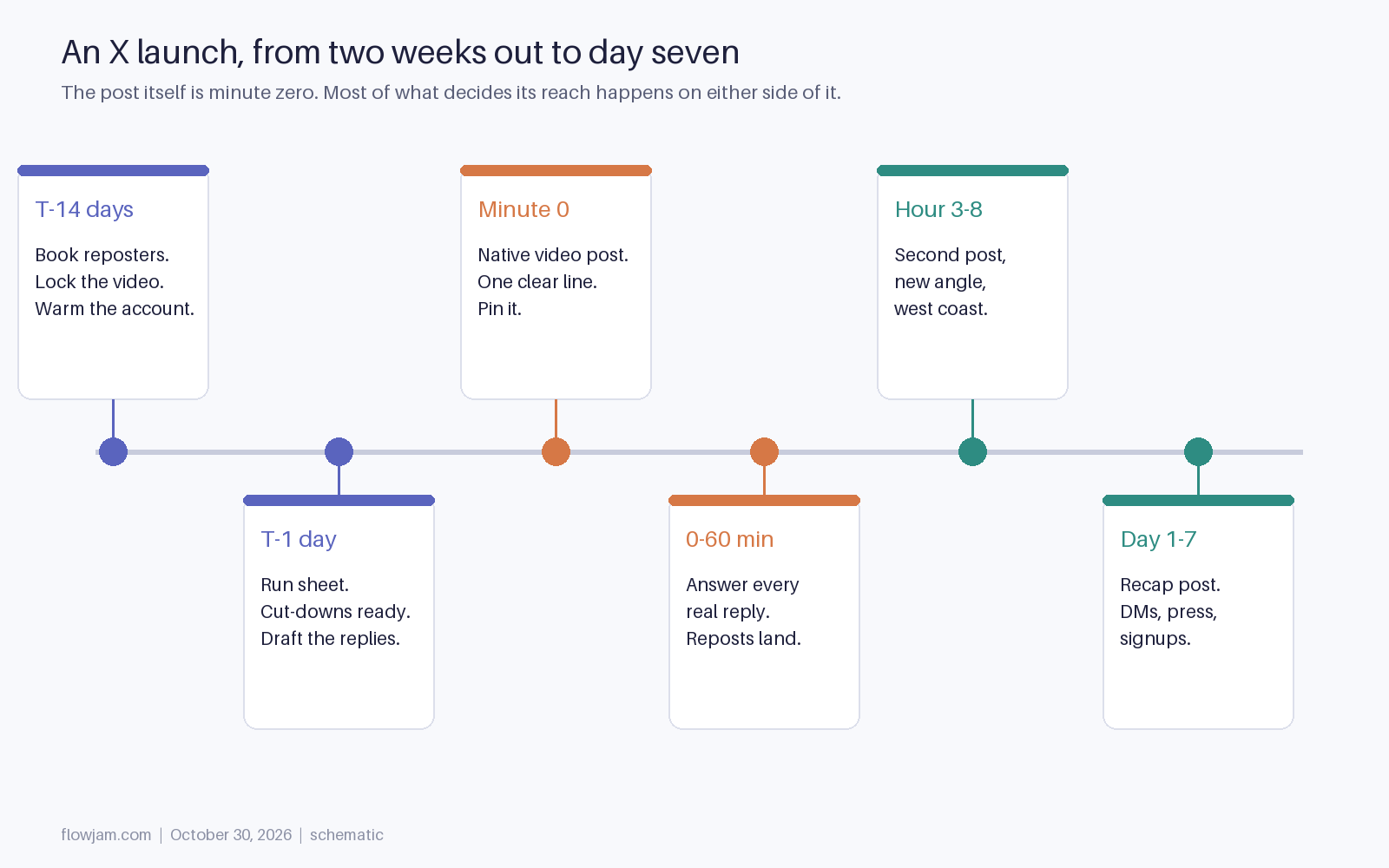
Launch on a Tuesday, Wednesday or Thursday morning in US Eastern time if your buyers are in the US. That's when the founders, operators and investors who repost launches are at their desks, and it gives you the US west coast later the same day. Avoid Fridays and weekends. Nothing magic happens at exactly 8 AM, so pick a time when the founder can stay in the replies for an hour.
Then plan the week:
- Hour 3 to 8: a second post with a different angle, such as a shorter clip of one feature or the story of why you built it. Same video or a cut-down, never the same text.
- Day 1 evening: a short recap with whatever real numbers you're happy to share, like signups, waitlist count or the best piece of feedback. People repost honest numbers.
- Day 2 to 7: answer every DM and serious reply, and post one useful clip a day. Most signups come after launch day, from people who saw it twice.
X is rarely the only channel. If you're also going on Product Hunt, pick which goes first, because your network can only show up for one push at a time. See our Product Hunt launch playbook and our guide to getting on the Hacker News front page. For writing the same announcement for email and your blog, see how to announce a product launch.
What sinks launches on X
The same handful of mistakes come up again and again:
- A cold account. If the founder hasn't posted in months, there's nobody waiting. Post for a few weeks before launch, even just progress clips.
- A video that needs sound. If someone watching muted can't tell what the product does, the video isn't finished.
- A thread instead of a post. Threads are fine for the story behind the launch, but in the replies, not as the launch.
- The founder leaving after ten minutes. The first hour is the part you can't get back.
- Launching on a Friday afternoon because that's when the build was done. Wait until Tuesday.
Sources: X Help Center: videos on X; Twitter's open-source ranking weights (the-algorithm-ml); SocialPilot on the X algorithm in 2026; 16 CFR 255.5 (FTC endorsement disclosure).
AP
About the author
Adam Petty
Founder, Flowjam
Adam is the founder of Flowjam, where he helps startups turn ideas into launch videos, product demos, and ads with AI video. He writes about AI video production, creative workflows, and go-to-market for early-stage teams.
Frequently asked questions
How do I launch a product on X?
Post one native video from the founder's account with a first line that names the product and what it does, put the link in the first reply, pin the post, and spend the first hour answering every real reply. Line up people to quote-post it two weeks ahead, and plan a second post and a recap for later the same day.
What is the best time to launch on X?
For a US audience, a Tuesday, Wednesday or Thursday morning in US Eastern time. Avoid Fridays and weekends. Pick a time when the founder can stay in the replies for the full first hour.
How long should a launch video on X be?
Standard accounts can upload up to 2 minutes 20 seconds, but most launch videos work best at 30 to 75 seconds. Show the product working in the first three seconds and burn in captions.
What aspect ratio should an X launch video be?
X accepts anything between 1:3 and 3:1. For software, use 16:9 or 1:1 so the interface stays readable. Use 9:16 for a founder talking to camera or a mobile app.
Should I put the link in the launch post?
Put it in the first reply. Whether X still reduces reach for posts with outside links is disputed, and moving the link to the reply costs almost nothing.
Is a thread better than a single post for a launch?
Use a single post with a native video as the launch. Add the story behind it as replies under that post, not as a separate thread.
Do paid reposts need to be disclosed?
Yes. Under the FTC's endorsement rules, anyone paid or given something of value to post about your launch should disclose it clearly in the post, for example with #ad.





Launch videos for
moon-shot founders.

About
We're a video production studio partnering with AI founders and startups. We make launch videos to show the world what you're building.
London / San Francisco
Made with love from London / San Francisco. Collaborating with clients worldwide.
Contact
Adam Petty
Founder
adam@flowjam.com
Founder
adam@flowjam.com