
Viral launch videos for moon-shot founders 🌸
Flowjam partners with AI founders and startups aiming for the moon, to create story-driven launch videos to build hype and show the world what they're building.

Full PortfolioBlog
Flowjam works with some of the most successful AI founders in the world after only launching in 2023.
Copyright 2026. Flowjam Ltd.
Copyright 2026. Flowjam Ltd.
AI Video for Financial Advisors: The Marketing Rule, Clause by Clause
Financial advisors can use AI video for voiceover, captions and an approved avatar of themselves. Fake client testimonials and mass-audience growth charts break the SEC Marketing Rule.

Most pages selling AI video to financial advisors lead with the same demo: a cloned advisor, a smiling "client" and a chart of a portfolio climbing to the top right.
Two of those three things are problems under SEC Rule 206(4)-1, the Marketing Rule that every registered investment adviser has had to follow since November 2022.
The rule doesn't mention AI once. It doesn't need to. It regulates what an advertisement says and implies, and a video made with a generator is an advertisement like any other. So the useful exercise is to take the rule apart and see where each piece of an AI video lands.
The definition: almost every video you post counts
Under the rule, an advertisement includes any direct or indirect communication that offers your advisory services to more than one person, plus any testimonial or endorsement you pay for.
A one-on-one communication is carved out, which matters for AI video. A personalized video recorded for a single prospect is generally not an advertisement. The same video with the name swapped by a tool and sent to 400 prospects is, because the rule treats one-on-one communications that are really mass-produced as advertisements.
Broker-dealers live under FINRA Rule 2210 instead, and FINRA has already answered the AI question directly. Its advertising FAQs say firms are responsible for their communications "regardless of whether they are generated by a human or AI technology." A video that doesn't promote a product or service skips principal pre-approval and filing, but it is still supervised as correspondence.
The seven general prohibitions, applied to a generated video
Paragraph (a) lists seven things no advertisement may do. Read with a video timeline open, they turn into a fairly specific edit checklist.
- (a)(1) No untrue statement of a material fact, and no omission that makes the rest misleading. A synthetic voice reading a script is fine. A synthetic person presented as a client is an untrue statement about who is talking.
- (a)(2) No material statement of fact you can't substantiate on demand from the SEC. If the voiceover says "we have helped 300 families retire early", keep the file that proves it.
- (a)(3) Nothing that creates an untrue or misleading implication. This is the clause that catches visuals. Stock footage of a yacht, a generated beach house or an avatar in a corner office all imply outcomes you can't promise.
- (a)(4) No talk of benefits without fair and balanced treatment of the material risks. A 30-second Reel about tax-loss harvesting still needs the risk line, and on screen long enough to read.
- (a)(5) No reference to specific investment advice that isn't presented in a fair and balanced way. Don't let a script generator pick your three best calls of the year.
- (a)(6) No cherry-picked performance results or time periods.
- (a)(7) Nothing otherwise materially misleading. This is the catch-all, and it is where an undisclosed AI clone of you would most likely be judged.
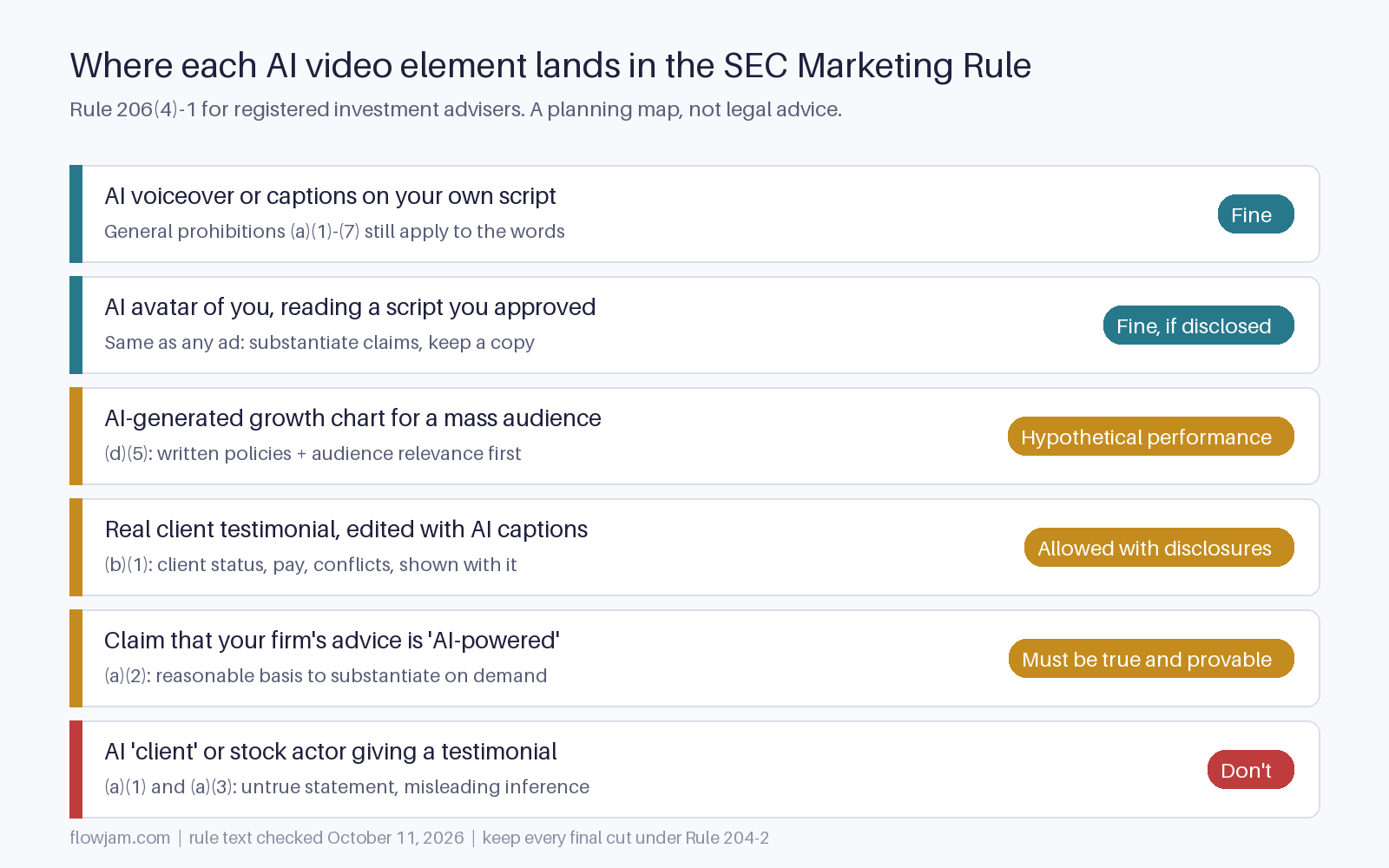
Nothing in the rule requires you to label an AI avatar of yourself. We still put a short line in the caption, such as "narrated by a digital version of Jane, scripted and approved by Jane", because it costs nothing and closes off the (a)(3) argument before anyone makes it.
The avatar tools themselves are covered in our AI avatar video tools roundup. If you clone yourself, use a vendor whose terms limit the clone to your account and require your consent to create it.
An AI client saying nice things is an untrue statement of fact
The old advertising rule effectively banned testimonials. The Marketing Rule allows them, with conditions, and those conditions assume a real person.
Under paragraph (b)(1), a testimonial has to clearly and prominently disclose whether the speaker is a current client, whether they were paid in cash or otherwise, and a brief statement of any material conflict of interest. Those disclosures have to be delivered with the testimonial, not on a separate page.
In a video, "clearly and prominently" means on screen while the person is talking, and at least as readable as the captions. The SEC staff's marketing compliance FAQs are the place to check any edge case before you publish.
This is where AI genuinely helps. A real client's two-minute phone recording can become a clean 40-second cut with burned-in captions and a disclosure bar, made in an afternoon. What AI can't do is supply the client. An avatar or a paid actor speaking as a satisfied investor fails (a)(1) before the disclosure question even comes up.
If you pay a promoter more than $1,000 over 12 months, paragraph (b)(2) also requires a written agreement, and you need a reasonable basis to believe the testimonial complies.
The growth chart that cost nine firms $850,000
Script generators love a compounding chart. "$100,000 at 7% for 25 years" makes a tidy animation, and AI video tools will render it in seconds.
Under the rule, a projection like that is hypothetical performance. You can only advertise it if you have adopted and implemented policies reasonably designed to make it relevant to the likely financial situation and investment objectives of the intended audience, and an Instagram audience is close to impossible to define that way.
This isn't theoretical. In September 2023 the SEC charged nine advisers for putting hypothetical performance on public websites without those policies, for $850,000 in combined penalties. Two of them were also charged for not keeping copies of their ads.
Our rule: keep the compounding math in one-on-one meetings and planning software, and keep it out of anything you post.
The quieter risk: saying your firm runs on AI
In March 2024 the SEC settled its first AI-washing cases against two advisers, Delphia and Global Predictions, for $400,000 in combined penalties. Global Predictions had called itself the "first regulated AI financial advisor".
Ask a script generator for a firm intro and it will often describe "our AI-powered planning process" whether or not one exists. Using AI to make your marketing does not make your advice AI-driven. Under (a)(2), every claim like that needs evidence you could hand over on request.
Read every generated script for words you didn't put there, and cut any claim about your own process that you couldn't document.
Keeping the files
Rule 204-2 under the Advisers Act, the books and records rule, requires you to keep a copy of every advertisement you send to more than one person, generally for five years from the end of the fiscal year it was last published, and the first two of those years in an easily accessible place.
For AI video that means the final rendered file, not the project file or the prompt. If you generate 20 language versions or 50 personalized cuts from one template, each one that went out is the record. Export them, name them by date and keep them with the substantiation for any claims in the script.
The same discipline shows up in our guides for other regulated fields, including AI video for accountants and AI video for law firms. For the production side, voiceover and captions included, start with our guide to making AI videos. If you'd rather hand the whole thing off, Flowjam makes videos from scripts you've already cleared with compliance.
This page explains rule text and isn't legal advice. Your chief compliance officer, or your broker-dealer's advertising review team, has the final say on anything you publish.
AP
About the author
Adam Petty
Founder, Flowjam
Adam is the founder of Flowjam, where he helps startups turn ideas into launch videos, product demos, and ads with AI video. He writes about AI video production, creative workflows, and go-to-market for early-stage teams.
Frequently asked questions
Can financial advisors use AI-generated video in their marketing?
Yes. The SEC Marketing Rule doesn't ban AI tools. It governs what an advertisement says and implies, so an AI voiceover, captions or an approved avatar of the advisor reading a compliant script are fine. A video that misleads, such as an AI-generated person posing as a client, is not.
Can an RIA use an AI avatar as a client testimonial?
No. Rule 206(4)-1 allows testimonials only with disclosures about whether the speaker is a current client, whether they were paid and any material conflicts. A synthetic or acted client is an untrue statement of material fact under paragraph (a)(1).
Do I need to disclose that a video uses an AI avatar of me?
The rule has no specific AI label requirement. A short caption saying the narrator is a digital version of the advisor, scripted and approved by them, reduces the risk of a misleading-implication finding under paragraph (a)(3), and costs nothing.
Are AI-generated growth projections allowed in advisor videos?
Only as hypothetical performance, which requires written policies making it relevant to the intended audience. The SEC charged nine advisers in September 2023 for showing hypothetical performance to the general public on their websites, with $850,000 in combined penalties.
How long do advisors have to keep marketing videos?
Under Advisers Act Rule 204-2, copies of advertisements are generally kept for five years from the end of the fiscal year they were last published, the first two years in an easily accessible place. Keep the final rendered file of every version sent out.
Can I use stock footage or AI-generated people in an advisor video?
As background, carefully. Under paragraph (a)(3) of the Marketing Rule, visuals can create a misleading implication, so a generated couple on a yacht implies outcomes you can't promise. Never present stock or AI-generated people as your clients.
What should I do if I already posted a non-compliant AI video?
Take it down, keep a copy of what ran and when, since Rule 204-2 still applies to advertisements you published, and bring it to your chief compliance officer to decide on any further steps.
Does FINRA treat AI-generated content differently?
No. FINRA's advertising FAQs say firms are responsible for communications whether a human or AI technology generated them, and the same Rule 2210 content standards, supervision and recordkeeping duties apply.




Launch videos for
moon-shot founders.

About
We're a video production studio partnering with AI founders and startups. We make launch videos to show the world what you're building.
London / San Francisco
Made with love from London / San Francisco. Collaborating with clients worldwide.
Contact
Adam Petty
Founder
adam@flowjam.com
Founder
adam@flowjam.com