
Viral launch videos for moon-shot founders 🌸
Flowjam partners with AI founders and startups aiming for the moon, to create story-driven launch videos to build hype and show the world what they're building.

Full PortfolioBlog
Flowjam works with some of the most successful AI founders in the world after only launching in 2023.
Copyright 2026. Flowjam Ltd.
Copyright 2026. Flowjam Ltd.
AI Video for Mortgage Loan Officers: Six Assumptions That Break Reg Z
Loan officers can use AI video for voiceover, dubbing and avatars. Quoting a rate, payment or down payment triggers Reg Z disclosures.

A loan officer's best content used to be the Tuesday rate update filmed in the car. AI tools now turn one script into a polished vertical video, a Spanish version and ten personalized follow-ups before lunch.
That speed is the risk. Mortgage advertising is governed line by line by Regulation Z section 1026.24 and the CFPB's Mortgage Acts and Practices rule, Regulation N, and neither cares how the video was made. These are the six assumptions we see break most often once AI is in the workflow.
"It's a Reel, not an ad"
Regulation Z defines an advertisement as a commercial message in any medium that promotes, directly or indirectly, a credit transaction. A 20-second clip on Instagram that says "rates dropped this week, DM me" qualifies the same way a mailer does.
The useful line is not ad versus content. It is whether the script contains a trigger term. A video about how pre-approval works, how points trade against rate or what an appraisal gap is can run with no extra disclosures at all. Most of the AI-generated education content loan officers post sits safely on that side, and that is where we'd point most of the volume.
"Saying the rate is enough"
This is the assumption AI script generators break most, because a number makes a better hook.
Under 1026.24(c), if you state a rate you must state the APR, using that term, and the note rate can't be more conspicuous than the APR. In a video, that means the APR on screen at least as large and as long as the rate, not in a scrolling footer.
Under 1026.24(d), four trigger terms go further: the amount or percentage of the down payment, the number of payments or repayment period, the amount of any payment and the amount of any finance charge. Say any one of them and the video must also state the down payment, the full repayment terms and the APR. Quote a monthly payment on a first-lien loan and you also have to say if taxes and insurance aren't included.
So "3.5% down" in a voiceover is not a teaser. It is a commitment to a full disclosure set.
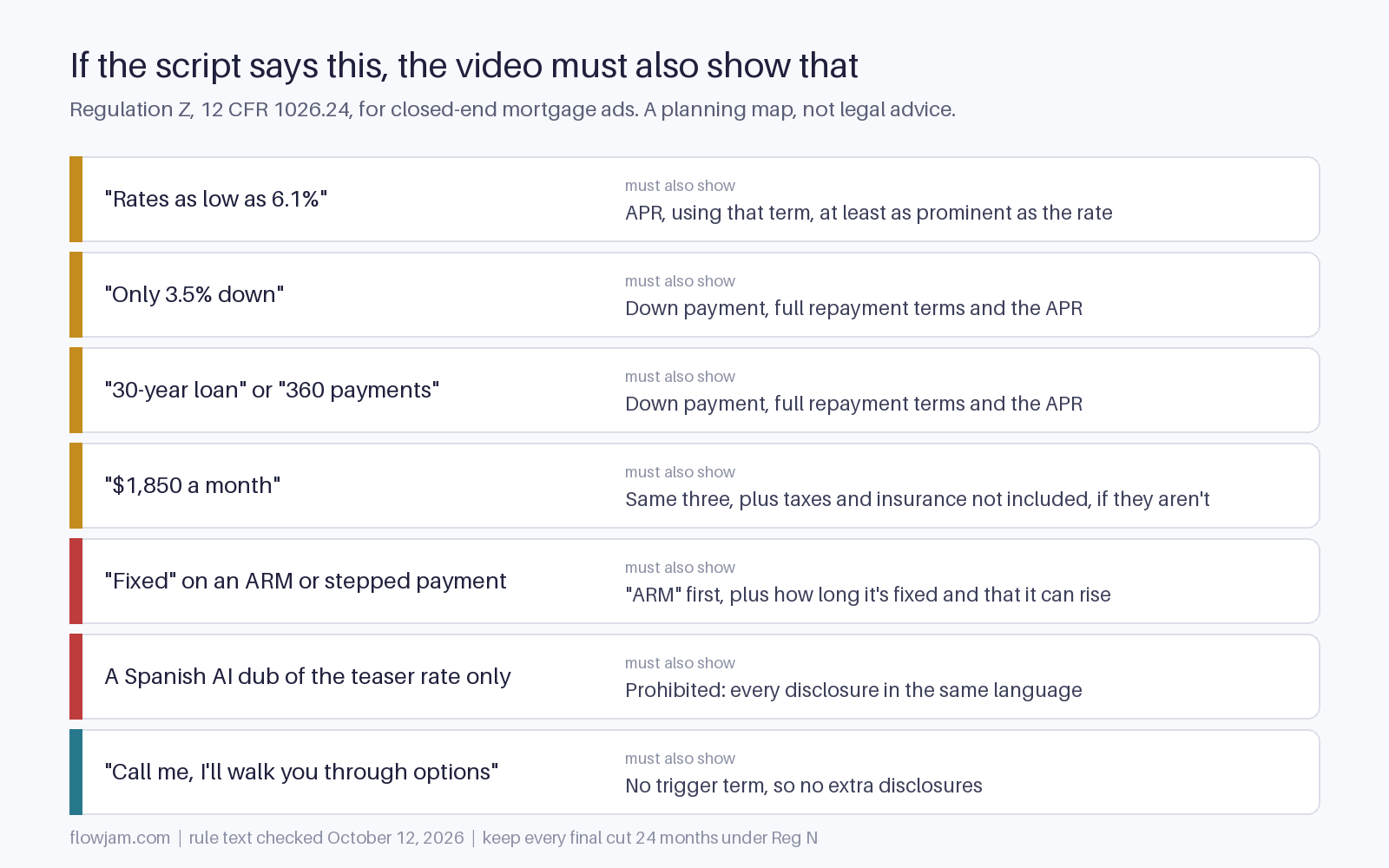
The rule has a shortcut for television and radio in 1026.24(g): state the APR and give a toll-free number for the rest. The text names television and radio only. Whether a vertical video on a social feed gets the same treatment is a question for your compliance team, not an assumption to build a content calendar on. Our default is to keep trigger terms out of short social clips and put the numbers in a landing page where the full disclosures fit.
"An AI dub is just a translation"
AI dubbing is one of the genuinely good uses here. One recorded explainer becomes Spanish, Vietnamese and Mandarin versions with matching lip movement, which used to need three shoots.
The trap is specific. Section 1026.24(i)(7) prohibits giving some trigger terms or disclosures, such as the initial rate or payment, only in a foreign language while giving others, such as the fully indexed rate or the full payment, only in English in the same ad.
The usual way this happens is a translated voiceover over the original English on-screen text. The spoken teaser rate is in Spanish and the disclosures on screen are still in English. Translate the captions and disclosure cards along with the audio, every time.
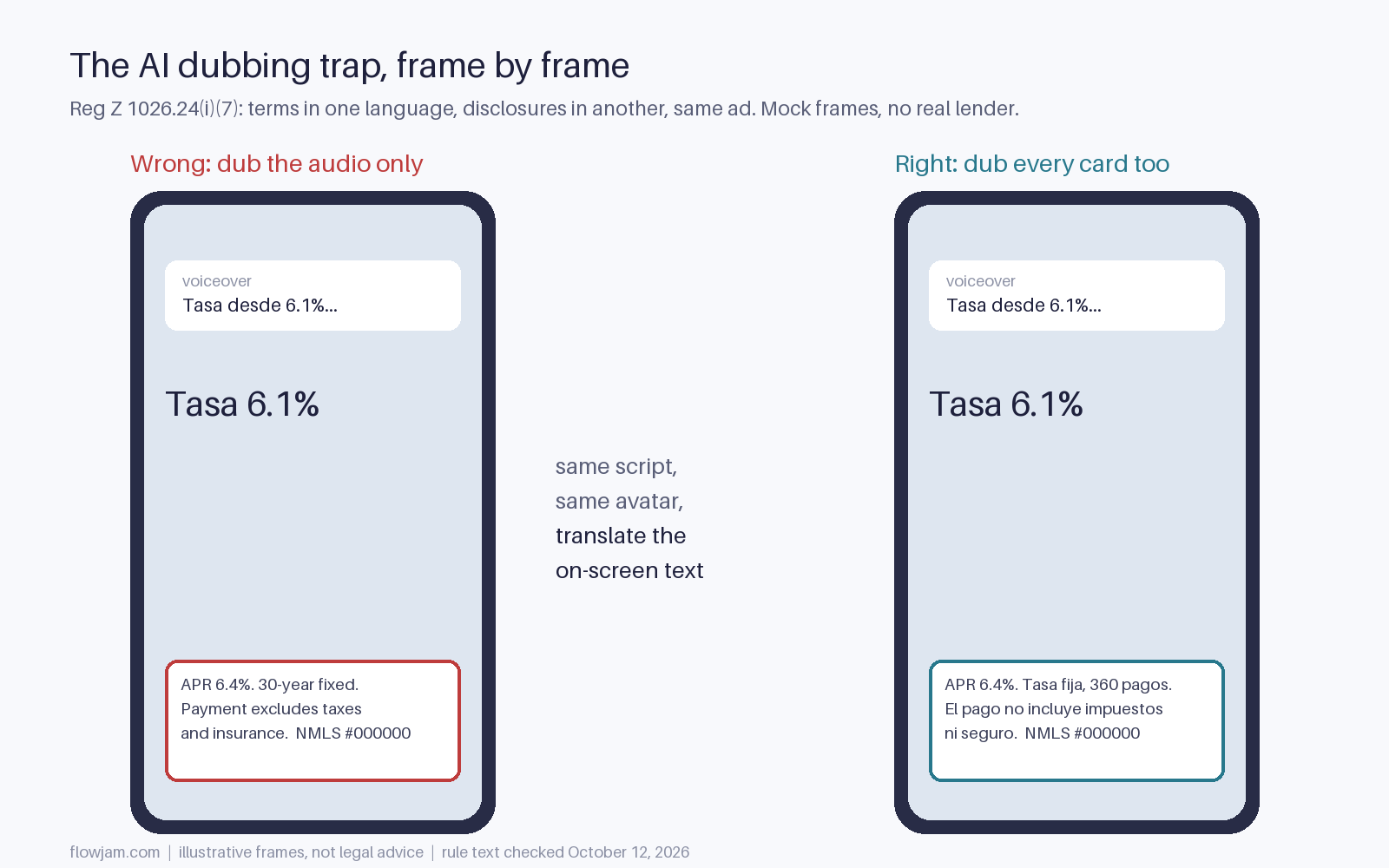
Our AI video translation tools comparison covers which tools translate burned-in text as well as speech, and our AI lip sync guide covers the dubbing side.
"An AI happy homeowner is just b-roll"
Since October 2024 the FTC's rule on consumer reviews and testimonials has made it a violation to create or disseminate a testimonial that misrepresents that the testimonialist exists or used the service. An AI-generated couple on a porch saying "Mike got us to closing in 21 days" is precisely that, and the rule carries civil penalties.
Generated people as unnamed background are a different case, but they bring their own question. The Fair Housing Act, at 42 U.S.C. 3604(c), bars ads that indicate a preference based on race, religion, familial status or other protected classes. When every person in your video is generated, every casting choice is yours. A year of ads where the AI only ever produced one kind of family is a pattern someone else can see.
Real past borrowers, recorded on a phone and cleaned up with AI captions, are fine. Get written consent and don't let the edit change what they said.
"An avatar of me can say anything I can"
It can. That is the problem. An avatar of the loan officer reading an approved script is the most useful AI format in this industry. You record once, then produce weekly market updates and personalized pre-approval follow-ups without being on camera every time.
The rules that apply are the ones you already follow. Regulation N, at 12 CFR 1014.3, bars misrepresenting rates, fees, the word "fixed" or any affiliation with a government program. That last one matters because AI scripts love phrases like "the new government program for first-time buyers". If the loan is FHA, say FHA and say you are not the government.
State licensing law usually adds your NMLS ID and the company's licensing details to anything promotional. Put them on the end card of the template, so a generated variant can't drop them.
Tool choice is covered in our AI avatar video tools roundup. Pick one that limits your clone to your own account.
"Delete the old video when rates move"
Rate videos go stale in days. AI makes re-rendering nearly free, so the instinct is to delete and replace.
Deleting is fine as long as you keep the file. Regulation N section 1014.5 requires keeping copies of all materially different commercial communications about mortgage terms for 24 months from the last date they ran, along with records of the products that were actually available at the time.
A video quoting last week's rate counts as materially different from this week's, so each weekly cut is its own record. Export the final file, name it with the date it went out and save the rate sheet you used beside it. Your company's compliance policy may ask for longer.
This is the same discipline as the other regulated fields we've covered, from AI video for financial advisors to AI video for real estate agents, whose listing videos often share a feed with yours. For the production side, start with our guide to making AI videos. If you'd rather not run it yourself, Flowjam produces videos from scripts your compliance team has already cleared.
This page explains rule text and isn't legal advice. Your company's compliance team and state regulator have the final say.
AP
About the author
Adam Petty
Founder, Flowjam
Adam is the founder of Flowjam, where he helps startups turn ideas into launch videos, product demos, and ads with AI video. He writes about AI video production, creative workflows, and go-to-market for early-stage teams.
Frequently asked questions
Can mortgage loan officers use AI-generated video in their marketing?
Yes. No federal rule bans AI tools in mortgage advertising. Regulation Z, Regulation N and the FTC testimonial rule govern what the ad says and shows, so an AI voiceover, captions, dubbing or an avatar of the loan officer reading an approved script are fine if the content complies.
Does mentioning a mortgage rate in a social video require the APR?
Yes. Under Regulation Z section 1026.24(c), an ad that states a rate must also state the annual percentage rate, using that term, and the other rate can't be more conspicuous than the APR.
What are the Regulation Z trigger terms?
The amount or percentage of the down payment, the number of payments or repayment period, the amount of any payment and the amount of any finance charge. Stating any one requires the down payment, full repayment terms and APR in the same ad.
Can I translate my mortgage videos with AI dubbing?
Yes, but translate the on-screen disclosures too. Section 1026.24(i)(7) prohibits giving some rate or payment terms only in a foreign language and the related disclosures only in English in the same ad.
Can I use an AI-generated borrower testimonial?
No. The FTC's rule on consumer reviews and testimonials, 16 CFR 465.2, prohibits creating or disseminating testimonials that misrepresent that the person exists or used the service, which describes an AI-generated borrower.
How long do I need to keep mortgage marketing videos?
Regulation N, 12 CFR 1014.5, requires keeping copies of materially different commercial communications about mortgage terms for 24 months from the last date they were disseminated, plus records of the products available at the time. Company policy may require longer.
Do I need my NMLS ID in a short video ad?
Many state licensing laws require the NMLS unique identifier in advertising, and many companies require it on every piece. Putting it on the end card of every template means AI-generated variants can't drop it.




Launch videos for
moon-shot founders.

About
We're a video production studio partnering with AI founders and startups. We make launch videos to show the world what you're building.
London / San Francisco
Made with love from London / San Francisco. Collaborating with clients worldwide.
Contact
Adam Petty
Founder
adam@flowjam.com
Founder
adam@flowjam.com