

Full PortfolioBlog
Flowjam works with some of the most successful AI founders in the world after only launching in 2023.
Copyright 2026. Flowjam Ltd.
Copyright 2026. Flowjam Ltd.
Facebook Ads for SaaS 2026: The Funnel, Targeting & Creative Playbook
Facebook ads for SaaS in 2026: the 3-campaign funnel, what to do now that interest targeting is dead (Advantage+), creative that converts with examples, benchmarks, and a setup checklist.

Last Updated: June 28, 2026 | By the Flowjam creative team — we build the ad and video creative behind SaaS Meta campaigns, so this is written from making the ads, not just running reports.
Most "Facebook ads for SaaS" guides are quietly out of date. On January 15, 2026, Meta deprecated detailed (interest) targeting, the interest audiences that powered SaaS campaigns for a decade stopped delivering. If a guide still tells you to stack interests like "marketing managers + SaaS + early adopters," it's teaching a dead playbook.
Here's what actually works for SaaS on Facebook and Instagram in 2026: a three-campaign funnel, AI-driven targeting (Advantage+), and demo-led creative. This guide shows you the structure, the creative, and the 2026 benchmarks, with real example ads, not just descriptions.
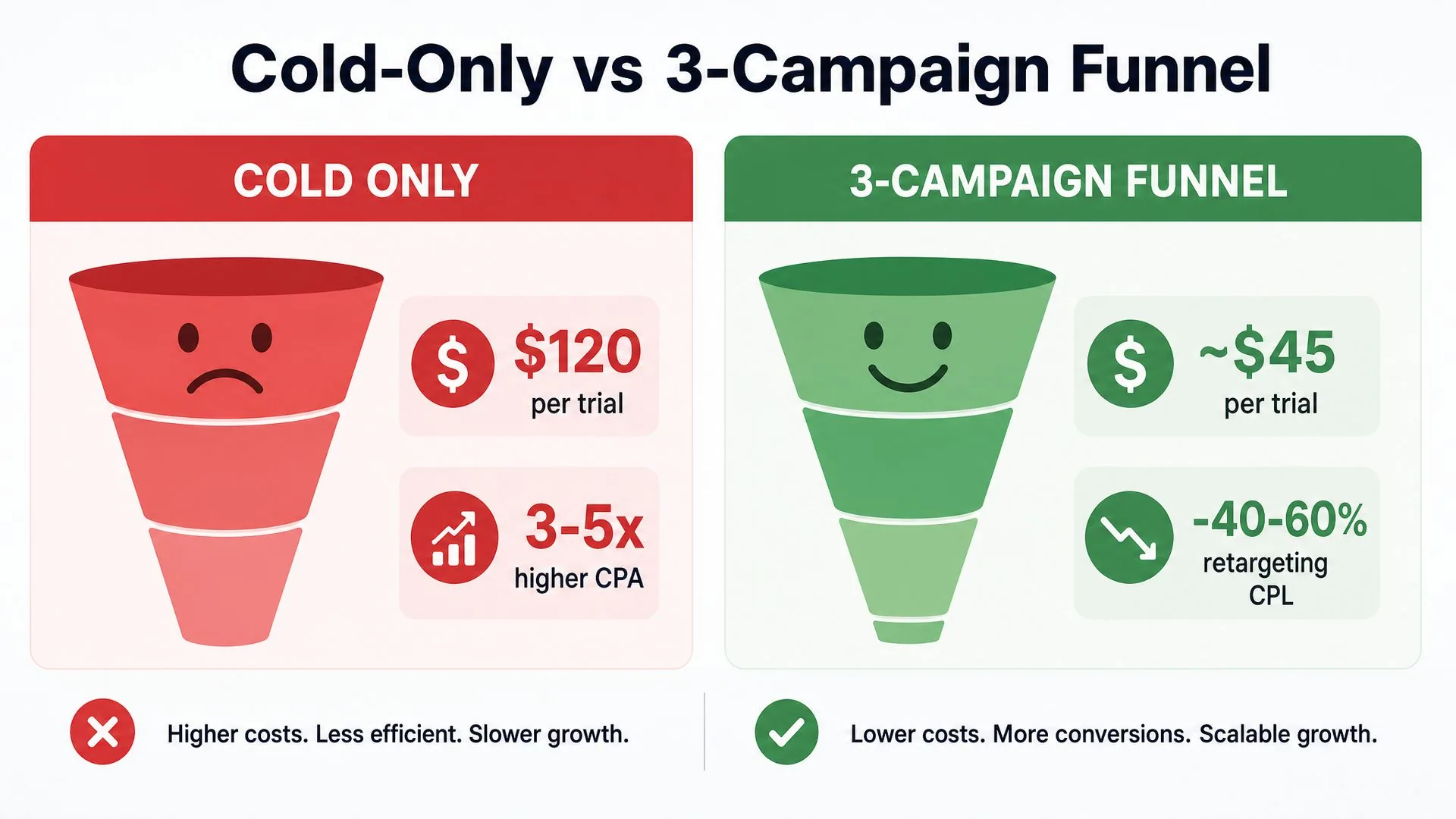
TL;DR: Don't run cold trial-acquisition alone, it costs 3-5x more. Build a funnel: awareness → trial acquisition → retargeting. Use Advantage+ Audience now that interest targeting is gone. Lead creative with the pain or a 15-30s demo. Meta is your retargeting workhorse (it cuts cost-per-lead 40-60%), not your cold-prospecting hero.
Table of Contents
- Why Facebook Ads Still Work for SaaS in 2026
- The 3-Campaign SaaS Funnel
- Targeting After the 2026 Interest-Targeting Death
- Creative That Converts (with Examples)
- Ad Formats: What to Use When
- Landing Pages & Offer Strategy
- Tracking, Budget & Scaling
- Campaign Setup Checklist
- 2026 Meta Benchmarks for SaaS
- Common Mistakes
- Frequently Asked Questions
Why Facebook Ads Still Work for SaaS in 2026
LinkedIn gets the B2B headlines, but Meta (Facebook + Instagram) remains the most cost-efficient place to build demand and re-engage SaaS buyers. CPCs run $1.50-5 versus LinkedIn's $8-15, and the targeting and creative tools are deeper. The catch: Meta rewards a funnel, not a single cold campaign. Used right, it's where you warm an audience cheaply and convert them on retargeting. Used wrong (cold trial-asks only), it's a money pit.
The 3-Campaign SaaS Funnel
The single biggest determinant of SaaS Meta performance is structure. Run three campaigns aligned to funnel stage:
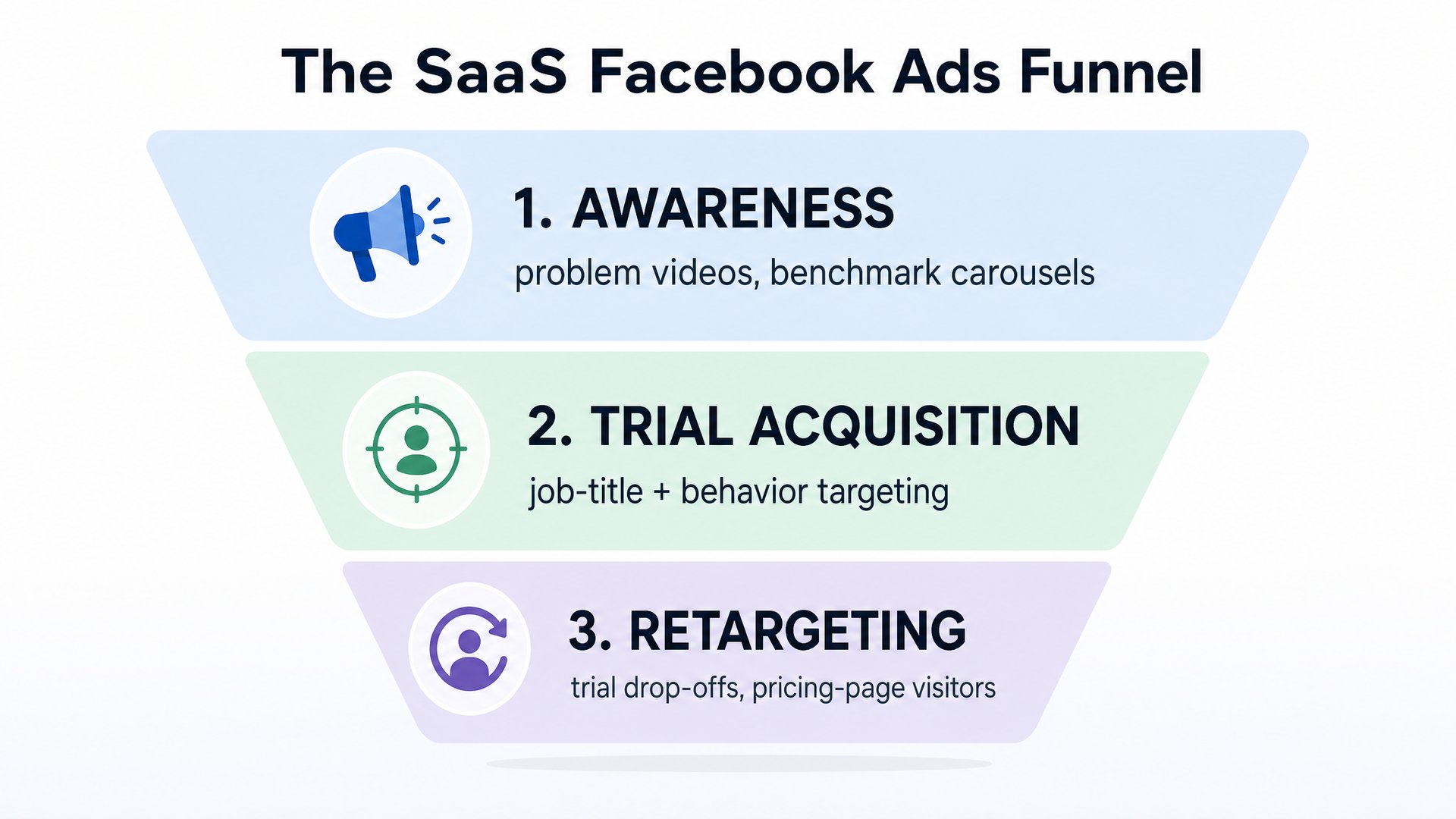
1. Awareness (top of funnel). Educational creative that builds a warm pool: short videos explaining the problem you solve, benchmark carousels, thought-leadership snippets. Cheap to run, and it's what makes the next stage affordable.
2. Trial acquisition (middle). Convert the warm pool into trials. Target decision-makers (CMO, VP Marketing, Head of Growth) layered with relevant behaviors. This is where the trial-start pixel event lives.
3. Retargeting (bottom). Re-engage the people closest to converting: trial signups who didn't upgrade (7-30 day window), pricing-page visitors who didn't start, and resource/blog readers (14-day window). Serve case studies, ROI proof, and comparison creative.
The number that justifies all of it: skipping awareness and going straight to cold trial-acquisition typically produces a CPA 3-5x higher. The two-touch funnel isn't optional, it's the difference between profitable and not.
Budget split and when to scale. A sane starting allocation is roughly 50% awareness, 25% trial acquisition, 25% retargeting, awareness has to feed the rest. Scale a campaign only once it's out of Meta's learning phase (about 50 optimization events per ad set per week) and holding a stable cost per result; then raise budget ~20% every few days rather than doubling it (big jumps reset learning). Shift spend toward retargeting as your warm pool grows, that's where the cheapest conversions live.
First-Week Budget Split by Spend Level
| Monthly Budget | Awareness 50% | Trial 25% | Retargeting 25% |
|---|---|---|---|
| $2,000 | $1,000 | $500 | $500 |
| $5,000 | $2,500 | $1,250 | $1,250 |
| $10,000 | $5,000 | $2,500 | $2,500 |
Early on, retargeting is thin (no warm pool yet), so its share effectively rolls into awareness until the pool fills, then it earns its 25%. Below ~$2,000/month you can't feed three campaigns enough signal, run awareness + retargeting only until you can.
Illustrative funnel math (a model, not a specific client's numbers): a $6,000/month budget split 50/25/25. Awareness builds a warm pool cheaply at a ~$0.03 cost-per-thru-play. Trial acquisition converts that pool at, say, a $40 cost-per-trial → ~37 trials from $1,500. Retargeting nudges trial drop-offs and pricing-page visitors at a 40-60% lower cost-per-lead than cold. If 20% of trials convert to paid at $99/mo, the funnel pays back as the warm pool compounds. Plug in your own CPC, trial rate, and conversion rate, the structure is the point, not these exact figures.
Targeting After the 2026 Interest-Targeting Death
This is what most guides get wrong. As of January 15, 2026, Meta retired detailed (interest) targeting, and interest audiences created before October 2025 no longer deliver. The old game of stacking narrow interests is over.
What works now:
- Advantage+ Audience (Meta's AI targeting) for prospecting, feed it a strong seed and let the algorithm find buyers. With interest targeting gone, the AI genuinely outperforms manual.
- Broad targeting at the top of funnel, the creative does the targeting now. A pain-point hook self-selects the right viewer better than any interest filter.
- Custom + lookalike audiences from your own data (trial users, customers, site visitors) for the mid and bottom funnel, these are first-party and unaffected by the deprecation.
The strategic shift: in 2026, your creative and your first-party data are your targeting. Pour energy into the hook, not into interest spreadsheets that no longer fire.
Creative That Converts (with Examples)
SaaS creative on Meta has to educate, demonstrate, and build credibility, usually in 15 seconds or less. Two patterns carry most of the wins.
The Pain-Point Ad
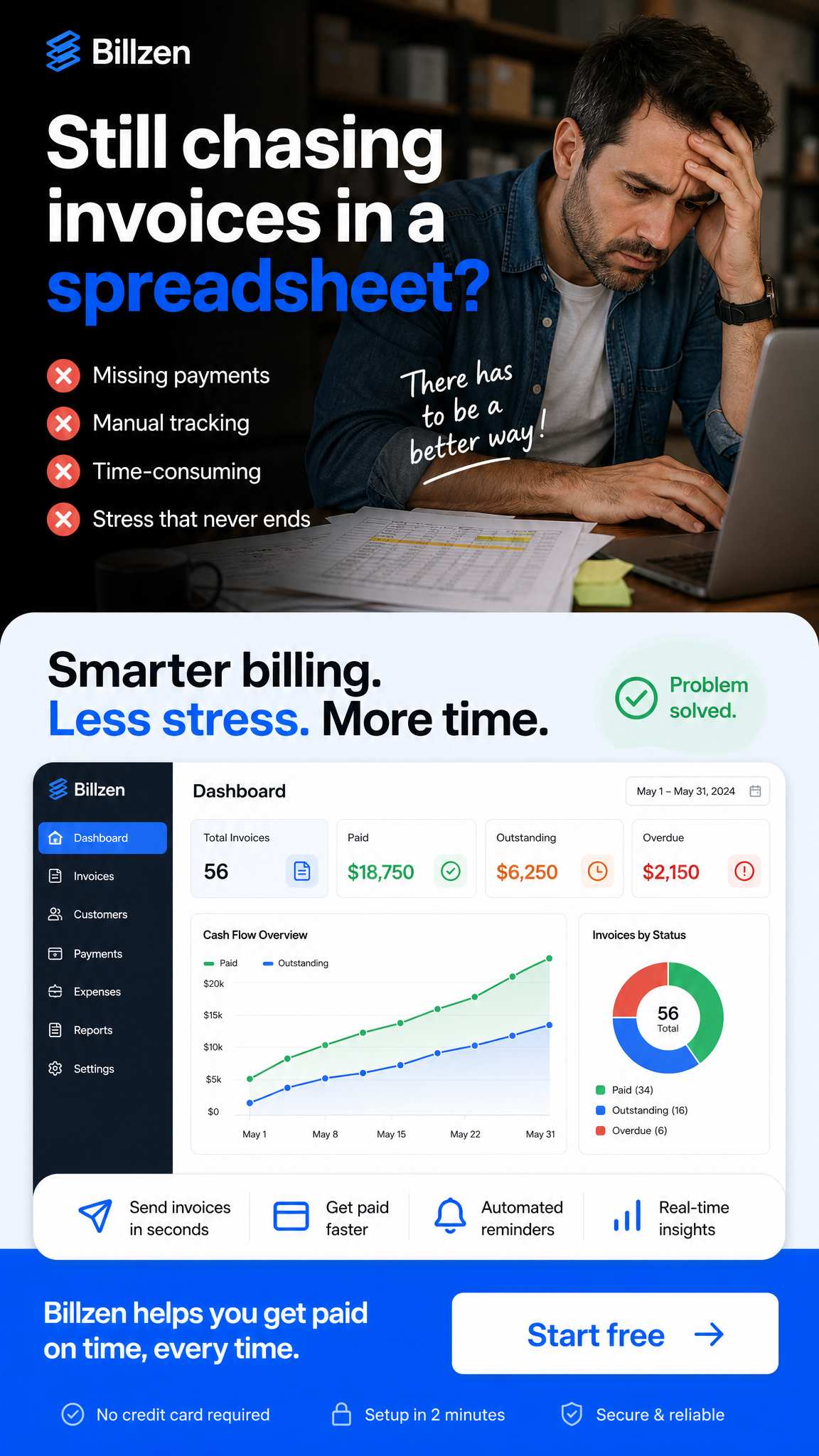
Lead with the frustration your ICP feels, then show the product erasing it. "Still chasing invoices in a spreadsheet?" names the pain in the first second, the messy list and stressed face make it visceral, and the clean dashboard below delivers the relief. Why it works: a pain hook self-selects the exact buyer and earns the next 10 seconds; the before/after makes the value obvious without a feature list.
The Retargeting Proof Ad
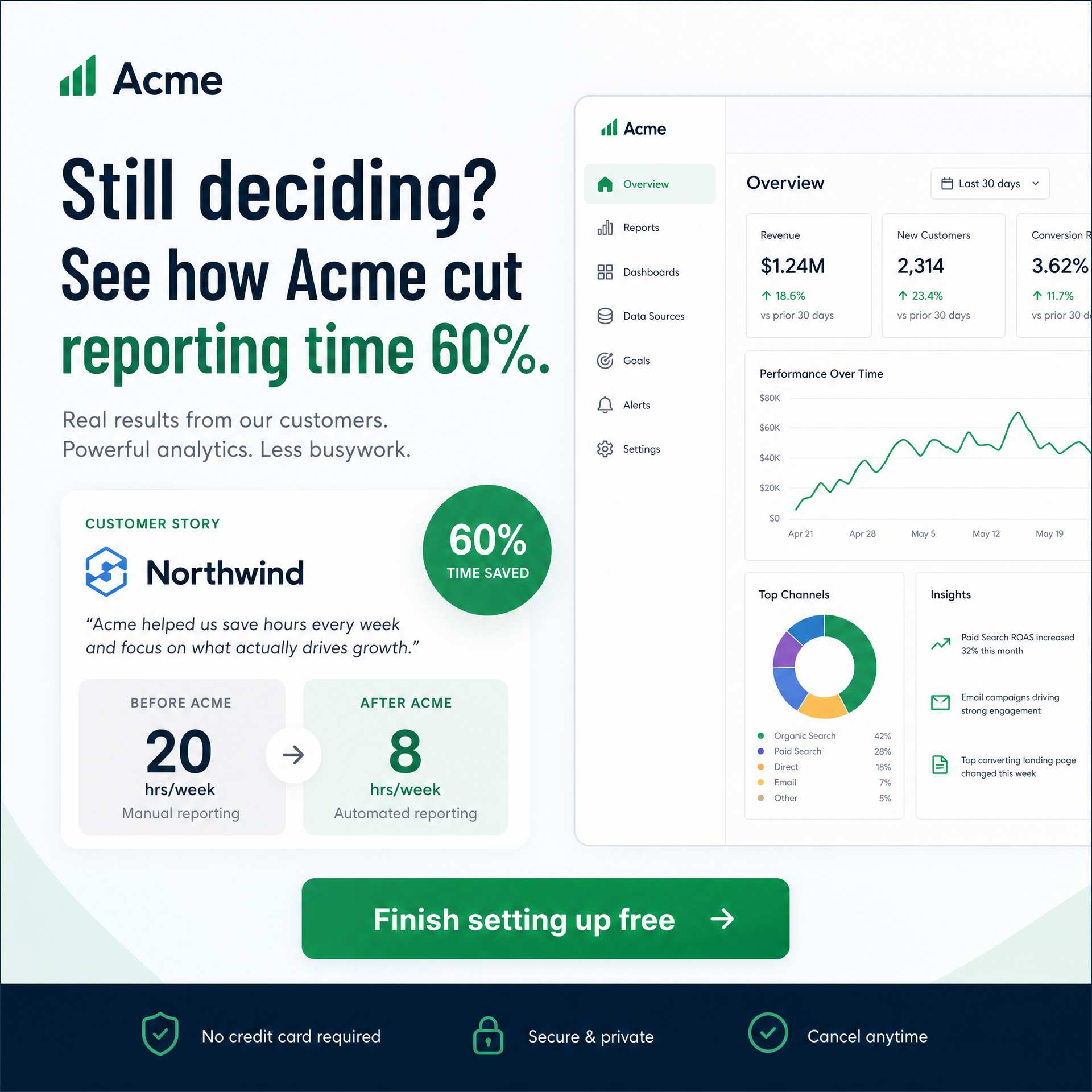
For warm audiences (trial drop-offs, pricing-page visitors), switch from pain to proof. "Still deciding? See how Acme cut reporting time 60%" pairs a customer result with a nudge to finish. Why it works: people at the bottom of the funnel don't need the problem re-explained, they need risk removed. A concrete result plus a "finish setting up" CTA does exactly that.
The third pattern: the 15-30s screen-recording demo. A short capture of the core workflow with a benefit voiceover, the format Loom, Vercel, and Linear all run, works across all three funnel stages because it shows the product doing the thing. If you make one asset, make that. (See our demo video guide for producing it.)
Ad Formats: What to Use When
Match the format to the funnel stage, not your mood:
| Format | Best Stage | Use For |
|---|---|---|
| Short video (15-30s screen demo) | All stages | Showing the product working; ~5x engagement of static |
| Pain-point static | Awareness | Cheap, fast scroll-stopper; self-selects the ICP |
| Carousel | Awareness / trial | Multi-benefit or step-by-step story across slides |
| Proof / case-study static | Retargeting | Remove risk for warm, near-converting buyers |
Run video where you can, it's the highest-performing SaaS format, but keep cheap statics in rotation for high-volume A/B testing. The winning account has a few hero videos plus a steady stream of static variations the algorithm can test.
Landing Pages & Offer Strategy
The ad only sets up the click; the landing page and offer close it. Two rules:
Match the page to the ad. Your $4 click just bought a homepage bounce. A pain-point ad about invoicing should land on an invoicing-specific page, not your generic homepage, message-match between ad and page is one of the biggest levers on conversion rate, and the gap between them is where budget quietly dies.
Stuck on the creative side? The ad does the heavy lifting, and demo-led video is what Meta rewards. See how to build a demo that converts →
Pick the right offer for the temperature. Cold audiences convert on low-commitment offers, a free trial, a free tool, or a lead magnet (benchmark report, ROI calculator). "Book a demo" is a bottom-funnel ask; using it cold is why so many SaaS campaigns stall. Save the demo CTA for retargeting, where intent is already high.
Tracking, Budget & Scaling
Fix your tracking first, or none of the numbers mean anything. Since iOS 14+, the pixel alone under-reports. Set up the Conversions API (server-side) so Meta gets clean signal on trial starts and conversions, and sanity-check against your own analytics. A campaign that looks mediocre in Ads Manager is often your best performer once server-side attribution is included.
Map the goal to a real event. Optimize prospecting toward a mid-funnel event (trial start or lead) rather than "purchase", you'll rarely hit the 50 weekly purchase events needed to exit the learning phase early on. As volume grows, move conversion campaigns to the paid event.
Scale deliberately. Raise budget ~20% every 2-3 days on winners; refresh creative every 1-2 weeks before fatigue sets in (creative is the fastest-decaying part of the account). Kill ad sets that can't reach ~50 events/week, consolidate rather than spreading a small budget thin.
Campaign Setup Checklist
- Install the Conversions API + pixel; define trial-start and paid events.
- Build first-party custom audiences (trial users, customers, site visitors) and lookalikes.
- Create 3 campaigns: awareness, trial acquisition, retargeting.
- Set Advantage+ / broad targeting for prospecting; custom audiences for retargeting.
- Load creative: 1-2 hero videos + several pain-point / proof statics per stage.
- Split budget ~50/25/25 (awareness/trial/retargeting).
- Optimize prospecting to trial-start; retargeting to paid conversion.
- Match every ad to a specific landing page with the right offer.
- Let each ad set hit ~50 events/week before judging; don't touch it mid-learning.
- Refresh creative every 1-2 weeks; scale winners +20% every few days.
A Creative Testing Framework That Won't Waste Budget
Opinionated take: most guides say "test everything." That's how you burn $5k learning nothing. Test fewer things, properly.
- Test one variable at a time. Same audience, same offer, change only the hook (or only the format). Otherwise you can't tell what moved the result.
- Give each variant enough budget to reach significance. A test that gets 3 conversions tells you nothing. Aim for ~50 events per variant before declaring a winner.
- Kill on leading indicators, scale on lagging ones. A weak hook shows up fast as a low 3-second view rate, kill it early. But judge winners on cost-per-trial, not CTR.
- Run a 30-day sprint with only 3 ad types (a demo video, a pain-point static, a proof static) before you expand. Depth beats a sprawl of half-funded variations.
An Illustrative Results Arc
An illustrative scenario (modeled to show the shape, not a specific client's reported numbers):
A B2B SaaS at ~$8k/month split 50/25/25. Month 1: awareness builds a warm pool; cold trial-acquisition alone is expensive (~$120/trial), retargeting not yet populated. Month 2: the warm pool is large enough that retargeting kicks in at ~40-60% lower cost-per-lead, and blended cost-per-trial drops toward ~$45. Month 3: with creative refreshed and Advantage+ optimized, the funnel stabilizes; if ~20% of trials convert at $99/mo, payback lands inside a couple of months and improves as the pool compounds. The lesson isn't the exact figures, it's the arc: cold is expensive, the funnel gets cheaper as your warm audience and first-party data grow.
2026 Meta Benchmarks for SaaS
| Metric | 2026 Range | Note |
|---|---|---|
| CTR (Facebook/IG) | 0.5-1.2% | Video pulls ~5x the engagement of static |
| CPC | $1.50-$5 | Far cheaper than LinkedIn ($8-15) |
| Retargeting impact | -40-60% CPL | Vs cold campaigns |
| Cold-only penalty | 3-5x CPA | Skipping awareness costs you |
The takeaway: Meta's strength for SaaS is cheap reach and efficient retargeting. Treat it as the warm-and-convert engine, and run high-intent capture on Google and ABM on LinkedIn. (We break down all three in our best SaaS ads teardown.)
Common Mistakes
Still stacking interest targeting. It's dead as of Jan 2026. Move to Advantage+ and first-party audiences.
Cold trial-asks with no awareness. The 3-5x CPA tax. Warm the audience first.
Lifestyle imagery and UGC. Underperforms for B2B SaaS, lead with demo proof and pain instead.
One creative, set and forget. Creative is the fastest-decaying part of any Meta account. Refresh constantly and let Advantage+ test variations.
Sending clicks to the homepage. Match each ad to a specific landing page or a trial flow.
Frequently Asked Questions
Do Facebook ads work for B2B SaaS in 2026?
Yes, when run as a funnel. Meta's cheap CPCs ($1.50-5) make it the most cost-efficient channel for building awareness and retargeting SaaS buyers. The mistake is treating it as a cold trial-acquisition channel alone, which costs 3-5x more. Warm an audience first, then convert on retargeting.
How do I target SaaS buyers now that interest targeting is gone?
Meta deprecated detailed interest targeting on January 15, 2026. Use Advantage+ Audience (AI targeting) and broad targeting for prospecting, letting the creative self-select buyers, plus custom and lookalike audiences built from your own trial, customer, and site-visitor data for mid and bottom funnel.
How should I structure a SaaS Facebook ads account?
Three campaigns by funnel stage: awareness (educational video/carousels to build a warm pool), trial acquisition (decision-maker targeting toward a trial-start event), and retargeting (trial drop-offs, pricing-page visitors, and content readers with proof creative). Skipping awareness raises CPA 3-5x.
What creative works best for SaaS on Facebook?
Pain-point ads (lead with the frustration, then the fix), 15-30 second screen-recording demos, and retargeting proof ads (a customer result + a finish-setup CTA). Avoid lifestyle imagery and UGC testimonials, which underperform for B2B software. Keep the hook readable in the first frame and design for sound-off.
What's a good budget for SaaS Facebook ads?
Allocate roughly 60% to awareness/prospecting, 25% to retargeting, and 15% to conversion, and fund each ad set enough to exit Meta's learning phase (about 50 optimization events per week). For most early SaaS, that means a $1,500-3,000/month minimum to gather enough signal.
Your funnel is only as good as the creative in it.
Meta rewards demo-led video, and that's the bottleneck for most SaaS teams. Flowjam produces the ad and demo video creative that makes these funnels work. See how we build it →
Keep building: our guide to creating software ads that convert, the best SaaS ads teardown, and our demo video guide.





Launch videos for
moon-shot founders.

About
We're a video production studio partnering with AI founders and startups. We make launch videos to show the world what you're building.
London, UK
Made with love from London. Collaborating with clients worldwide.
Contact
Adam Petty
Founder
adam@flowjam.com
Founder
adam@flowjam.com