
Viral launch videos for moon-shot founders 🌸
Flowjam partners with AI founders and startups aiming for the moon, to create story-driven launch videos to build hype and show the world what they're building.

Full PortfolioBlog
Flowjam works with some of the most successful AI founders in the world after only launching in 2023.
Copyright 2026. Flowjam Ltd.
Copyright 2026. Flowjam Ltd.
AI Video for Healthcare: What a Clinic Should and Shouldn't Hand to AI
AI video suits clinic tours, prep and translation. Videos built from a patient chart need an AI disclaimer, and AI patients or testimonials are off limits.

Since January 2025, a California clinic that sends a patient an AI-made video about their care has to say so out loud, twice. Most clinics making AI video haven't noticed, because their first clip is a harmless welcome tour with a smiling avatar in scrubs.
That clip is fine. The trouble starts with the third or fourth one, when someone asks the tool to explain a patient's lab results, or to make a testimonial because no real patient would sit for one. Four rules from California and the FTC now draw those lines.
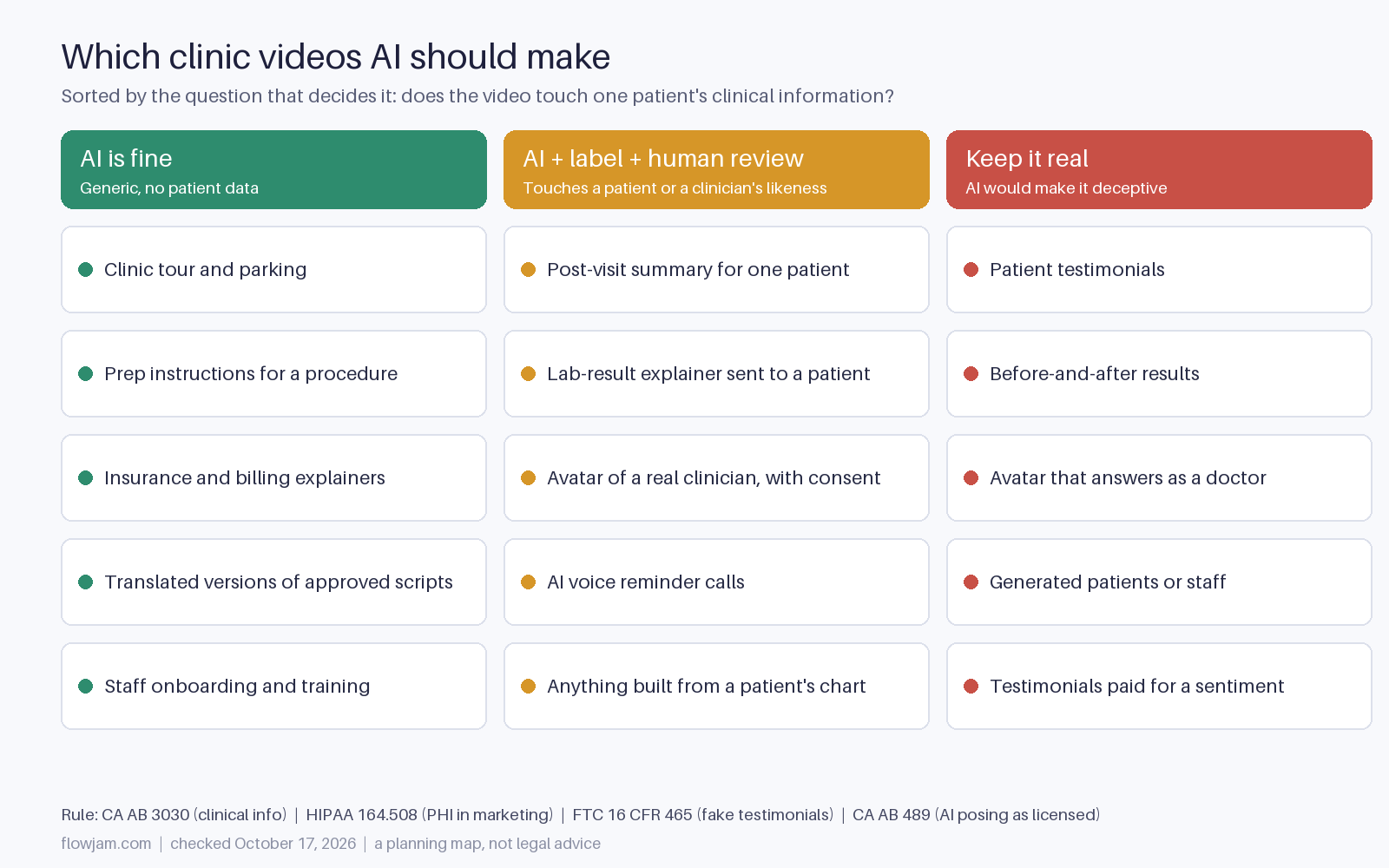
AI can make almost any clinic video. The rules decide who is allowed to appear in it. Here's how we'd sort a clinic's list.
How to decide when a clinic should use AI video
Ask whether the video carries one patient's clinical information. If it doesn't, AI video for healthcare is mostly a production choice. If it does, a disclosure law and HIPAA come along with it.
Then ask a second question: could a viewer believe a real patient or a real licensed clinician is speaking when they aren't? If yes, it's off the list, however good the footage looks. Generate the room, never the patient.
AI patient education videos: hand them to AI
Most of a clinic's video backlog sits here. Directions and parking, what to bring to a first visit, how to prep for a colonoscopy, what a prior authorization is, how billing works, staff onboarding. None of it names a patient, and all of it gets asked at the front desk fifty times a week.
This is where AI earns its keep. A script a clinician has approved can become a narrated explainer in a day, then a Spanish, Vietnamese or Tagalog version the same afternoon. Our AI video translation tools roundup compares the dubbing options.
Two rules still apply. A clinician signs off on the script before anything is generated, because a model will happily write a prep instruction that's wrong for your protocol. And the clip carries a date, because outdated prep instructions are worse than none.
Personalized AI patient videos: a disclaimer or a clinician review
Personalized video is the tempting next step. A post-visit recap in the doctor's voice, a short clip explaining this patient's A1C trend, a reminder that walks through their own medication schedule.
In California this is now regulated. AB 3030, in force since January 1, 2025, covers health facilities, clinics and physician offices that use generative AI to create patient communications about clinical information. Those messages need a disclaimer that AI generated them and clear instructions for reaching a human. For audio and video, the disclaimer is spoken at the start and the end. The exemption is a licensed provider reading and reviewing the message before it goes out.
That gives a clinic two workable paths. Have a clinician review every personalized clip, which keeps it exempt but caps volume. Or ship at scale with the spoken disclaimer and a callback line. Picking neither is the one option that doesn't work. If a clinician didn't read it, the patient hears that a machine wrote it.
HIPAA sits on top. Feeding chart data into a video tool means the vendor handles protected health information, so you need a business associate agreement before the first upload. And if any of that data drifts into marketing, 45 CFR 164.508(a)(3) requires the patient's written authorization.
- Opening line we'd use: "This video was created with AI from your visit notes. To talk with your care team, call 555-0142."
- Closing line: "This message was AI-generated. Reply or call 555-0142 to reach a person."
Can a clinic use an AI avatar of a doctor?
Yes, if the doctor is real, has agreed in writing, and the avatar delivers a script she approved. An avatar of your medical director reading the flu-season update in four languages is a sensible use. Label it on screen, and agree in writing what happens to the avatar if she leaves. Our AI avatar tools roundup covers how the main tools handle consent.
What a clinic can't do is let an avatar act as a clinician. California's AB 489, in force since January 1, 2026, bars AI systems from using terms, letters or phrases that imply the advice or care comes from a licensed person. Each use counts as a separate violation, enforced by the licensing boards.
So the line runs between the avatar reading a doctor's script and the avatar answering a patient's question. A "Dr. Ava" chat-video that responds to symptoms is the version we'd never build, in California or anywhere else.
AI patient testimonials and before-and-afters: keep them real
This is the one decision without a gray zone. A testimonial from a patient who doesn't exist isn't marketing, it's a fake review with a face. The FTC's rule on consumer reviews and testimonials, 16 CFR Part 465, in force since October 2024, bans testimonials that misrepresent who gave them, including ones from people who don't exist or who never used the service. An AI patient saying your clinic fixed her back pain is exactly that, and the rule carries civil penalties per violation.
A real patient's testimonial has its own requirement. Their story is protected health information, so using it in marketing needs a signed HIPAA authorization. Our AI video for dentists page covers how practices collect those, and AI video for med spas covers before-and-after imagery.
Where AI does help here is the editing. Captions, cleanup, a translated version of a real patient's own words. The patient stays real; the tool only tidies the footage.
AI voice appointment reminders need their own check
Appointment reminders in a cloned front-desk voice look like an easy win. In February 2024 the FCC ruled that AI-generated voices count as artificial voices under the Telephone Consumer Protection Act, so every robocall consent rule applies to them. Healthcare messages have a narrow exemption with its own conditions, so check it with counsel before a single call goes out, and treat a video sent by text or email as the simpler default.
This page explains rule text and isn't legal advice. Most of these rules are California's or federal, and other states are moving, so your counsel has the final say.
For the production side, our guide to making AI videos covers script to export.
If you'd rather not rebuild these guardrails for every clip, Flowjam makes clinic video templates with the clinician sign-off step, the AI disclaimer and the callback line built in, so every version your staff makes ships with them.
AP
About the author
Adam Petty
Founder, Flowjam
Adam is the founder of Flowjam, where he helps startups turn ideas into launch videos, product demos, and ads with AI video. He writes about AI video production, creative workflows, and go-to-market for early-stage teams.
Frequently asked questions
Can healthcare providers use AI-generated video?
Yes. No US law bans AI video in healthcare. Generic patient education such as clinic tours, prep instructions and billing explainers can be made with AI once a clinician approves the script. Videos built from a patient's clinical information carry extra rules, such as California AB 3030 and HIPAA.
What does California AB 3030 require for AI patient videos?
Since January 1, 2025, California clinics and physician offices that use generative AI for patient communications about clinical information must include a disclaimer that AI generated it and instructions for reaching a human. For audio and video the disclaimer is spoken at the start and end. Messages read and reviewed by a licensed provider are exempt.
Can a clinic make an AI avatar of its doctor?
Yes, with the doctor's written consent, an on-screen AI label and a script the doctor approved. California AB 489, in force since January 1, 2026, bars AI systems from implying that advice or care comes from a licensed person, so the avatar should deliver an approved script, not answer patients' questions as a clinician.
Are AI-generated patient testimonials legal?
No. The FTC's rule on consumer reviews and testimonials, 16 CFR Part 465, bans testimonials that misrepresent who gave them, including ones attributed to people who don't exist or who never used the service. Use real patients with a signed HIPAA marketing authorization.
Do I need a BAA with an AI video vendor?
If you upload protected health information, such as chart data for a personalized video, the vendor is handling PHI on your behalf, so you need a business associate agreement first. Generic scripts with no patient data don't require one.
Can clinics send AI voice appointment reminders?
Carefully. The FCC ruled in February 2024 that AI-generated voices are artificial voices under the TCPA, so robocall consent rules apply. Healthcare messages have a narrow exemption with conditions, so confirm it with counsel, or send a video reminder by text or email instead.
What are the best uses of AI video for healthcare?
Clinic tours, procedure prep, insurance and billing explainers, staff training, and translated versions of clinician-approved scripts. These use AI for volume without inventing patients or clinicians.





Launch videos for
moon-shot founders.

About
We're a video production studio partnering with AI founders and startups. We make launch videos to show the world what you're building.
London / San Francisco
Made with love from London / San Francisco. Collaborating with clients worldwide.
Contact
Adam Petty
Founder
adam@flowjam.com
Founder
adam@flowjam.com