
Viral launch videos for moon-shot founders 🌸
Flowjam partners with AI founders and startups aiming for the moon, to create story-driven launch videos to build hype and show the world what they're building.

Full PortfolioBlog
Flowjam works with some of the most successful AI founders in the world after only launching in 2023.
Copyright 2026. Flowjam Ltd.
Copyright 2026. Flowjam Ltd.
AI Video for Recruiting: A Video Job Ad Is Still a Job Ad
Recruiters can use AI avatars and dubbing for job videos. Pay-transparency laws, Title VII ad rules and Illinois' AI interview law still apply.

An AI recruiting clip isn't a new kind of content. It's a job ad, and job ads have had rules for decades.
Recruiting teams found the obvious use for AI video quickly. One recruiter records five minutes of footage, and an avatar of her now fronts a 30-second clip for every open role, in English and Spanish, with a personalized version for each sourced candidate.
That works, and we'd encourage it. What breaks is the assumption that a 30-second Reel sits outside the rules written for postings, ads and interviews. They were written to cover any medium, and each one lands on a specific frame of the video.
Does an AI recruiting video need the pay range on screen?
Pay transparency laws now cover a large share of US hiring. Washington's is the broadest, and its definition shows why video isn't a loophole. The state defines a posting as any solicitation intended to recruit applicants for a specific available position that includes qualifications, whether done directly or through a third party, electronically or in print. California, Colorado, New York and several cities have their own versions with different thresholds.
A Reel that says "we're hiring a support engineer, two years of SaaS experience, link below" fits that definition word for word. A general employer-brand video about what it's like to work at your company, with no specific role and no qualifications, usually doesn't.
So the decision rule is simple. If the video names a role, put the pay range on screen and show it for long enough to read. If you'd rather not, keep the video about the team and send people to a posting that carries the range. Don't count on a voiceover saying "competitive salary" to cover you, because a vague phrase isn't a range.
Here's the rewrite we'd make on a typical AI-drafted role clip.
- Before: "Join our young, energetic team of digital natives! Competitive pay. DM us."
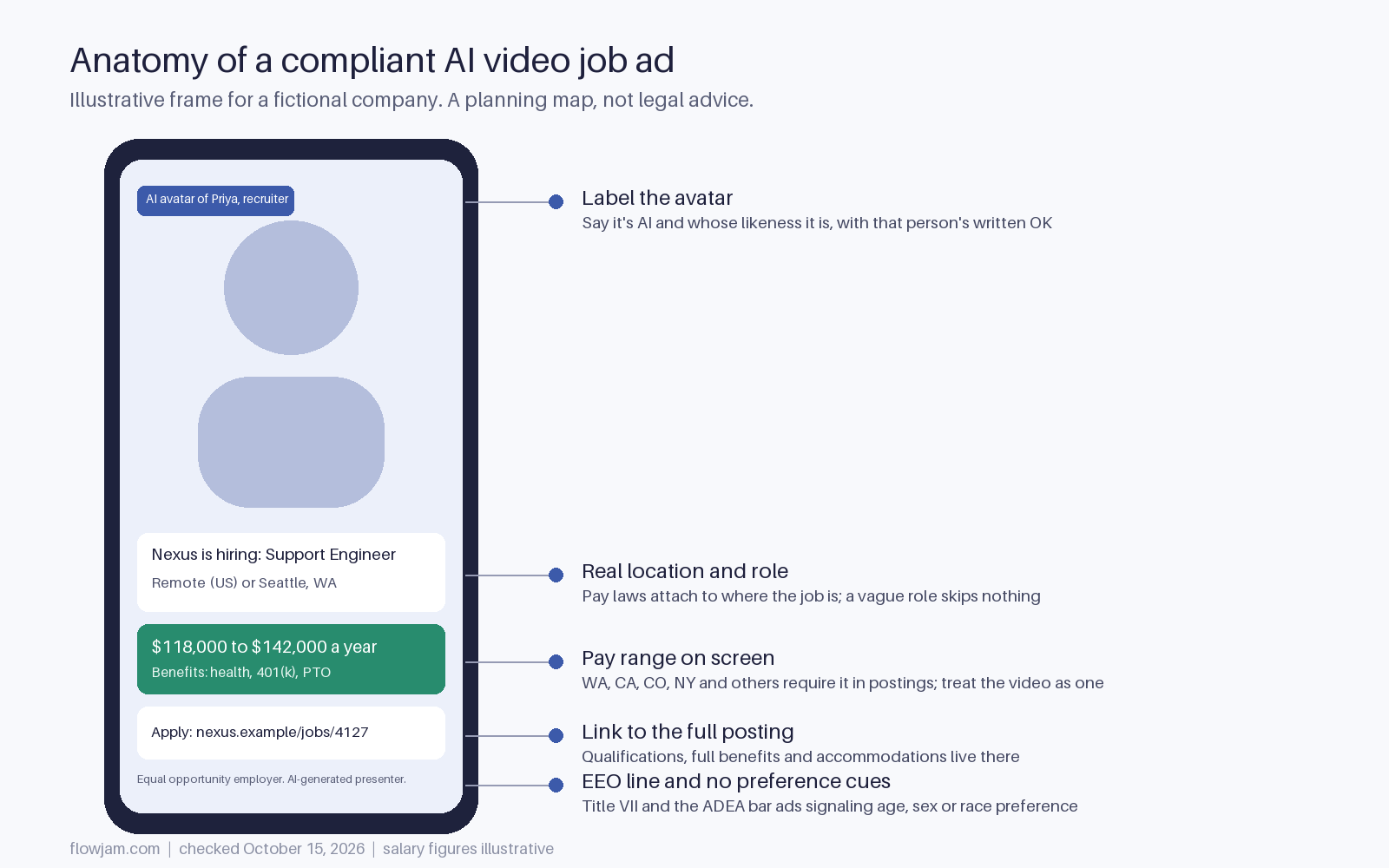
- After: "We're hiring a support engineer, remote in the US or in Seattle. The range is $118,000 to $142,000. Here's what the first 90 days look like, and the link to apply is below."
The before version fails three ways at once. "Young" and "digital natives" read as an age preference, "competitive pay" isn't a range, and a DM isn't a posting anyone can audit.
Can AI-generated employees appear in a job ad?
Title VII, at 42 U.S.C. 2000e-3(b), makes it unlawful to publish a job advertisement indicating a preference based on race, color, religion, sex or national origin. The ADEA, at 29 U.S.C. 623(e), does the same for age. Neither is new, and neither cares that the people in the ad were rendered rather than cast.
With real footage, your ad shows whoever works there. With generated footage, every face is a choice someone made with a prompt. A year of recruiting videos where the AI only ever produced people in their twenties is a pattern a plaintiff's lawyer can screenshot, and "the model picked them" won't be a defense.
There's a second problem with generated teams. If the people in the video don't work at your company, the ad shows candidates a workplace that doesn't exist. Our rule is to use real employees, filmed on a phone and cleaned up with AI, when the video is meant to show the team. Use generated people only for clearly illustrative scenes, such as a mock customer call in a support role explainer.
Where AI video for recruiting earns its keep: a real recruiter, labeled
The strongest format is an avatar of an actual recruiter or hiring manager, made with their written consent, labeled on screen as AI. It answers the same five questions every candidate asks: what the role is, what the pay is, where it's based, what the process looks like and how long it takes.
Personalized versions sent by email to sourced candidates work for the same reason, and they're where AI pays for itself, because nobody records 200 individual intros by hand. Our guide to AI personalized video for sales covers how teams build them, and the mechanics carry over to recruiting.
Plan for the day that recruiter leaves. Agree in writing what happens to their avatar, and retire it when they go. A former employee's face still pitching your open roles is a bad look and, depending on the state, a likeness claim. Our AI avatar tools roundup compares how the main tools handle consent and access.
When the AI watches the candidate, a different law applies
Many searches for AI video in recruiting are really about the opposite direction: candidates recording one-way interviews that software scores. That's regulated separately, and more tightly.
Illinois' Artificial Intelligence Video Interview Act, in force since January 2020, applies when an employer uses AI to analyze recorded interviews for Illinois-based roles. Before the interview, the employer has to tell the applicant AI may be used, explain how it works and what general characteristics it evaluates, and get consent. Videos can only be shared with people whose expertise is needed to evaluate the applicant, and if the applicant asks, every copy has to be deleted within 30 days.
In New York City, Local Law 144 covers automated employment decision tools more broadly. If software substantially assists the hiring decision, it needs an independent bias audit within the past year, a public summary of the results and notice to candidates.
None of this touches an avatar that pitches a role. It applies to whatever happens after the candidate hits record.
This page explains rule text and isn't legal advice. Employment law varies by state and city, and your counsel has the final say.
The best argument against all of this
The strongest objection isn't legal. It's that candidates can tell. A senior engineer who gets an avatar intro may read it as a sign the company won't spend a human's time on them, and some will.
We think that objection is right about the wrong format. Avatars are good at the logistics candidates want answered fast: pay, location, process and timeline. They're bad at the thing that actually closes candidates, which is a real hiring manager explaining why the work matters. So the split we'd make is that AI handles the volume of role clips, translations and outreach, and the hiring manager records one real, unpolished minute for the people who make the shortlist. For the production side of both, our guide to making AI videos is the place to start, and Flowjam can build the role-clip template with the pay card and labels locked in.
AP
About the author
Adam Petty
Founder, Flowjam
Adam is the founder of Flowjam, where he helps startups turn ideas into launch videos, product demos, and ads with AI video. He writes about AI video production, creative workflows, and go-to-market for early-stage teams.
Frequently asked questions
Can recruiters use AI-generated video for job ads?
Yes. No federal law bans AI video in recruiting. The same rules that govern any job advertisement apply, including pay-transparency laws in states like Washington, California, Colorado and New York, and the Title VII and ADEA bans on ads indicating a preference.
Does a video job ad need to include the salary range?
In pay-transparency jurisdictions, a video that recruits for a specific role is generally treated as a job posting. Washington defines a posting as any solicitation to recruit applicants for a specific position that includes qualifications, in any format, so the range should appear on screen or the video should point to a posting that carries it.
Is it legal to use AI-generated people in recruiting videos?
It can be, but Title VII (42 U.S.C. 2000e-3(b)) and the ADEA (29 U.S.C. 623(e)) prohibit job ads that indicate a preference based on race, sex, national origin, religion or age, and generated casting choices are attributable to the employer. Showing generated people as if they were your team also misrepresents the workplace.
Can I make an AI avatar of our recruiter?
Yes, with the recruiter's written consent, an on-screen AI label and a written agreement on what happens to the avatar when they leave. Retire it at departure.
What does Illinois require for AI video interviews?
Under the Artificial Intelligence Video Interview Act, employers using AI to analyze recorded interviews for Illinois-based roles must notify applicants, explain how the AI works and what it evaluates, get consent, limit sharing and delete videos within 30 days of an applicant's request.
Does NYC Local Law 144 apply to AI recruiting videos?
Not to promotional videos. It applies to automated employment decision tools that substantially assist hiring decisions, such as software scoring recorded interviews, which need an annual independent bias audit, a public summary and candidate notice.





Launch videos for
moon-shot founders.

About
We're a video production studio partnering with AI founders and startups. We make launch videos to show the world what you're building.
London / San Francisco
Made with love from London / San Francisco. Collaborating with clients worldwide.
Contact
Adam Petty
Founder
adam@flowjam.com
Founder
adam@flowjam.com