
Viral launch videos for moon-shot founders 🌸
Flowjam partners with AI founders and startups aiming for the moon, to create story-driven launch videos to build hype and show the world what they're building.

Full PortfolioBlog
Flowjam works with some of the most successful AI founders in the world after only launching in 2023.
Copyright 2026. Flowjam Ltd.
Copyright 2026. Flowjam Ltd.
AI Video for Car Dealerships: Payment Ads, Avatars and California's CARS Act
Dealers can use AI video for walkarounds, avatars and dubbing. A quoted payment or $0 down triggers Reg Z or Reg M disclosures; California now requires total price.

Dealers were early to AI video for a plain reason: a lot with 300 units needs 300 walkarounds, and nobody has time to film them. Tools now turn VIN data and a few phone clips into a captioned video per car, plus a weekly special read by an avatar of the sales manager.
At that volume, what goes wrong is rarely the tool. It is a payment figure, a generated car or a fake buyer, and the rules on all three predate AI by decades, plus one California law that took effect on October 1, 2026.
Can a dealership's AI avatar say the monthly payment?
Yes, but the payment pulls a full set of disclosures into the same video. On a finance offer, Regulation Z section 1026.24(d) treats the payment amount, the number of payments or term, the down payment and the finance charge as trigger terms. Say any one and the ad must also state the down payment, the full repayment terms and the APR.
On a lease, the rule is Regulation M section 1013.7. The payment amount is a trigger, and so is any statement about money due at signing, including a statement that none is required. Once triggered, the ad has to say it's a lease and give the total due at signing, the number, amount and timing of payments, whether there's a security deposit and that extra charges may apply at lease end.
That's why "$0 down" is not the free hook AI script tools treat it as. It's a trigger term, and it carries the whole disclosure set with it.
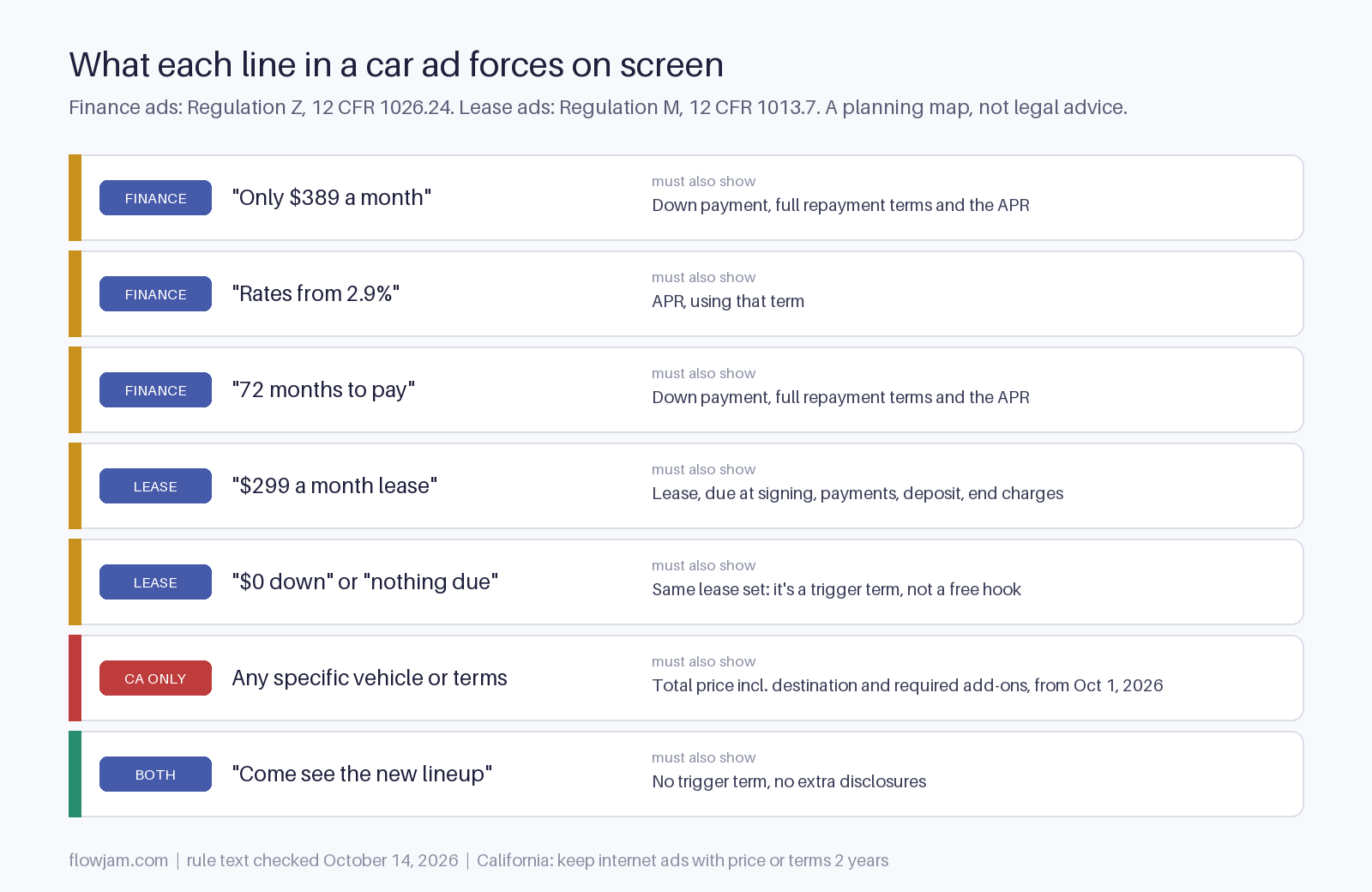
Here is the kind of rewrite we make on an AI-drafted lease opener. The model name is made up.
- Before: "Drive the new Crestline SUV home for $0 down and $299 a month!"
- After, spoken: "The new Crestline SUV is on our lot this week. Here is what a lease looks like." Then a full-screen card: "Lease. $299 a month for 36 months. $3,499 due at signing. No security deposit. Excess mileage and wear charges may apply at lease end. With approved credit."
The numbers on that card are illustrative. Yours come from the actual offer sheet, and in California the card also carries the total price of the vehicle.
Our default for avatar videos is a two-step build. The avatar does the hook and the vehicle, the payment lives on a full-screen disclosure card that holds long enough to read, and the template locks that card so a regenerated variant can't drop it.
Does a 15-second Reel get the TV shortcut?
Both rules give broadcast a shortcut. Television and radio ads can state fewer terms and point to a toll-free number or, for leases, a print ad running in local media, and Regulation M says that number has to stay live for at least ten days.
The text says television and radio. Whether a vertical video in a social feed or a pre-roll counts is something to settle with your counsel, not to assume. We'd keep payment figures out of short social cuts entirely and send viewers to a vehicle page where the full terms fit.
We sell in California. What changed on October 1?
California's Combating Auto Retail Scams Act, SB 766, signed on October 6, 2025, took effect on October 1, 2026. It requires dealers to show the vehicle's total price in advertising that references a specific vehicle or financing terms. The total includes destination and any features the buyer can't decline, and can leave out taxes, title and license fees. Optional products such as GAP and service contracts have to be presented as optional, and misrepresenting price, financing or lease terms is prohibited outright.
Two things in that law hit AI video directly. First, the per-vehicle walkaround that a tool builds from your inventory feed now needs the total price, not just the MSRP or a payment, if it names the car. Second, internet ads that show price, features or financing terms have to be kept in retrievable form for two years from when they were served to a California consumer. If your tool renders a fresh variant per car per week, that's a lot of files, and the export settings need to save every one.
The federal version, the FTC's CARS Rule, never took effect. The Fifth Circuit vacated it in January 2025 on procedural grounds. Deceptive pricing is still illegal under Section 5 of the FTC Act, so outside California the bar is lower on format but not on honesty.
Can a car dealership use AI-generated footage of the car?
For a model-year teaser with no price attached, generated footage is low risk. For anything that advertises a unit on your lot, use real footage of that unit. A generated video of a higher trim, a color you don't have in stock or a clean interior on a car that has wear is a misrepresentation of the thing being sold. If the advertised car isn't really available to buy at the advertised terms, it also starts to look like the bait advertising the FTC's Guides Against Bait Advertising describe.
The safe split is easy to remember. AI can make the captions, music, voiceover, translation and the graphics, but the footage of the car itself should be real.
Can we use AI customer testimonials?
No. Since October 2024 the FTC's rule on consumer reviews and testimonials has prohibited creating or sharing a testimonial that misrepresents that the person exists or bought from you, with civil penalties per violation. A generated family beside a new SUV saying the finance office was painless is exactly that.
Real buyers filmed at delivery, with written consent and AI used only for captions and cleanup, are the version that works. They're also better ads.
What about AI voice follow-up calls?
Get consent first. In February 2024 the FCC ruled, in FCC 24-17, that AI-generated voices are artificial voices under the Telephone Consumer Protection Act. A cloned voice calling an internet lead about a car needs the same consent as a prerecorded robocall, which for telemarketing means prior express written consent, and the statute allows damages per call.
A personalized video the lead opens by email is a different and much safer channel. Our guide to AI personalized video for sales covers how stores build those.
Finance offers here run on the same Regulation Z section as mortgages, so our AI video for mortgage loan officers page goes deeper on trigger terms and dubbing. For production, start with our guide to making AI videos or our AI video ads guide. If you'd rather hand it off, Flowjam builds dealer videos from the offer sheet your F&I or compliance team has already approved, with the disclosure card set as a fixed end card rather than something a new variant can drop.
This page explains rule text and isn't legal advice. Your counsel, your OEM's co-op rules and your state regulator have the final say.
AP
About the author
Adam Petty
Founder, Flowjam
Adam is the founder of Flowjam, where he helps startups turn ideas into launch videos, product demos, and ads with AI video. He writes about AI video production, creative workflows, and go-to-market for early-stage teams.
Frequently asked questions
Can car dealerships use AI-generated video in their advertising?
Yes. No federal rule bans AI tools in auto advertising. Regulation Z, Regulation M, the FTC Act and state law govern what the ad says and shows, so AI voiceover, captions, translation and an avatar of a real staff member are fine when the content complies.
Does saying a monthly payment in a car video require more disclosures?
Yes. For financing, Regulation Z 1026.24(d) requires the down payment, repayment terms and APR. For leases, Regulation M 1013.7 requires stating it is a lease, the total due at signing, the payment schedule, any security deposit and possible end-of-lease charges.
Is "$0 down" a trigger term in a lease ad?
Yes. Under Regulation M 1013.7, a statement about any payment due at signing, including that no payment is required, triggers the full set of lease disclosures.
What does California's CARS Act require in dealer ads?
From October 1, 2026, SB 766 requires California dealers to show the total price in ads referencing a specific vehicle or financing terms, including destination and non-optional features but excluding taxes and government fees, and to keep internet ads showing price or terms for two years.
Is the FTC CARS Rule in effect?
No. The Fifth Circuit vacated the FTC's CARS Rule in January 2025 before it took effect. Deceptive auto pricing remains illegal under Section 5 of the FTC Act.
Can a dealer use AI-generated customer testimonials?
No. The FTC rule at 16 CFR 465.2 prohibits testimonials that misrepresent that the person exists or had the experience described, which covers AI-generated buyers.
Can a dealership use an AI voice to call leads?
Only with consent. The FCC ruled in February 2024 that AI-generated voices are artificial voices under the TCPA, so marketing calls using them need prior express written consent.





Launch videos for
moon-shot founders.

About
We're a video production studio partnering with AI founders and startups. We make launch videos to show the world what you're building.
London / San Francisco
Made with love from London / San Francisco. Collaborating with clients worldwide.
Contact
Adam Petty
Founder
adam@flowjam.com
Founder
adam@flowjam.com