
Viral launch videos for moon-shot founders 🌸
Flowjam partners with AI founders and startups aiming for the moon, to create story-driven launch videos to build hype and show the world what they're building.

Full PortfolioBlog
Flowjam works with some of the most successful AI founders in the world after only launching in 2023.
Copyright 2026. Flowjam Ltd.
Copyright 2026. Flowjam Ltd.
AI Video for Insurance Agents: What Medicare and Call Rules Allow
Insurance agents can use AI avatars, captions and dubbing. Medicare rules require actor-portrayal labels, the TPMO disclaimer and no cold social DMs.

If you sell Medicare Advantage or Part D plans, the line between a fine AI video and a compliance finding is not the tool. It's the channel you send it through and who appears on screen.
If you sell life, health or property and casualty outside Medicare, the rules are looser, but two of them follow you everywhere: fake testimonials and AI voices on the phone. Here is how we'd decide each format.
If the person on screen is you
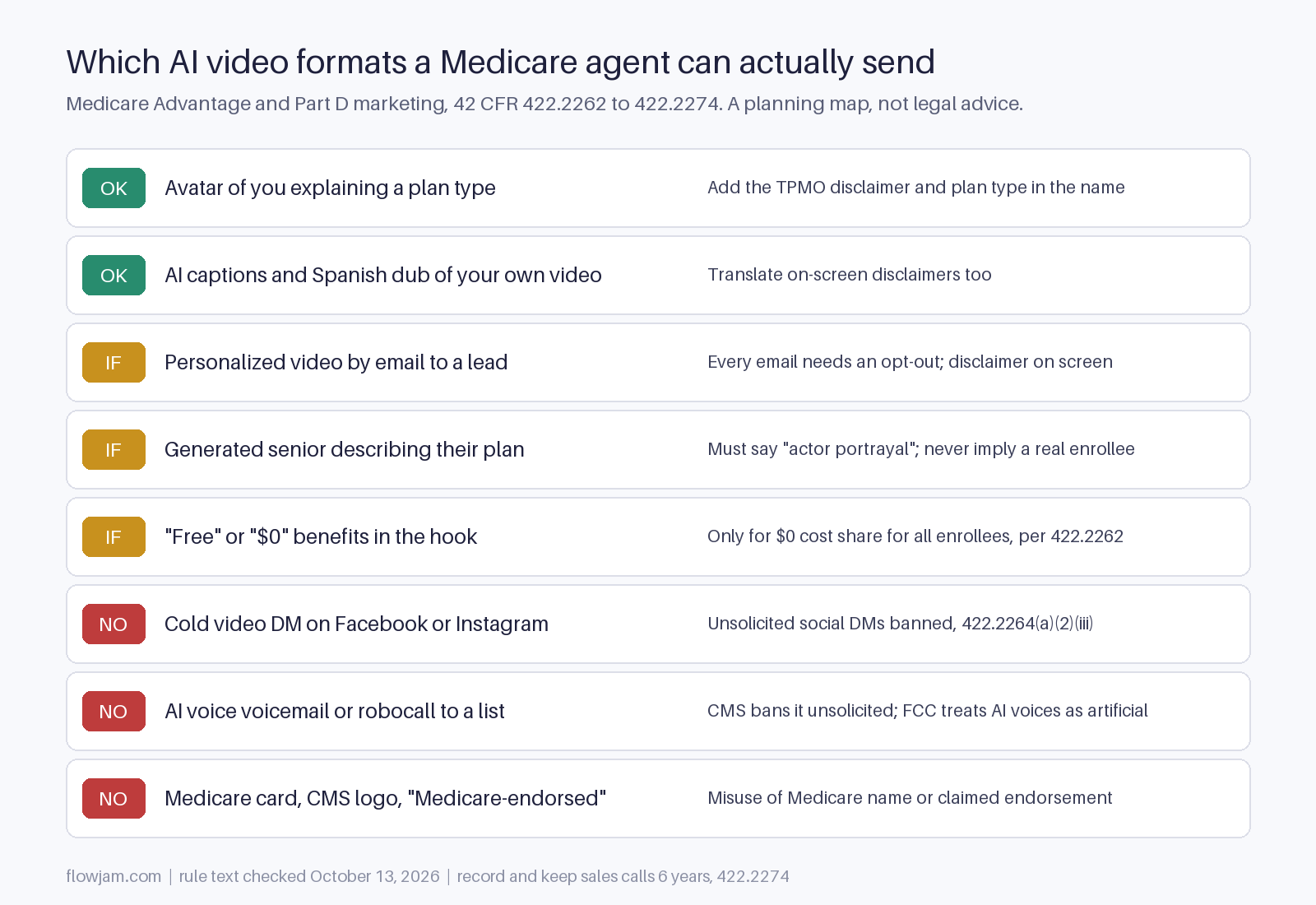
Use it. An avatar of the agent reading an approved script is the strongest AI format in insurance, because the trust is already yours. You record a few minutes once, then produce a weekly explainer on deductibles, a plan-year change video every October and a thank-you to each new client without filming again.
For Medicare work, CMS treats the video as marketing material like any other. Three things go into the template, not the script, so no generated variant can lose them. The plan type has to appear in the plan name under 422.2262(a)(1)(viii), so "Acme Advantage" becomes "Acme Advantage (HMO)". The third-party marketing organization disclaimer from 422.2267(e)(41) goes on screen. It starts "We do not offer every plan available in your area" and gives your current count of organizations and plans, so update it when your appointments change. Your license and appointment details go on the end card if your state asks for them.
"We do not offer every plan available in your area. Currently we represent [number] organizations which offer [number] products in your area. Please contact Medicare.gov or 1-800-MEDICARE to get information on all of your options."
That is the wording for agents who don't represent every organization in the area, from 422.2267(e)(41). Put it on a full-screen card for at least as long as a viewer needs to read it, not in a two-second footer.
Pick an avatar tool that locks your clone to your account. Our AI avatar video tools roundup compares how each one handles consent and access.
If the person on screen is a generated senior
Label it, or don't use it. Under 422.2262(b), anyone portraying a real or fictitious situation in Medicare marketing must be identified as an actor portrayal. A beneficiary giving a testimonial must have been enrolled when it was made, and paid endorsements must say so. A generated 70-year-old saying "this plan saved me $2,000 on prescriptions" is out unless the video says actor portrayal, and the savings claim still has to be true of the plan.
Outside Medicare the floor is the FTC. Its rule on consumer reviews and testimonials, 16 CFR 465.2, has barred testimonials that misrepresent that the person exists or used the product since October 2024. Most states add their own testimonial rules for life and annuity ads, modeled on NAIC regulations, and they generally require testimonials to be genuine and paid ones to be disclosed.
Our rule is simple. Generated people can illustrate a situation, such as a couple comparing two quotes at a kitchen table, with a visible actor portrayal label. They never speak as clients. For a real client story, record the client on a phone and use AI only for captions and cleanup.
If you send it to someone who didn't ask
This is where most AI video plans for Medicare agents break, because personalized video at scale is the whole pitch of the tools.
Under 422.2264(a), unsolicited contact by mail, print and email is allowed, as long as every email has an opt-out. Unsolicited direct messages on social platforms are banned, and so are unsolicited calls, texts and voicemails. A personalized avatar video emailed to a lead with an unsubscribe link is fine. The same video sent as a cold Instagram or Facebook DM is not, however good it looks.
Once someone does reach out, you can reply in the channel they used. Keep the TPMO disclaimer on screen in every reply video, because it travels with the marketing, not with the first touch.
For agents outside Medicare, cold email video is governed by CAN-SPAM, which also requires an opt-out and a physical address. Our guide to AI personalized video for sales covers the production side.
If the AI does the talking on a phone
Don't, unless you have written consent. In February 2024 the FCC ruled, in declaratory ruling FCC 24-17, that AI-generated voices count as artificial voices under the Telephone Consumer Protection Act. A call or voicemail using a cloned voice needs the same consent as a prerecorded robocall, which for telemarketing means prior express written consent, and the TCPA allows damages per call.
For Medicare, CMS stacks a second rule on top. 422.2274(g)(2)(ii) requires every marketing and sales call to be recorded in full, including the audio of web-based calls, and kept for six years. If you run sales appointments over video, the recording requirement comes with them. A voice clone of you leaving voicemails for an aged-in lead list breaks both rules at once.
AI voice is fine in a video that someone chooses to watch. It's the outbound call that triggers the consent rules.
If the hook uses Medicare, "free" or a dollar figure
Change the hook. The 422.2262(a)(1) list bars claiming that Medicare, CMS or HHS recommends or endorses you, and misusing the Medicare name, the CMS logo or government products. In practice that rules out generated Medicare card images, which need CMS authorization, and the "new government benefit" phrasing AI script tools write by default.
"Free" can't describe a $0 premium or a cut in premium, deductible or cost sharing. It can describe a benefit only when the cost share is zero for every enrollee. If the plan's dental allowance varies by county, a generated graphic saying "free dental" is a problem, not a hook.
Here is the rewrite we'd make on a typical AI-drafted opener.
- Before: "Seniors, the government just announced free dental, vision and grocery money. Call now to claim yours."
- After: "Your Medicare Advantage plan can change on January 1. Here are the three lines in your Annual Notice of Change worth checking this month."
The before version has three problems. It implies a government announcement. It uses free for benefits that vary by plan. And opening on "Seniors" edges toward implying the plans are only for seniors, which 422.2262(a)(1)(v) bars, since Medicare covers people under 65 too.
The test we use on every AI-written script is to read the first five seconds as a compliance reviewer would. If the hook only works because it hints at a government connection or a giveaway, rewrite it around the actual question people ask, such as what changes in their plan next year.
Medicare versus every other line
| Format | Medicare Advantage / Part D | Life, health, P&C |
|---|---|---|
| Avatar of the agent | Yeswith TPMO disclaimer and plan type | Yes |
| AI captions and dubbing | Yestranslate the disclaimers too | Yes |
| Generated client testimonial | Noactor portrayal label at minimum | NoFTC and state rules |
| Cold personalized email video | Yesopt-out in every email | YesCAN-SPAM opt-out and address |
| Cold social DM video | No | Check platform rules and state law |
| AI voice call or voicemail | Nounsolicited calls banned | Only with prior express written consent |
Carriers and FMOs often add their own review, and some require submission of any video that names their plans. Their rules can be stricter than the federal floor.
This is the same pattern as the other regulated fields we've covered, from AI video for mortgage loan officers to AI video for financial advisors. For the production side, start with our guide to making AI videos. If you'd rather hand it off, Flowjam produces videos from scripts your compliance team has already cleared.
This page explains rule text and isn't legal advice. CMS guidance, your carriers and your state insurance department have the final say.
AP
About the author
Adam Petty
Founder, Flowjam
Adam is the founder of Flowjam, where he helps startups turn ideas into launch videos, product demos, and ads with AI video. He writes about AI video production, creative workflows, and go-to-market for early-stage teams.
Frequently asked questions
Can insurance agents use AI-generated video in their marketing?
Yes. No federal rule bans AI tools in insurance marketing. The rules govern what the video says, who appears in it and how it is sent, so an avatar of the agent, AI captions and dubbing are fine when the content complies.
Can a Medicare agent use an AI avatar of a senior?
Only with a clear actor portrayal label. Under 42 CFR 422.2262(b), anyone portraying a real or fictitious situation in Medicare marketing must be identified as an actor portrayal, and a generated person can never present as a real enrollee.
Can I send personalized AI videos to Medicare leads?
By email, yes, if every email includes an opt-out, per 42 CFR 422.2264(a)(1). Unsolicited social media direct messages, texts, calls and voicemails to Medicare beneficiaries are prohibited.
Is an AI voice clone legal for insurance calls?
Only with consent, and for telemarketing that means prior express written consent. The FCC ruled in February 2024 (FCC 24-17) that AI-generated voices are artificial voices under the TCPA, so calls and voicemails using them need the same consent as prerecorded robocalls.
Does the TPMO disclaimer need to appear in videos?
Yes, for third-party marketing organizations selling Medicare Advantage or Part D. 42 CFR 422.2267(e)(41) requires the disclaimer in marketing materials, television ads and websites, and verbally on sales calls before discussing benefits.
Can I say a Medicare plan is free in a video?
Not to describe a $0 premium or a reduction in premium or cost sharing. Under 42 CFR 422.2262, free can describe a benefit only when it has zero cost share for all enrollees.
How long must Medicare sales calls be recorded and kept?
42 CFR 422.2274(g)(2)(ii) requires recording all marketing and sales calls in full, including audio of web-based calls, and keeping them for at least six years.





Launch videos for
moon-shot founders.

About
We're a video production studio partnering with AI founders and startups. We make launch videos to show the world what you're building.
London / San Francisco
Made with love from London / San Francisco. Collaborating with clients worldwide.
Contact
Adam Petty
Founder
adam@flowjam.com
Founder
adam@flowjam.com