
Viral launch videos for moon-shot founders 🌸
Flowjam partners with AI founders and startups aiming for the moon, to create story-driven launch videos to build hype and show the world what they're building.

Full PortfolioBlog
Flowjam works with some of the most successful AI founders in the world after only launching in 2023.
Copyright 2026. Flowjam Ltd.
Copyright 2026. Flowjam Ltd.
AI Video for Nonprofits: Five Defaults That Cost Donor Trust
Nonprofits can use AI video for thank-yous, translation and appeals. Label synthetic people, keep solicitation disclosures, get consent for AI voice calls.

In October 2025, The Guardian reported that aid agencies were running AI-generated images of extreme poverty in fundraising campaigns. The story wasn't about a broken law. What those groups risked was something harder to get back, the benefit of the doubt on every real photo they'd ever posted.
That's the actual risk in AI video for nonprofits. The tools are cheap and good, and a volunteer can now make an appeal in an afternoon. The trouble is five assumptions that come along with them, because donors and regulators still apply the old rules to the new footage.
Myth 1: AI-generated beneficiaries get a charity around consent
This is the one behind the Guardian story. Arsenii Alenichev, a researcher at the Institute of Tropical Medicine in Antwerp, had collected more than 100 of them and called the trend poverty porn 2.0. His explanation for why groups use them was blunt: they're cheap, and nobody has to ask for consent.
The reasoning sounds tidy. If the child in the frame doesn't exist, there's no one whose dignity or privacy you can harm. In practice the opposite happens. A prompt for a hungry child returns the most stereotyped picture the model has seen, and it stands in for a whole community that never agreed to be portrayed that way. When donors find out it's synthetic, they stop trusting the real photos too.
Our rule is narrow. Real beneficiaries appear only with informed consent, and generated people never stand in for suffering. AI earns its place in the scenes around the story, such as an animated map of the delivery route, a diagram of where a gift goes, or a dubbed version of a real interview.
Myth 2: a stylized scene in an AI fundraising video doesn't need a label
Some teams argue that a stylized AI scene is obviously illustrative, so a label would only break the mood. The UK's Fundraising Regulator disagrees. Guidance it published in December 2025 asks charities to make clear what is AI-generated, particularly where content could be mistaken by donors for real situations or people, and to publish an AI policy on their website.
That guidance only binds UK fundraising, but it's the clearest statement any regulator has made, and it's the test a skeptical donor will apply anywhere. If a reasonable viewer could think a scene was filmed, label it. That covers any photoreal person who isn't real, any cloned or synthetic voice of a real staff member, and any composite story told as one person's. A plainly animated map or chart doesn't need one.
Here's on-screen wording we'd use, short enough to read on a phone:
- For a synthetic presenter: "AI avatar of Dana Ruiz, executive director, used with her permission."
- For an illustrative scene: "Illustration: AI-generated. Not a real family."
- For a composite story: "Composite story based on several families we serve. Names changed, voiced by a staff member."
Put the label on the scene itself, in the first second it appears. A line in the YouTube description doesn't reach the many viewers who never open it.
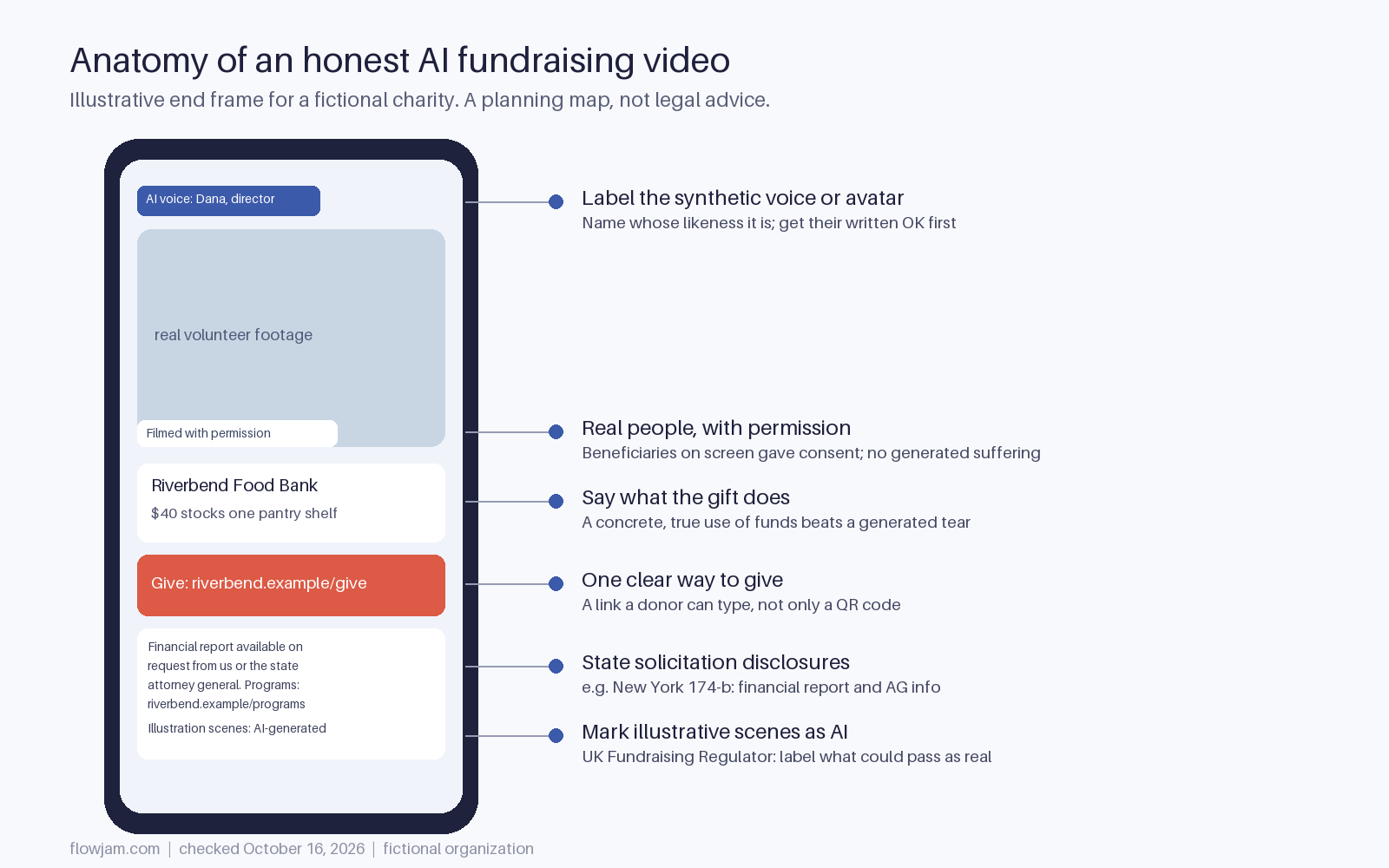
Myth 3: a donation video skips the disclosures a letter carries
State charitable solicitation laws were written around mail and phone, but most apply to any solicitation. New York's Executive Law 174-b is a good example. A registered charity's solicitation has to say that its last financial report is available on request from the organization or the attorney general, describe the programs the money funds or offer that description on request, and point people to the attorney general's charities website and phone number. For written materials the statement must be conspicuous, in print no smaller than ten-point bold.
The statute doesn't carve out video. Our practice is to treat a fundraising video like a written solicitation, so the disclosure goes on the end card at a readable size and stays on screen long enough to read, with the full text on the donation page the video links to. Other states have their own wording, so check the ones where you're registered.
This is the myth that costs nothing to fix. Build the disclosure into the end-card template once and every AI-generated version inherits it.
Is it legal for a nonprofit to send AI voice calls or voicemails?
Partly, and the split matters. In February 2024 the FCC ruled that AI-generated and cloned voices are artificial voices under the Telephone Consumer Protection Act, so every robocall rule applies to them.
Tax-exempt nonprofits do get a carve-out, but it's narrow. Under 47 CFR 64.1200(a)(3)(iv), a nonprofit can make prerecorded or artificial-voice calls to a residential landline without consent if it makes no more than three such calls in any 30 days and honors opt-out requests. The exemption doesn't reach cell phones. Calls to a mobile number with an artificial voice need the person's prior express consent, and many donor lists are mostly mobile numbers.
So the cloned-director voicemail drop to the whole list is the one format we'd tell a charity not to run. A personalized video thank-you sent by email or text to donors who gave you their number for that purpose gets the same warmth without the robocall exposure. If you're sending texts, check those consent rules too, because the TCPA covers automated texts as well.
This page explains rule text and isn't legal advice. Charity regulation varies by state and country, so your counsel has the final say.
Myth 4: AI video for nonprofits is mainly for the big appeal
Teams reach for AI to make the year-end emotional appeal, which is the one video where real footage of real people matters most. The tools are better at the unglamorous work around it.
The jobs we'd hand to AI first are personalized thank-you videos to every first-time donor within a day of the gift, dubbed or translated versions of a real interview for the communities you serve (our AI video translation tools roundup compares the options), volunteer orientation and training clips that change every season, and a board or annual report recap built from your own numbers.
None of those need a synthetic beneficiary, and all of them used to go unmade because nobody had the hours.
Here's the rewrite we'd make on a typical AI-drafted appeal opening. The numbers are illustrative.
- Before: "In a world where hunger knows no borders, one child's tears can change everything. Will you be the hero she needs?"
- After: "Last Tuesday, 212 families picked up groceries at our Eastside pantry. Forty dollars restocks one shelf. Here's what that shelf looked like at 6 p.m."
The first version is what a model produces when you ask for emotion. The second only works if you have the real number and the real shelf, which is the point.
Myth 5: an avatar of the founder can stand in for the founder
An avatar of your executive director, trained on a few minutes of footage, is a reasonable way to deliver routine updates, event reminders and program explainers in several languages. Get her written consent, label it, and agree in writing what happens to the avatar when she leaves. Our AI avatar tools roundup compares how the main tools handle consent and access.
What an avatar can't do is ask a major donor for a gift. The objection we hear from development staff is that donors can tell, and for anyone giving at a level where they'd expect a phone call, that objection is right. Use AI for volume and reach, and keep the asks that depend on a relationship in the director's own unedited voice.
For the production side, our guide to making AI videos covers the workflow from script to export. Flowjam builds nonprofit video templates with the disclosure end card, AI labels and donate link locked in, so every version a volunteer makes, in any language, ships with them.
AP
About the author
Adam Petty
Founder, Flowjam
Adam is the founder of Flowjam, where he helps startups turn ideas into launch videos, product demos, and ads with AI video. He writes about AI video production, creative workflows, and go-to-market for early-stage teams.
Frequently asked questions
Can nonprofits use AI-generated video for fundraising?
Yes. No US law bans AI video in charitable fundraising. State charitable solicitation rules still apply to the video, and the UK Fundraising Regulator's December 2025 guidance asks charities to label AI-generated content that donors could mistake for real people or situations.
Should charities use AI-generated images of beneficiaries?
We advise against photoreal AI images of people in need. In October 2025 The Guardian reported researcher Arsenii Alenichev's collection of more than 100 AI-generated poverty images used in campaigns, criticized as stereotyped and used partly to avoid consent. Use real beneficiaries with informed consent, and keep AI for maps, diagrams, translation and clearly labeled illustration.
How should a nonprofit label AI-generated video?
Put a short label on the scene itself when it first appears, for example: AI avatar of the executive director, used with her permission, or Illustration: AI-generated, not a real family. A note in the video description alone is not enough for most viewers.
Do fundraising videos need state solicitation disclosures?
Often, yes. New York Executive Law 174-b requires a registered charity's solicitations to say its latest financial report is available on request, describe its programs or offer that description, and identify the attorney general's charities website and phone number. Treat a video like a written solicitation and put the disclosure on the end card.
Can a nonprofit send AI voice robocalls to donors?
Only within narrow limits. The FCC ruled in February 2024 that AI voices are artificial voices under the TCPA. Tax-exempt nonprofits may call residential landlines with an artificial voice up to three times in 30 days if they honor opt-outs, but calls to cell phones need prior express consent.
What are the best uses of AI video for nonprofits?
Personalized donor thank-you videos, dubbed or translated versions of real interviews, volunteer training clips, program explainers and annual report recaps. These use AI for volume without inventing the people the charity serves.
Can we make an AI avatar of our executive director?
Yes, with her written consent, an on-screen AI label and a written agreement on what happens to the avatar when she leaves. Keep major-gift asks in her real voice.





Launch videos for
moon-shot founders.

About
We're a video production studio partnering with AI founders and startups. We make launch videos to show the world what you're building.
London / San Francisco
Made with love from London / San Francisco. Collaborating with clients worldwide.
Contact
Adam Petty
Founder
adam@flowjam.com
Founder
adam@flowjam.com