
Viral launch videos for moon-shot founders 🌸
Flowjam partners with AI founders and startups aiming for the moon, to create story-driven launch videos to build hype and show the world what they're building.

Full PortfolioBlog
Flowjam works with some of the most successful AI founders in the world after only launching in 2023.
Copyright 2026. Flowjam Ltd.
Copyright 2026. Flowjam Ltd.
AI Video for Hotels: What to Automate and the FTC Total-Price Rule
Hotels can use AI video for pre-arrival guides, translations and staff training. Room footage must be real, and any price shown must be the total under the FTC fee rule.

Hotels should hand most of their video to AI and keep two things out of its reach: the room itself, and any price on screen.
A 15-second reel says "ocean-view king from $189" and the booking engine adds a $35 resort fee at checkout. Since May 12, 2025 the FTC has required hotels to advertise the total price, fees included, so that reel breaks a federal rule. The AI tool that cut it in four minutes has no idea.
Everything else is open, and there's a lot of it. A property repeats the same explanations to every guest, in a dozen languages, and retrains staff every season. That's the work AI video does best.
Which hotel videos to hand to AI
Sort by one question: does the guest decide to book based on what the video shows? If no, AI can make most of it. If yes, the pictures have to be the real property.
| Video | What AI can do | What stays real |
|---|---|---|
| Pre-arrival guide (parking, check-in, Wi-Fi) | Script, voice, avatar host, every language | Shots of the actual entrance and lobby |
| Translated guest information | Dubbing and lip sync from one English master | A staff check of each language |
| Housekeeping and front-desk training | Nearly all of it | Your own room standards and procedures |
| Local area guide | Script, edit, captions | Places that exist, at their real distance |
| Room and amenity reels | Camera moves on approved photos, cuts, music | The room, view, pool and size |
| Guest testimonials | Captions and trims of real clips | The guest, the words, the stay |
The order we'd build in: the pre-arrival guide first, because it cuts front-desk calls on day one. Then translations of that same guide. Then staff training, which every property reshoots each spring anyway. Our AI training video generator guide covers that workflow, and the AI video translation tools roundup compares the dubbing options.
Room reels come last, and only from photos you already own.
If you want the pre-arrival guide and its translations done this week, Flowjam builds hotel video from your own photos and scripts, with the total-price frame ready for any reel that quotes a rate.
If the video shows the room, the room has to be real
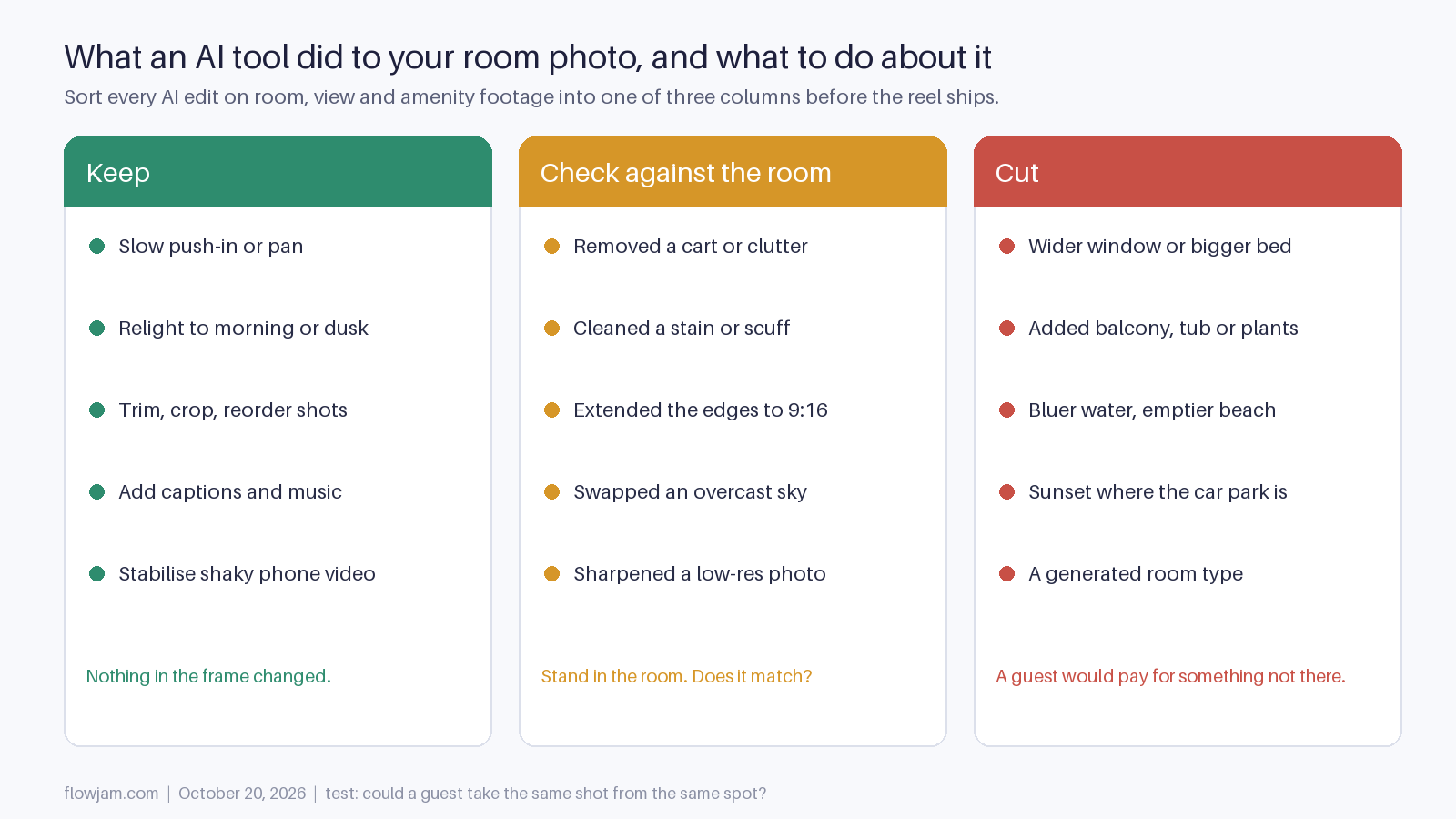
Image-to-video tools will happily turn a still of your standard queen into a slow push-in with morning light. That's fine. The same tools will also widen the window, add a balcony, blue the water and drop a sunset where the parking lot is. That isn't.
The FTC's policy statement on deception asks whether a representation is likely to mislead a reasonable consumer about something material. A traveler choosing a room on the view is the textbook case. No rule names AI room imagery yet, and none needs to.
So the rules we'd hand an editor are short:
- If the tool only moves the camera, relights or trims, keep it.
- If the tool adds or removes anything in the frame, compare the result to the room before it ships.
- If a guest couldn't take the same shot from the same spot, cut it.
- If a room type has no photo yet, show the floor plan, not a generated room.
The photo-to-video workflow itself is in our AI video generator from photo guide.
If a price appears on screen, show the total
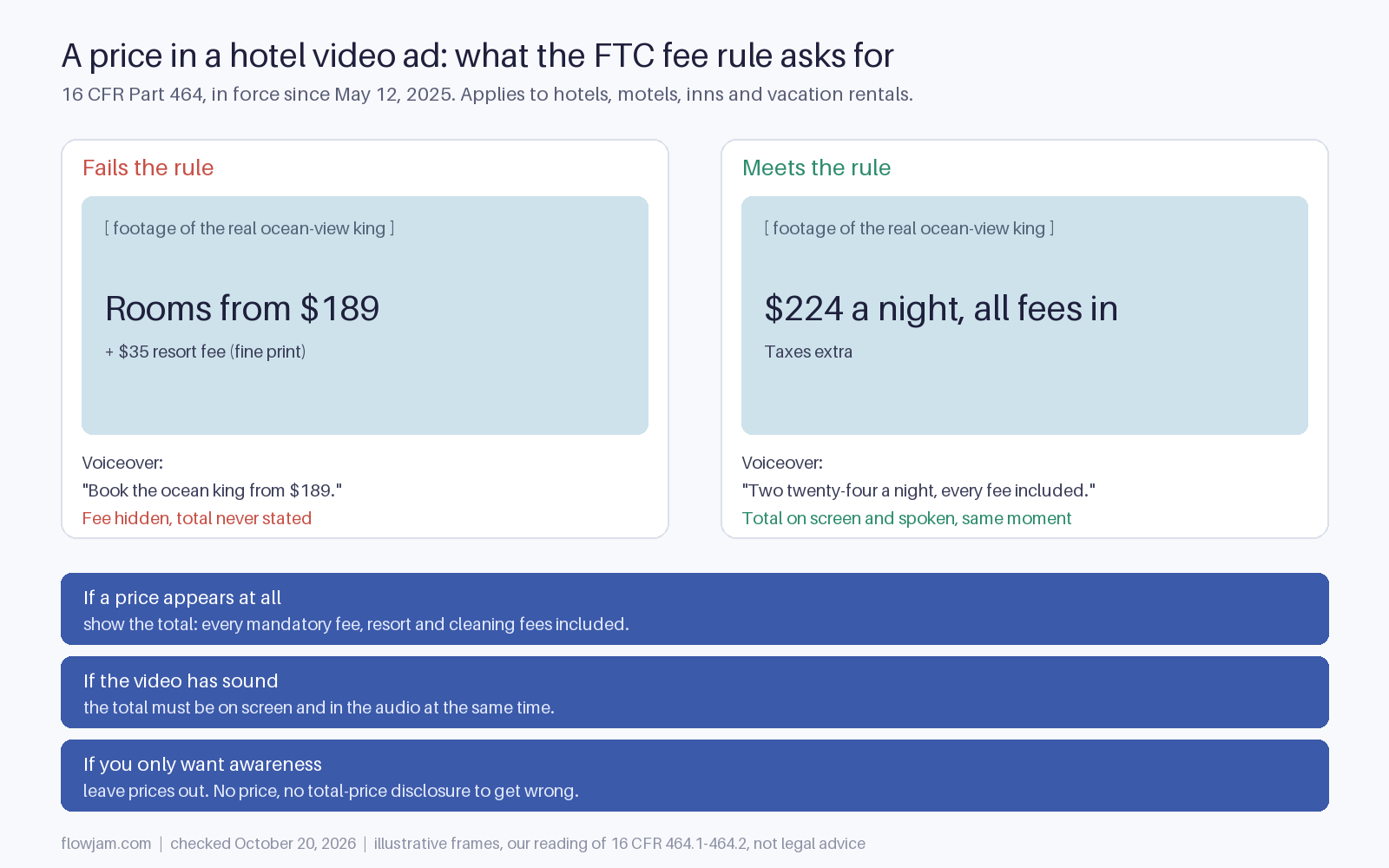
The FTC's Rule on Unfair or Deceptive Fees covers short-term lodging, which 16 CFR 464.1 defines as a hotel, motel, inn, short-term rental, vacation rental or other place of lodging. Under 464.2, any business that offers, displays or advertises a price has to disclose the total price clearly and conspicuously, and more prominently than the other pricing information.
The total is everything the guest must pay, resort, destination and cleaning fees included. Government taxes and optional extras can sit outside it.
The line most hotel video teams miss is in the definition of clearly and conspicuously. In a communication that is both visual and audible, "such as a television advertisement", the disclosure has to be presented in both the visual and audible portions at the same time, "even if the representation requiring the disclosure is made in only one means." Put a price on screen in a reel with a voiceover and the total has to be spoken too.
Two more traps. Section 464.3 bans misrepresenting any fee, so an AI voiceover that calls a mandatory resort fee "optional amenities" is its own violation. And the rule covers third parties too, so the number in your ad has to match what the online travel agency and your own booking engine charge. The FTC's fee rule FAQ answers the edge cases.
The cleanest option for a brand or awareness reel is to leave prices out entirely. No number, nothing to disclose.
AI guests are fake reviews
A smiling couple raving about the spa, generated from a prompt, is a testimonial from someone who doesn't exist. The FTC's 2024 rule on consumer reviews bans exactly that, including AI-generated reviews and testimonials, with civil penalties per violation.
Use real guests who signed a release. AI can still caption their clip, trim it and translate it, as long as the words stay theirs.
Staff avatars at the front desk
An avatar of your real general manager welcoming guests in the pre-arrival video works well, and it's the one avatar use we'd push hotels toward. Get written consent, approve every script, and settle what happens to the avatar when that manager leaves. Our AI avatar tools roundup compares how the main tools handle consent and deletion.
Skip the avatar that answers booking questions live in the manager's face. Guests can't tell which answers a person stands behind.
For the production steps, our guide to making AI videos runs from script to export. If you'd rather start from hotel templates with the total-price frame and caption check built in, Flowjam makes those.
The case we'd still watch is the dynamic ad, where a feed swaps tonight's rate into the same AI-made video. The rate changes hourly and the voiceover was recorded once, so the spoken total is the part that breaks first.
AP
About the author
Adam Petty
Founder, Flowjam
Adam is the founder of Flowjam, where he helps startups turn ideas into launch videos, product demos, and ads with AI video. He writes about AI video production, creative workflows, and go-to-market for early-stage teams.
Frequently asked questions
Can hotels use AI-generated video in marketing?
Yes. Pre-arrival guides, translated guest information, staff training and local area guides are all good uses. Footage that shows the room, view or amenities a guest is booking should be the real property, with AI limited to camera moves, relighting and edits.
Does the FTC junk fee rule apply to hotel video ads?
Yes, if the video shows or says a price. The FTC Rule on Unfair or Deceptive Fees (16 CFR Part 464), in force since May 12, 2025, covers short-term lodging and requires the total price, including mandatory resort, destination and cleaning fees, to be disclosed clearly and conspicuously and more prominently than other pricing.
Does the total price need to be spoken in a video ad?
Under 16 CFR 464.1, a disclosure in a communication that is both visual and audible must appear in both portions at the same time, even if the price is only shown in one. A price on screen in a video with a voiceover means the total should be said aloud too.
Can taxes be left out of the total price?
Yes. Government charges and optional extras can be excluded from the total price. Mandatory fees the hotel charges, such as resort or cleaning fees, cannot.
Can a hotel use AI to enhance room photos for video?
Camera moves, relighting and trims are fine. Adding or removing anything in the frame, such as a bigger window, a balcony or a better view, risks misleading guests about something they are paying for. Compare any generated frame to the real room before publishing.
Can hotels use AI-generated guest testimonials?
No. The FTC's 2024 rule on consumer reviews and testimonials bans fake reviews, including AI-generated testimonials from people who don't exist. Use real guests with a signed release.
What AI hotel video should a property make first?
A pre-arrival guide covering parking, check-in and Wi-Fi, then translated versions of the same guide, then staff training. These save front-desk time immediately and carry no pricing or imagery risk.





Launch videos for
moon-shot founders.

About
We're a video production studio partnering with AI founders and startups. We make launch videos to show the world what you're building.
London / San Francisco
Made with love from London / San Francisco. Collaborating with clients worldwide.
Contact
Adam Petty
Founder
adam@flowjam.com
Founder
adam@flowjam.com