
Viral launch videos for moon-shot founders 
Flowjam partners with AI founders and startups aiming for the moon, to create story-driven launch videos to build hype and show the world what they're building.

Full PortfolioBlog
Flowjam works with some of the most successful AI founders in the world after only launching in 2023.
Copyright 2026. Flowjam Ltd.
Copyright 2026. Flowjam Ltd.
How to Write a Launch Tweet: Line One Is the Product
A good launch tweet says what the product does in line one, attaches a native video, puts the link in the first reply and ends on a question people answer.

Most launch tweets open with "Excited to announce". That line is about you, and the stranger scrolling past doesn't know you yet.
We make launch videos at Flowjam, so we read a lot of launch posts the night before they go out. The ones that work all do four things.
- Line one says what the product does and who it is for.
- A native video is attached, showing the product working.
- The link sits in the first reply, not the post.
- The last line is a question your users actually want to answer.
What the first line of a launch tweet has to do
The first line has to answer one question: what does this do, and for whom? If someone reads only that line and scrolls on, they should still know.
If your product has a clear before and after, put both in the line. "Closes your books in 20 minutes instead of 3 days" beats "the future of accounting" because the reader can check it against their own month.
If the product is new enough that there's no before, name the job instead. "Turns a Figma file into a working landing page" tells people what to expect when they tap the video.
If you're tempted to open with the team, the funding or the 18 months it took, move that to the second reply. People who care will find it there. People who don't won't see it get in the way.
Leave out the exclamation marks, the rocket emoji and the word "revolutionary". None of them break the post, but each one makes it look like every other launch that day.
One post, a thread or a long post
Default to one post with a video, plus a short run of replies underneath. A launch is one idea, and one post is the format that forces you to state it.
If you can say it in 280 characters, use one post. That's the standard limit, and a launch line that needs more usually hasn't been decided yet.
If you have Premium, you can write much longer posts (X help center), but the timeline still shows only the opening and hides the rest behind "Show more". So a long post only helps if the opening would have worked as a post by itself.
If you want to explain how it works, use a thread, but treat post one as the whole launch. Far fewer people open a thread than see its first post, and the ones who do already liked post one. Our guide to founder threads covers the format in more depth.
Whatever you pick, attach the video to the first post, uploaded as a file rather than linked. Native video autoplays in the timeline (X help center), while a YouTube link shows up as a card nobody presses play on. The specs are in our post on the X launch video.
Where the link goes
Put the link in the first reply, not in the launch post. In November 2024 Elon Musk said X's algorithm gives links less attention because people spend less time on X when they click away, and told users to write the description in the main post and put the link in the reply (Business Today).
X's stance on links has moved around since then, and nobody outside the company can tell you exactly how much a link costs on any given day. We'd still put it in the reply. Moving it costs you nothing, and the launch post reads better without a URL in it.
Write the first reply before you post the launch, so you can drop it in within seconds. Give it one line of context and the link: "Try it free here, no card needed: [link]". Then pin the launch post to your profile so anyone who visits from a repost lands on it.
A launch tweet rewritten, start to finish
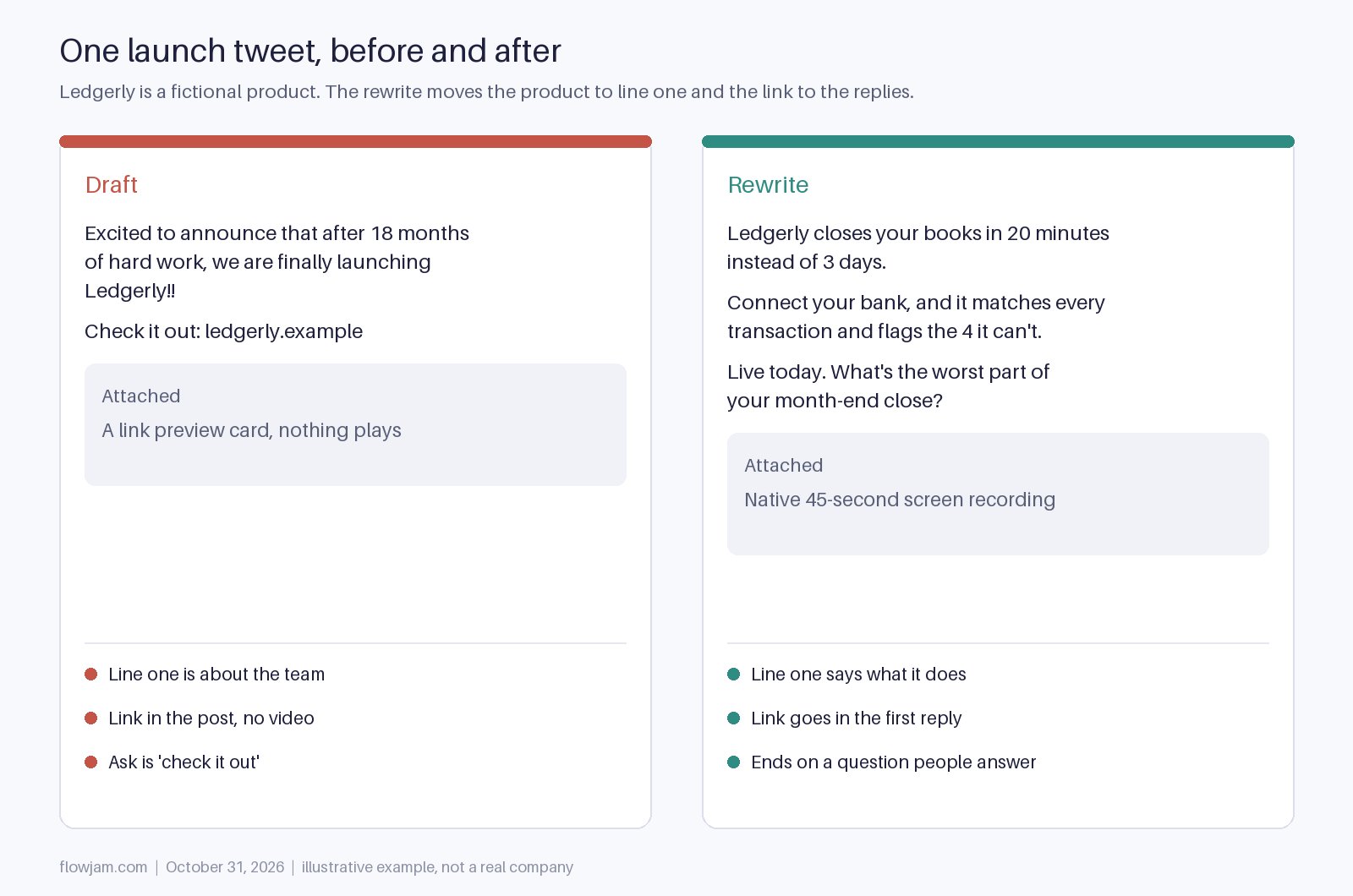
Here's a draft in the shape most launch posts take, for a fictional accounting product called Ledgerly.
"Excited to announce that after 18 months of hard work, we are finally launching Ledgerly!! Check it out: ledgerly.example"
Nothing in it is wrong exactly. But line one is about the team, the reader learns nothing about what Ledgerly does, the link sits in the post and there's no video. The only thing it asks the reader to do is "check it out", which nobody does.
The rewrite:
"Ledgerly closes your books in 20 minutes instead of 3 days. Connect your bank, and it matches every transaction and flags the 4 it can't. Live today. What's the worst part of your month-end close?"
Attached is a 45-second screen recording of a real close. The link goes in the first reply. The 18 months and the team thank-you go in reply two.
The line people react to most is usually the one with a number in it. Only use a number you can show in the video. If the video shows a 20-minute close, say 20 minutes. If you can't show it, cut it.
End on a question, then stay in the replies
The last line is your ask, and on X the best ask is a reply. When X open-sourced its ranking model in 2023, the published weights put a reply at 13.5 and a like at 0.5. A reply that the author then engaged with was weighted 75 (the-algorithm-ml). Those are 2023 numbers and X has changed things since, but the direction hasn't changed much: conversation travels further than applause.
So ask something your users have a real answer to. "What's the worst part of your month-end close?" gets answers. "Thoughts?" gets silence, and "RT appreciated" gets a few pity reposts.
Then block out the first hour and answer every reply yourself, with something more than "thanks!". That's where the 75 comes from. The full playbook for launching on X covers what to line up around the post, from reposters booked in advance to the hours after.
The most common reason a good launch post goes out weak is that the video wasn't ready, so it ships with a screenshot instead. That's the part we handle: a captioned X cut and a short ad version, built from your product and your launch date.
When to break these rules
If you already have a large, warm audience, "It's live." with a video can outperform everything above, because people already know what you're building and have been waiting for it. The rules here are for founders whose launch post is going to strangers, which is most of us.
And if your product is genuinely hard to explain in a line, don't force a slogan. Show it. A video that makes the job obvious in three seconds plus a plain first line like "Here's what we built" beats a clever line that's wrong about what the product does.
AP
About the author
Adam Petty
Founder, Flowjam
Adam is the founder of Flowjam, where he helps startups turn ideas into launch videos, product demos, and ads with AI video. He writes about AI video production, creative workflows, and go-to-market for early-stage teams.
Frequently asked questions
What should a launch tweet say?
Say what the product does and for whom in the first line, attach a native video showing it working, and end on a question your users can answer. A quick test: cover everything but line one and ask a friend what the product does. If they can't say, rewrite line one.
Should I put the link in my launch tweet or in the reply?
In the reply. In November 2024 Elon Musk said X gives posts with links less attention and suggested putting the description in the main post and the link in a reply. X's handling of links has shifted since, but moving the link costs nothing. Post the reply within a minute of the launch post so early visitors find it.
Is a thread or a single post better for a product launch on X?
A single post with a native video, followed by a few replies, works for most launches. If you use a thread, treat post one as the whole launch, because most readers never open the rest.
How long should a launch tweet be?
Keep it within the standard 280 characters, and in our view shorter is better: three short lines read faster than one dense block on a phone. Premium accounts can post longer, but the timeline hides everything past the opening behind Show more.
What is a good call to action for a launch tweet?
A specific question your users have a real answer to, such as the worst part of the problem your product solves. Avoid "Thoughts?" and "RT appreciated". Replies count for far more than likes in the ranking weights X open-sourced in 2023, and answering them yourself counts for more still.
Should I pin my launch tweet?
Yes. You can pin one post at a time, so pin the launch post on launch day and anyone who arrives from a repost or a mention lands on it. Swap it out at your next real update, not the next day.





Launch videos for
moon-shot founders.

About
We're a video production studio partnering with AI founders and startups. We make launch videos to show the world what you're building.
London / San Francisco
Made with love from London / San Francisco. Collaborating with clients worldwide.
Contact
Adam Petty
Founder
adam@flowjam.com
Founder
adam@flowjam.com