
Viral launch videos for moon-shot founders 
Flowjam partners with AI founders and startups aiming for the moon, to create story-driven launch videos to build hype and show the world what they're building.

Full PortfolioBlog
Flowjam works with some of the most successful AI founders in the world after only launching in 2023.
Copyright 2026. Flowjam Ltd.
Copyright 2026. Flowjam Ltd.
AI Video for Supplement Brands: Five Claim Myths That Get Ads Pulled
AI video for supplement brands: make ingredient and how-to-take videos first, keep claims to structure/function, and never present an avatar as a customer.

AI video generators write supplement ads like the ones that get warning letters. That is the whole problem, and it isn't the tool's fault: it learned from them. Supplement brands still need a lot of video. Every SKU wants an ingredient explainer, a how-to-take clip, a subscription reminder and six ad variants a week for Meta and TikTok.
The tools handle that volume fine. What they don't handle is the claim line. Here are five common beliefs about AI supplement video, and what the FDA, the FTC, Meta and TikTok actually say.
Myth 1: AI video for supplement brands is mainly for ads
The best first use isn't an ad at all. It's the content your customers ask support about: what's in it, when to take it, whether it goes with food, how long before they notice anything, how to pause the subscription. Those videos repeat across every SKU, change when the formula changes, and carry far less claim risk than a paid spot.
Our order for a new brand is ingredient explainers first, then how-to-take videos for each product page, then onboarding emails for subscribers, and paid ads last. By the time you write ad scripts, you have a library of approved, evidence-backed language to build them from. That library is the asset. The ads are just new cuts of it.
That's the setup Flowjam is built for: one approved script per product, one consistent presenter, and every version from a 15-second Reel to a 90-second product-page explainer cut from it. Approve the words once, and every cut says the same thing.
Myth 2: The FDA disclaimer makes any supplement claim safe
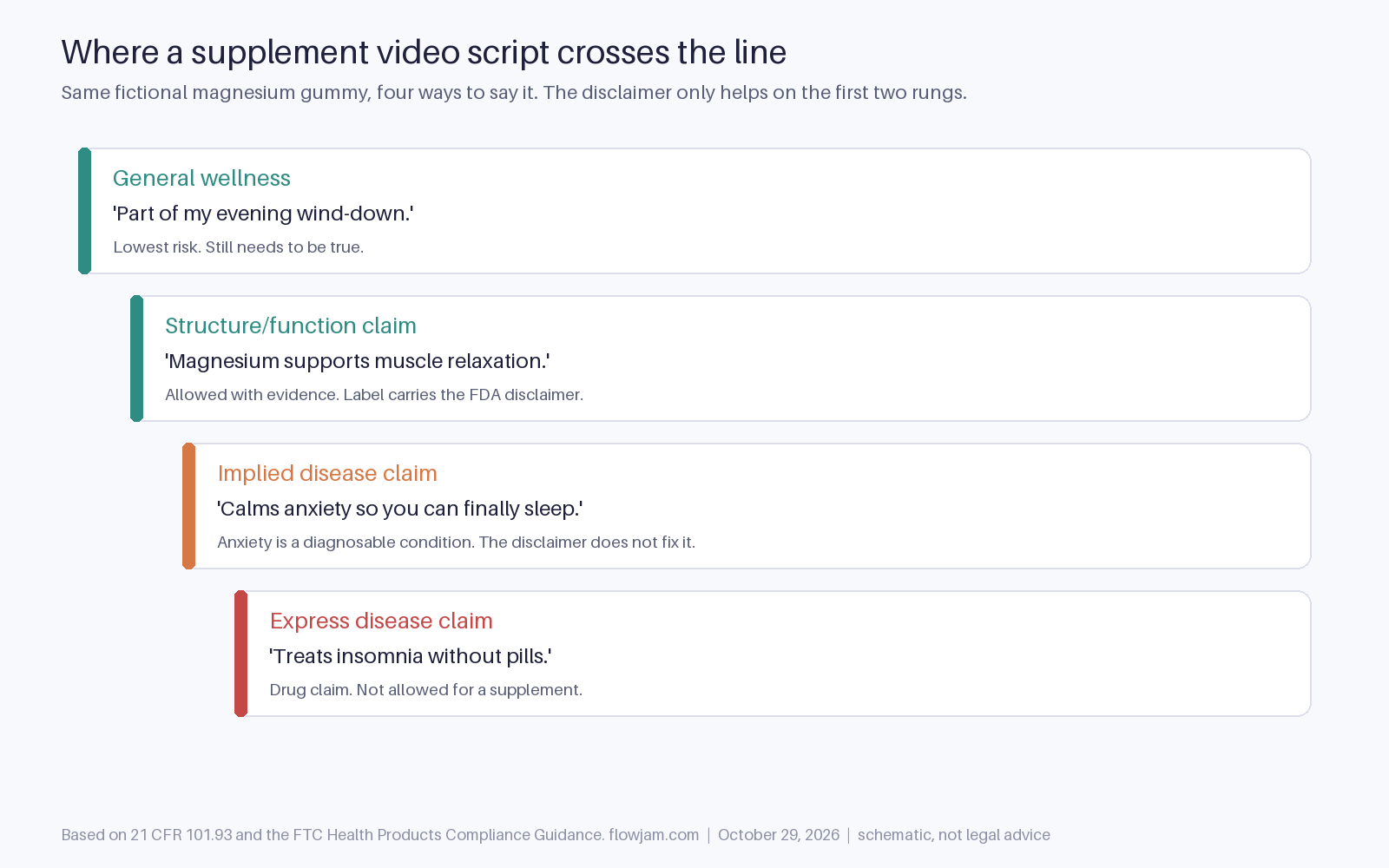
It doesn't, and this is the one that gets brands in real trouble. The familiar line, "This statement has not been evaluated by the Food and Drug Administration. This product is not intended to diagnose, treat, cure, or prevent any disease", goes with structure/function claims on labels and labeling (21 CFR 101.93). It lets you say magnesium supports muscle relaxation. It does nothing for a script that says your gummy calms anxiety or fixes insomnia. Those are disease claims, and a supplement can't make them with or without the disclaimer.
The FTC is even blunter about ads: the disclaimer "won't cure an otherwise deceptive ad" (FTC Health Products Compliance Guidance).
AI tools drift up the ladder without being asked. Ask for something "more emotional" and "supports a restful evening" becomes "finally beat your sleepless nights". Lock the claim wording before you generate anything, and treat any new benefit in a variant as a rewrite that needs review. Our guide to making AI videos shows where in the workflow to lock it.
Myth 3: Label approval covers your video ads
The label and the ad answer to different agencies. FDA polices the label. The FTC polices the ad, and its standard is competent and reliable scientific evidence, which for health benefit claims generally means randomized, controlled human trials (FTC). Animal studies, different doses and reviews don't count.
Video also makes claims a label never would. A presenter rubbing their temples, then smiling after a gummy, is a claim about headaches whether anyone says the word or not. Review the shot list as well as the voiceover. AI-generated b-roll is where implied claims sneak in, because nobody wrote them down.
Myth 4: An AI avatar testimonial isn't really a testimonial
It is if it talks like a customer. Under the FTC's Endorsement Guides, an ad that presents people as actual consumers should use actual consumers, or clearly say they aren't (16 CFR 255.2(c)). An avatar saying "I've taken these for three months and I sleep through the night" is a consumer endorsement from someone who doesn't exist. Under the FTC's newer rule that's a fake consumer review, and the rule names AI-generated reviews specifically (16 CFR 465.2).
Even real testimonials have a catch. A customer's result is read as what buyers will generally get, so if your best reviewer lost far more weight than most people do, the ad has to disclose what's typical (16 CFR 255.2(b)). "Results not typical" on its own doesn't do it, per the FTC guidance.
Avatars work well as a narrator or a brand host who explains the ingredient and never claims to have taken it. Keep them on that side of the line, and label them as AI.
Myth 5: Meta and TikTok ban supplement video ads
They restrict them, which is different. Meta requires ads for dietary, health, weight loss or weight gain products to target people 18 and over. Within that, it allows ads that show people using the product and its effect, as long as they clearly indicate how long it took to see results, and it bans statements of inferiority about appearance and close-ups pinching body fat (Meta).
TikTok allows weight loss supplements in the US with the same 18-plus rule for weight loss or muscle gain claims. It prohibits saying the product works without diet or exercise, and bans ads that shame bodies or tie confidence and desirability to appearance (TikTok).
For AI video that turns into two practical rules. Never let a generator invent a before-and-after: a synthetic transformation is a made-up result, whatever the platform permits. And build the 18-plus targeting into the campaign template rather than trusting someone to remember it per ad.
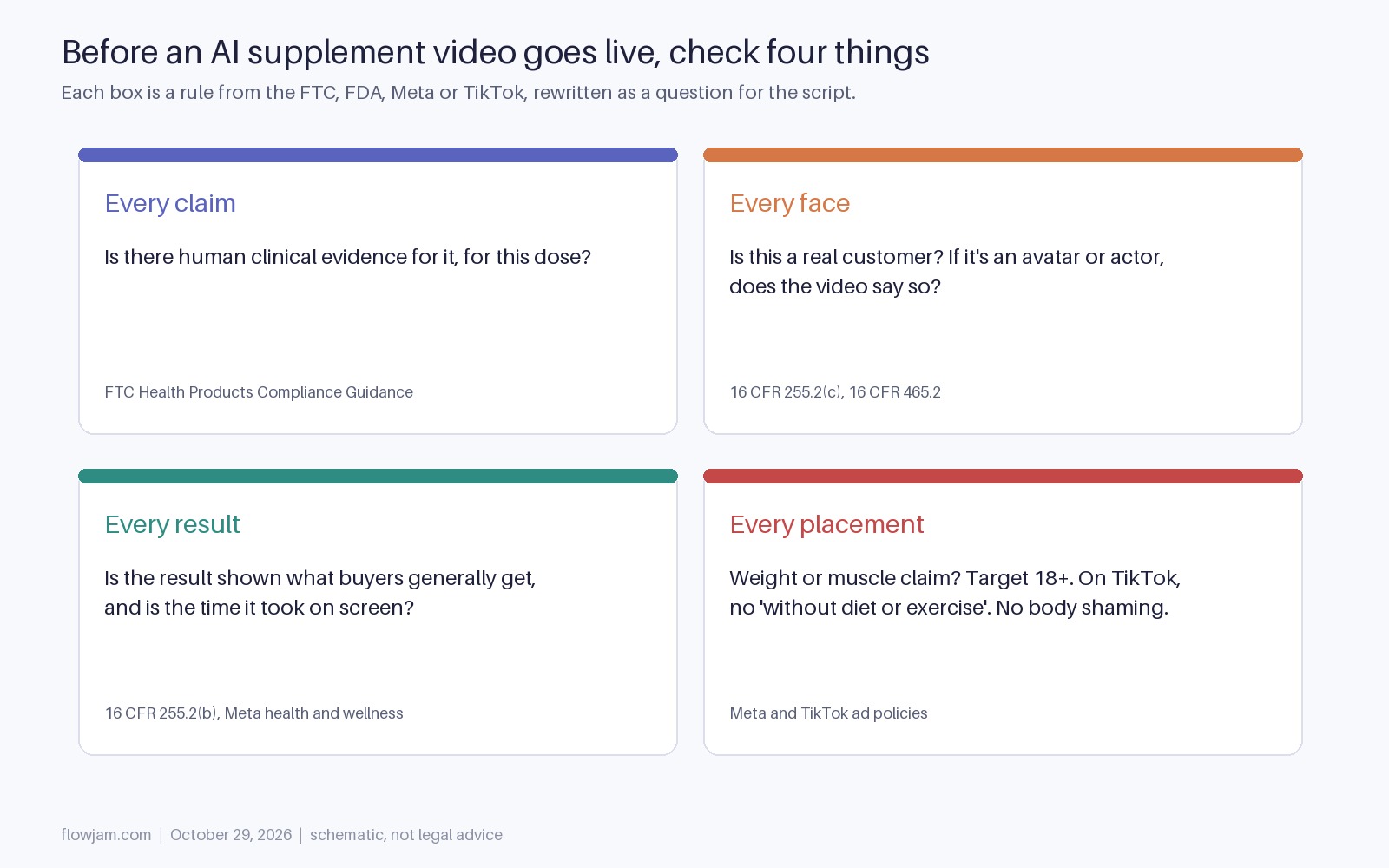
Here is a 20-second how-to-take script that clears all four, for a fictional brand, Halewell Magnesium Gummies. The presenter is an AI host, labeled as AI in the caption.
"Halewell magnesium, two gummies with dinner." On screen: two gummies on a plate. "Magnesium supports normal muscle function and relaxation." Asterisk to the disclaimer on screen. "Take it daily. Most people build it into their evening routine." On screen: "Questions? Ask your doctor if you take medication."
Nothing about anxiety, insomnia or how fast you'll feel it. It's less exciting than the version a generator writes on its own. It's also the version that's still running in six months. Boring claims, bold creative: that's the trade.
If you want that library built for your range, send Flowjam one product page and its approved claims. You get back the how-to-take video, the product-page explainer and the ad cuts, all using the same locked wording, ready for your reviewer.
For the broader ad playbook see our hub on AI video ads, and for regulated health content AI video for healthcare. If you sell on Amazon too, AI video for Amazon sellers covers its moderation rules, and our AI video for fitness post covers body-image rules from the gym side.
AP
About the author
Adam Petty
Founder, Flowjam
Adam is the founder of Flowjam, where he helps startups turn ideas into launch videos, product demos, and ads with AI video. He writes about AI video production, creative workflows, and go-to-market for early-stage teams.
Frequently asked questions
Can supplement brands use AI-generated video in ads?
Yes. No US rule bans AI video for supplements. The usual rules still apply: claims need competent and reliable scientific evidence under FTC guidance, disease claims are off limits, avatars can't pose as real customers, and Meta and TikTok require 18-plus targeting for weight-related claims.
Does a supplement video ad need the FDA disclaimer?
The FDA disclaimer rule at 21 CFR 101.93 applies to structure/function claims on labels and labeling. Many brands add it to video ads too, which is sensible. But the FTC says the disclaimer won't cure an otherwise deceptive ad, and it never makes a disease claim allowable.
What's the difference between a structure/function claim and a disease claim?
A structure/function claim describes how an ingredient affects normal body function, such as magnesium supports muscle relaxation. A disease claim says or implies the product diagnoses, treats, cures or prevents a disease, such as treats insomnia or reduces anxiety. Supplements can make the first with evidence, never the second.
Can an AI avatar give a testimonial for a supplement?
No, not as a customer. FTC Endorsement Guides say ads presenting people as actual consumers must use actual consumers or clearly disclose that they aren't, and the FTC fake reviews rule covers AI-generated reviews. Use avatars as narrators or hosts, labeled as AI.
Can supplement ads show before-and-after results on Meta?
Meta allows ads targeted to people 18 and over to show the product's effect if they clearly indicate the time taken to see results, but bans statements of inferiority and close-ups pinching body fat. Never use an AI-generated transformation, since that's a fabricated result.
Are weight loss supplement ads allowed on TikTok?
In the US, yes, with restrictions. Weight loss or muscle gain claims must target people 18 and over, ads can't say the product works without diet or exercise, and ads can't shame bodies or suggest appearance determines confidence or desirability.
What AI videos should a supplement brand make first?
Ingredient explainers and how-to-take videos for each product page, then subscriber onboarding. They answer the questions support gets most, carry less claim risk than ads, and give you a library of approved language to build ad scripts from.





Launch videos for
moon-shot founders.

About
We're a video production studio partnering with AI founders and startups. We make launch videos to show the world what you're building.
London / San Francisco
Made with love from London / San Francisco. Collaborating with clients worldwide.
Contact
Adam Petty
Founder
adam@flowjam.com
Founder
adam@flowjam.com