
Viral launch videos for moon-shot founders 
Flowjam partners with AI founders and startups aiming for the moon, to create story-driven launch videos to build hype and show the world what they're building.

Full PortfolioBlog
Flowjam works with some of the most successful AI founders in the world after only launching in 2023.
Copyright 2026. Flowjam Ltd.
Copyright 2026. Flowjam Ltd.
AI Video for Banks and Credit Unions: What to Make First and How to Stay Compliant
AI video for banks and credit unions: start with how-tos and scam education, then add Member FDIC or NCUA, APY and APR wording to any promotional video.

Most of the video a bank or credit union needs is not advertising. It's how to set up direct deposit, how to dispute a card charge, what to do when the app locks you out, and what a scam call sounds like.
That is the work AI video is good at, and none of it carries the disclosure rules that make bank marketing slow. The rules start the moment a script promotes an account, says a rate or quotes a payment. The useful question is which videos to make first, and what each one has to say on screen. Our short version: teach with AI freely, and sell with it only behind a locked disclosure.
What should a bank or credit union make with AI video first?
Start where the volume is and the rules are lightest. Member service questions repeat all month, the answers change whenever the app changes, and re-filming a branch employee every time a button moves is why most institutions never made these videos in the first place.
| Video | AI fit | What it has to include |
|---|---|---|
| App and online banking how-tos | Strong. Screen recording plus an AI voice, regenerated when the app changes | Captions. No rates, no account promotion |
| Scam and fraud education | Strong, if disclosed | How the institution really contacts members, said out loud |
| Staff training (BSA, new systems, onboarding) | Strong. Internal, nothing published | Sign-off from whoever owns the procedure |
| Branch or product explainers on the website | Good | The official statement if it promotes deposit accounts |
| Savings or CD rate ads | Good, with a locked end card | Official statement, APY wording, minimum balance, fee statement |
| Loan and card ads | Good, with a locked end card | Rate as APR, plus trigger-term disclosures |
| Member testimonials | No | Film real members who agreed to it |
If you only have budget for one project this quarter, make the ten how-to videos your call center gets asked about most. They pay back in shorter calls, nobody in compliance has to read a rate disclosure, and you learn how the tool handles your brand before anything goes on paid media.
If you want to see what that first batch looks like for your own app, Flowjam turns a script and a screen recording into a finished, captioned how-to video, with one presenter and voice kept the same across the whole series.
When does the video need Member FDIC or Federally insured by NCUA?
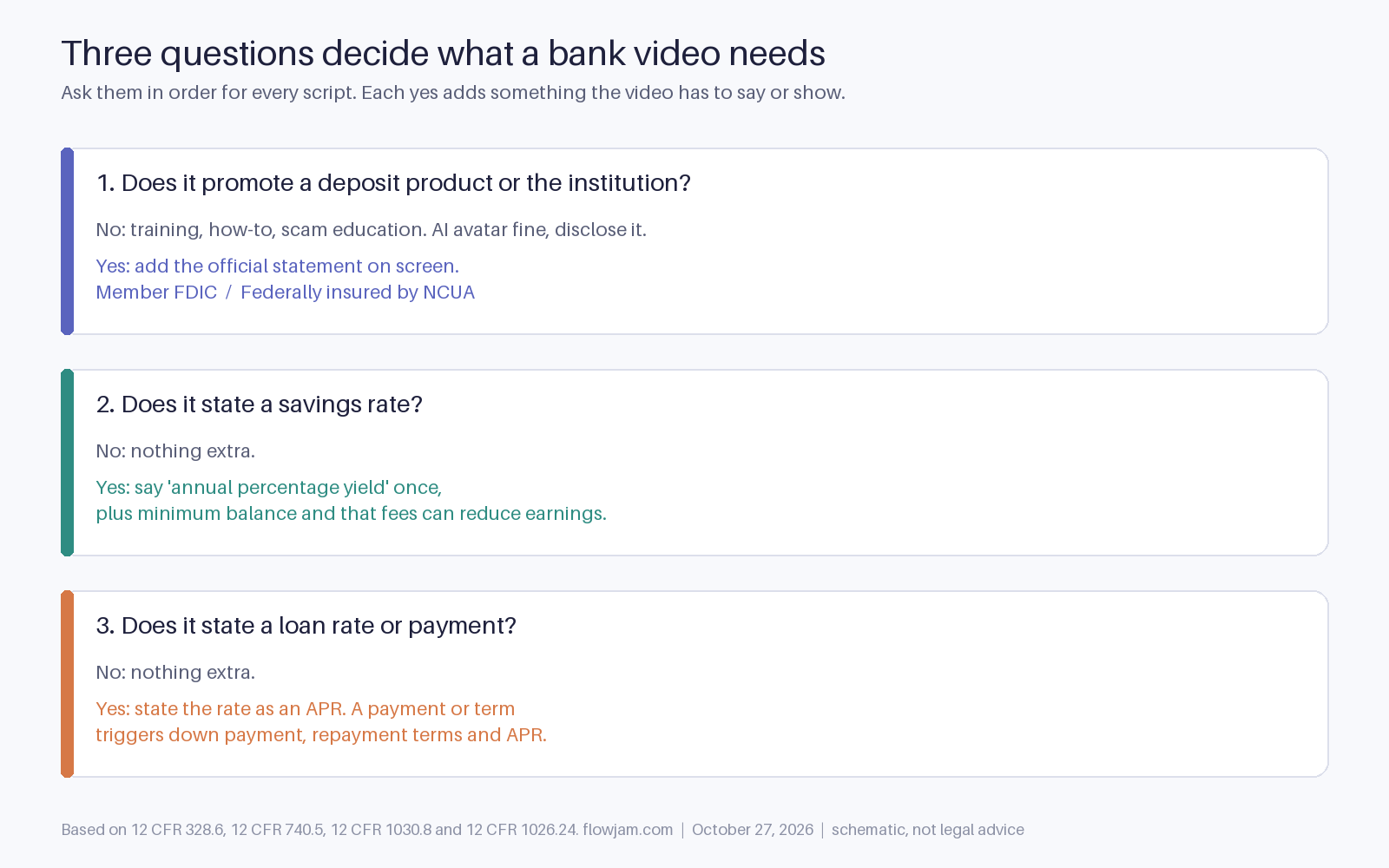
When it advertises. FDIC-insured banks must include the official advertising statement, "Member FDIC" or one of its approved variants, in ads that promote deposit products or the bank itself (12 CFR 328.6). Federally insured credit unions have the same duty with "Federally insured by NCUA" or "Insured by NCUA", in type no smaller than the smallest font elsewhere in the ad (12 CFR 740.5).
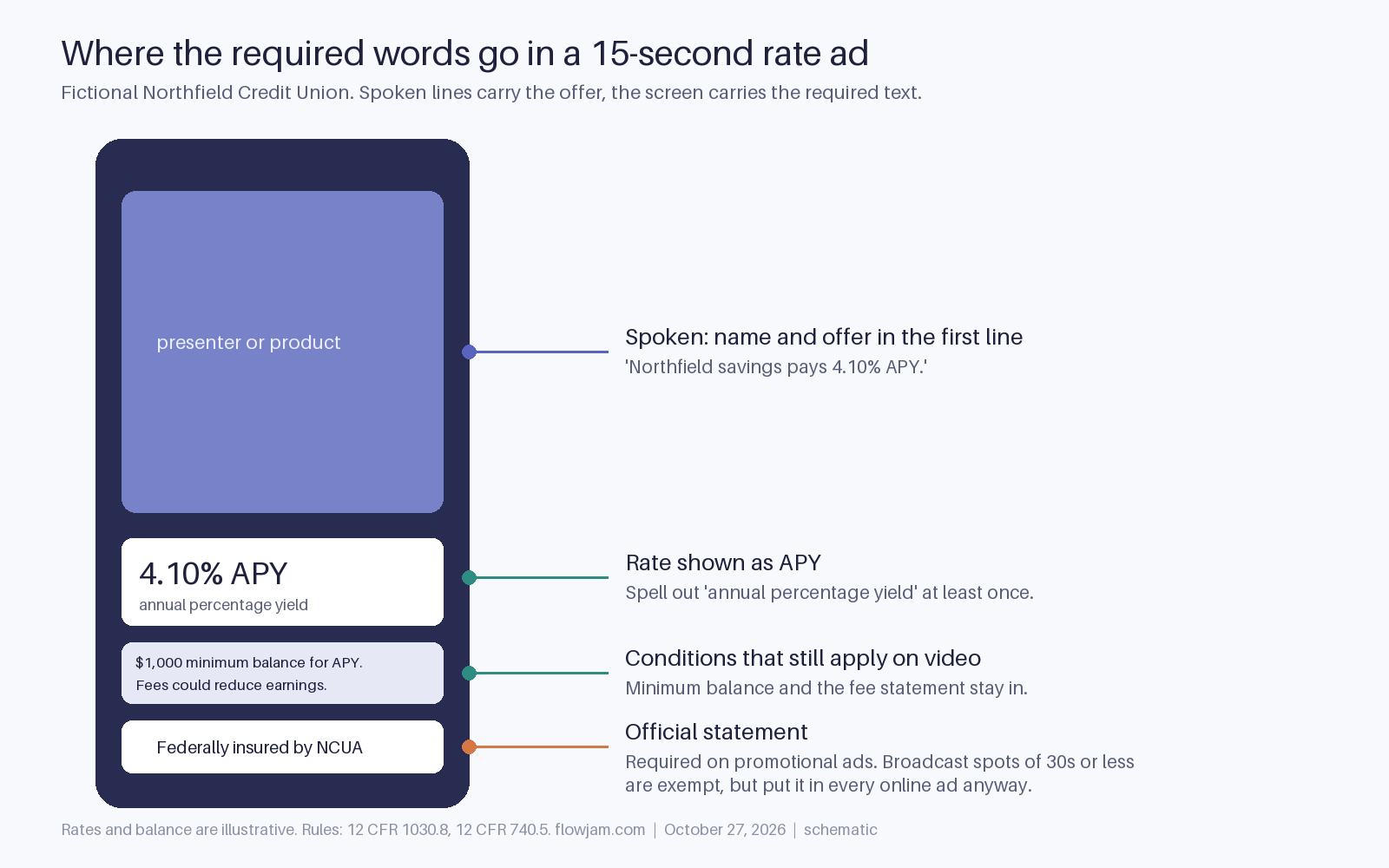
Both rules exempt radio and television ads of 30 seconds or less, other than display ads. That exemption is written for broadcast. A 15-second pre-roll on YouTube or a Reel isn't named in it, so our rule is simple: if it runs online, the statement goes on screen. It costs one line of text in the end card.
The video itself doesn't need the newer FDIC digital sign, which covers web and app pages such as the homepage, login and account-opening screens (12 CFR 328.5). But if you embed the video on an account-opening page, the page still needs the sign.
What changes when the script says a rate?
A savings or CD rate has to appear as an annual percentage yield. "APY" is fine as long as "annual percentage yield" is spelled out at least once, and an interest rate can only appear alongside the APY, never more prominently (12 CFR 1030.8). Once you state an APY, the ad also has to disclose conditions such as the minimum balance needed to earn it and that fees could reduce earnings.
Television and radio ads get a partial break. They can leave out some of those extras, such as the minimum opening deposit and early withdrawal penalties, but not all of them. Treat the minimum balance and the fee line as always in.
Loans follow the credit rules. A rate in a loan or card ad has to be stated as an annual percentage rate. Mention a payment amount, a number of payments or a down payment and you've used a trigger term, which pulls in the down payment, the repayment terms and the APR (12 CFR 1026.24). Our AI video for mortgage loan officers post goes further into trigger terms in spoken scripts.
Here is where AI creates a new problem. Ask a tool for five versions of a rate ad and you get five scripts, and the model will happily write "earn more with high-yield savings" in one and "4.10% on your savings" in another. Only the second needs the disclosures, and nobody notices which is which at 6pm on a Friday. The fix is a locked end card: compliance approves one disclosure frame per offer, and every generated variant ends on it, untouched.
Should a bank put an AI avatar of its staff in front of members?
Yes for teaching, no for anything that asks the viewer to do something with their money. In November 2024 FinCEN warned that suspicious activity reports describing deepfake media had been rising since 2023, with criminals using generated images, video and audio to open accounts and get past identity checks (FinCEN). Your members are being told not to trust a convincing video of someone from their bank.
That makes the rules for your own avatar easy to write. Disclose that it's AI-generated, in the video and in the description. Use a real employee's likeness only with their written consent, and decide up front what happens to it when they leave. Never have an avatar ask for a login, a code, a transfer or a callback to a number. And end every scam-education video with how the institution actually contacts people, so the real channel is the one they remember.
We'd skip the AI chief executive. A cloned CEO delivering a quarterly message saves an hour of filming and teaches members that a video of the CEO is a normal way to hear from the bank, which is exactly what a fraudster wants them to believe. Fake members are a firmer line. An avatar presented as a satisfied customer who doesn't exist is a fake testimonial under the FTC's rule (16 CFR 465.2).
What setup works for a compliance team?
Pick tools by how well they fit review, not by how good the avatars look. Four checks matter. Can you lock an approved script so the tool can't paraphrase it when you change the voice or language? Can you keep a fixed end card across every variant? Are captions and on-screen text editable, since generators still mangle figures? And can you export each version with a date, so the file compliance approved is the file that ran?
For member education, a screen recorder plus an AI voice tool covers most of it cheaply. Rate ads benefit from a tool that builds every cut from one approved master. That's the part Flowjam handles: one approved script, one presenter, one locked end card, delivered in every size and language you need. Bring one offer and its approved disclosures, and you get the full set of cuts back for compliance to check side by side.
The same review discipline shows up in our AI video for financial advisors post, and the full production workflow is in how to make AI videos.
AP
About the author
Adam Petty
Founder, Flowjam
Adam is the founder of Flowjam, where he helps startups turn ideas into launch videos, product demos, and ads with AI video. He writes about AI video production, creative workflows, and go-to-market for early-stage teams.
Frequently asked questions
Can banks and credit unions use AI-generated video?
Yes. No federal rule bans AI video in bank or credit union marketing. The usual advertising rules still apply: the official FDIC or NCUA statement on promotional ads, APY wording for savings rates, APR and trigger-term disclosures for loans, and no fake customer testimonials.
Does a bank video ad need to say Member FDIC?
If it promotes deposit products or the bank, yes, under 12 CFR 328.6. Radio and television ads of 30 seconds or less, other than display ads, are exempt. Online video isn't named in that exemption, so the safe choice is to put Member FDIC on screen in every online ad.
Do credit union video ads need Federally insured by NCUA?
Yes for advertisements, under 12 CFR 740.5, in type no smaller than the smallest font used elsewhere in the ad. Radio and TV ads of 30 seconds or less are exempt. Insured by NCUA and the full sentence naming the National Credit Union Administration are also accepted.
What has to be disclosed when a bank video states a savings rate?
The rate must be shown as an annual percentage yield, with the full term used at least once if you abbreviate it to APY. The ad also has to disclose conditions such as the minimum balance needed to earn the APY and that fees could reduce earnings. Broadcast ads can omit some extras, like the minimum opening deposit.
What is the best first AI video project for a bank?
Member service how-tos: setting up direct deposit, disputing a charge, resetting online banking access. They answer questions your call center gets constantly, change whenever the app changes, and carry no rate or advertising disclosures.
Is it safe for a bank to use an AI avatar of an employee?
For education and how-tos, yes, with the employee's written consent and a clear AI disclosure. Never have an avatar ask for logins, codes, transfers or callbacks. FinCEN has reported rising deepfake fraud targeting financial institutions and their customers since 2023.
Do bank videos need captions?
Plan on it. WCAG 2.2, the accessibility standard regulators and courts commonly point to, requires captions for prerecorded video with audio (success criterion 1.2.2). AI tools generate captions quickly, but check every figure, rate and product name by hand before publishing.
Do banks have to disclose that a video was made with AI?
No general US federal rule requires it for bank marketing as of October 2026, though platforms like Meta and LinkedIn may label AI content. In the EU, the AI Act requires deepfake content to be disclosed from 2 August 2026. Disclosing avatars is the safer default everywhere, especially given deepfake fraud.
Can a bank use AI avatars as customer testimonials?
No. An AI avatar presented as a real customer who doesn't exist is a fake testimonial under the FTC rule at 16 CFR 465.2. Use real members who agreed to appear, or don't run a testimonial.





Launch videos for
moon-shot founders.

About
We're a video production studio partnering with AI founders and startups. We make launch videos to show the world what you're building.
London / San Francisco
Made with love from London / San Francisco. Collaborating with clients worldwide.
Contact
Adam Petty
Founder
adam@flowjam.com
Founder
adam@flowjam.com