
Viral launch videos for moon-shot founders 
Flowjam partners with AI founders and startups aiming for the moon, to create story-driven launch videos to build hype and show the world what they're building.

Full PortfolioBlog
Flowjam works with some of the most successful AI founders in the world after only launching in 2023.
Copyright 2026. Flowjam Ltd.
Copyright 2026. Flowjam Ltd.
Launch Thread Template: Five Posts, and the First One Does the Work
A launch thread on X needs five posts: the launch with video, the link, how it works, the story and one specific ask. Template plus a filled-in example.

Most launch threads are too long. Twelve posts of origin story, feature list and thank-yous, and the product doesn't show up until post six.
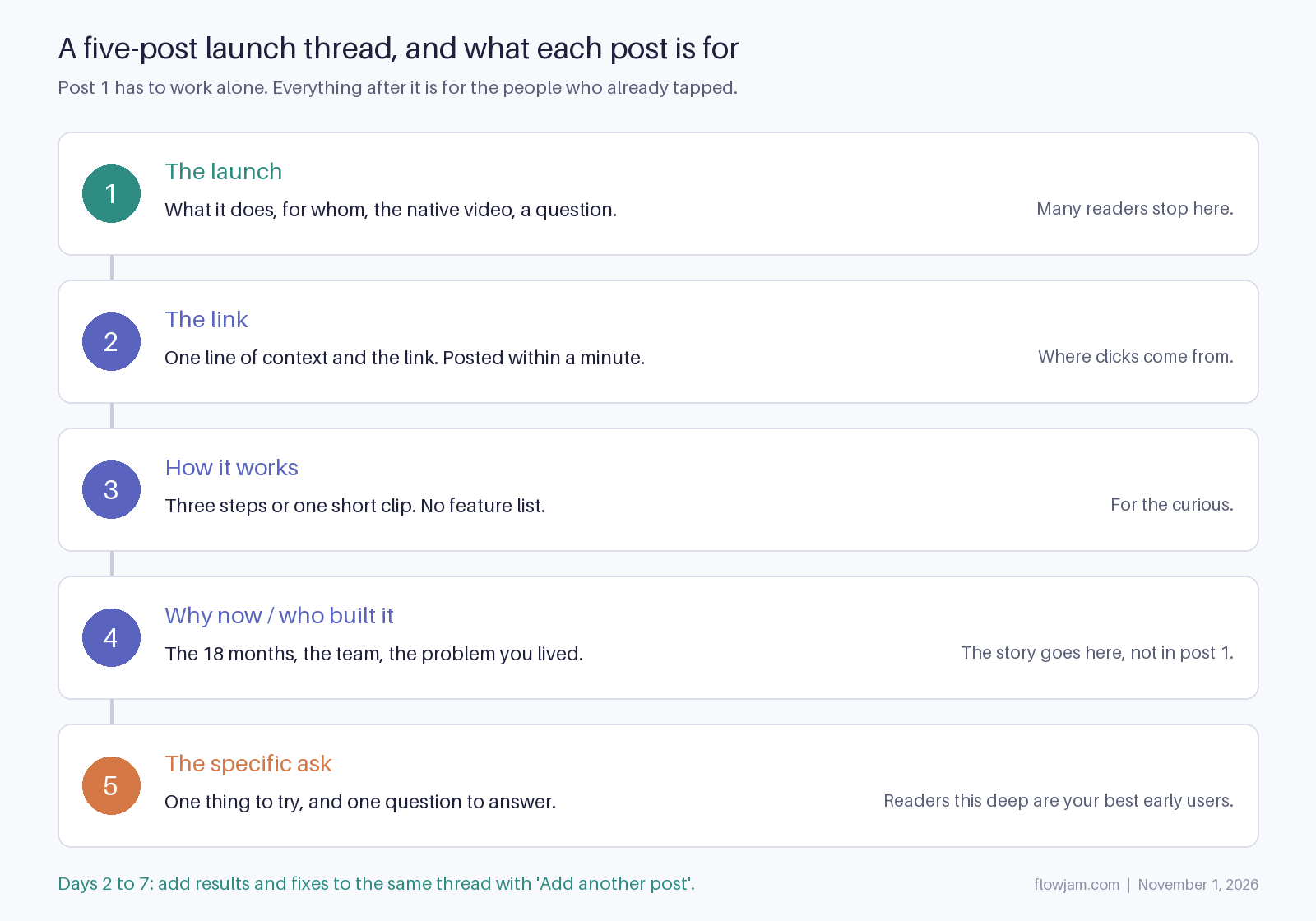
A launch thread is not your diary. Five posts is enough. Post one carries the launch on its own, and the other four are for people who already tapped. Here's the template, a filled-in version for a fictional product, and why we'd stop at five.
The launch thread template
Copy this and replace the brackets. Each post has one job, and if a post doesn't do its job, cut it rather than padding it.
Post 1, the launch: [Product] [does the job] for [who], [new way] instead of [old way]. [One line on how]. Live today. [Question your users want to answer?] [native video attached]
Post 2, the link: Try it here, [free / no card / waitlist]: [link]
Post 3, how it works: Three steps: 1) [connect / upload / install]. 2) [what the product does]. 3) [what you get]. [short clip or one screenshot]
Post 4, why we built it: [The problem you lived, in two sentences]. [Who's on the team, and how long it took]. [Thank-you, if you want one].
Post 5, the specific ask: If you [use case], try [one specific thing] and tell us [one specific thing]. We're answering every reply today.
The template filled in
Here it is for Halewell, a fictional scheduling tool for clinics. The product isn't real, but the shape is the one we'd post.
1. Halewell fills cancelled clinic appointments from your waitlist in about a minute, instead of a receptionist calling down a list. Live today. How do you fill cancellations right now? [45-second screen recording]
2. Try it free for 30 days, no card: halewell.example
3. How it works: connect your calendar, Halewell texts the next patient on the waitlist when a slot opens, and they confirm with one tap. [8-second clip of a slot filling]
4. We built it after watching a physio clinic lose four appointments a day to late cancellations. Two of us, nine months, a lot of waiting-room coffee.
5. If you run a clinic, connect one practitioner's calendar this week and tell us how many slots it fills. We're in the replies all day.
Post one would work if nobody opened the thread. That's the test. If post one only makes sense after post three, swap them. Our post on how to write a launch tweet goes deeper on that first line.
The template is the easy part. The 45-second video in post one is what usually isn't ready on launch morning, and it's the part Flowjam makes: a captioned X cut of your product working, ready to attach.
Why five posts, not fifteen
Every post after the first is a place for readers to drop off, and on launch day you want them on your site, not on post nine. Once a thread passes a handful of posts, it reads like an essay to someone who wanted a demo.
The ranker doesn't reward length for its own sake either. In the weights X published in 2023, a like counted 0.5, a reply 13.5, and a reply the author then engaged with 75 (the-algorithm-ml). Those numbers have moved since, but the point holds: what earns reach is conversation under the post, not post count. A tight thread with a real question gets replies. A long thread asks for patience and leaves less to reply to.
And you don't have to say everything on day one. Once a thread is live, X lets you add more posts to it from the thread page with "Add another post" (X help center). So save the numbers, the first customer and the bug you fixed overnight for days two to seven, and add them to the same thread. Each one gives people a reason to come back to it.
Where the video, the link and the story go
The video goes in post one, uploaded to X rather than linked, because native video autoplays and a link card doesn't. The specs are in our X launch video guide.
The link goes in post two, ready to paste the second post one is up. It's the same logic as a single launch tweet: the launch post reads better without a URL, and X has said in the past that it shows posts with links less.
The story goes in post four. Founders put it first because it matters most to them, but a stranger needs to know what the product does before they care who built it. If your video ends up as a talking-head origin story instead of a demo, that's usually the same mistake. Our launch videos start with the product working for exactly this reason.
Everything else, like pinning the thread, booking reposters and the first hour in the replies, is in the full guide to launching on X.
The case for a long thread
There's one situation where we'd break the five-post rule: you've been building in public for months, and your followers have watched the product take shape. For them, a long "here's everything we shipped" thread is a payoff, not a pitch, and they'll read all of it.
Even then, we'd launch with five and post the long version the next day, as its own thread. The launch thread is for people who've never heard of you, and the build story is for people who have. Mixing them makes both worse.
AP
About the author
Adam Petty
Founder, Flowjam
Adam is the founder of Flowjam, where he helps startups turn ideas into launch videos, product demos, and ads with AI video. He writes about AI video production, creative workflows, and go-to-market for early-stage teams.
Frequently asked questions
How many posts should a launch thread have?
Five is enough for most launches: the launch with a native video, the link, how it works, the story, and a specific ask. You can add results and fixes to the same thread over the following days with Add another post.
What goes in the first post of a launch thread?
What the product does, for whom, and the before and after, with a native video attached and a question at the end. It should make sense to someone who never opens the rest of the thread.
Should the link go in the first post of a launch thread?
Put it in the second post, ready to paste as soon as the first is live. The launch post reads better without a URL, and X has said in the past that it shows posts with links less.
Can I add to a thread after posting it on X?
Yes. On the thread page, the author can tap Add another post to continue the thread. It's a good place for launch-week updates such as first results, fixes and customer replies.
Is a thread better than a single launch tweet?
Not always. A single post with a video and the link in the first reply is the simplest launch. A five-post thread adds room for how it works and why you built it, but post one still has to carry the launch on its own.
When does a long launch thread make sense?
When you have a warm audience that has followed you building in public. Even then, launch with a short thread and post the long build story the next day as its own thread.





Launch videos for
moon-shot founders.

About
We're a video production studio partnering with AI founders and startups. We make launch videos to show the world what you're building.
London / San Francisco
Made with love from London / San Francisco. Collaborating with clients worldwide.
Contact
Adam Petty
Founder
adam@flowjam.com
Founder
adam@flowjam.com