
Viral launch videos for moon-shot founders 🌸
Flowjam partners with AI founders and startups aiming for the moon, to create story-driven launch videos to build hype and show the world what they're building.

Full PortfolioBlog
Flowjam works with some of the most successful AI founders in the world after only launching in 2023.
Copyright 2026. Flowjam Ltd.
Copyright 2026. Flowjam Ltd.
AI Video for Pharma: What Drug Companies Can Make Without an FDA Problem
Pharma teams can use AI video for training and market research now. Promotional and DTC video still needs MLR review, Form FDA 2253 and a compliant major statement.

An AI tool can turn out forty versions of a product video in an afternoon. A pharma company has to submit each one to the FDA on Form 2253 when it first goes out, after a medical, legal and regulatory review that usually takes weeks. That mismatch decides almost everything about how drug companies should use AI video.
Most AI video vendors pitch pharma on speed. Speed is the easy part. The teams that get value from AI video for pharma are the ones that decide which videos never need review, and build the rest so review happens once.
These are the questions brand, medical and training teams actually ask, answered in the order we'd tackle them.
What should a pharma team make with AI video first?
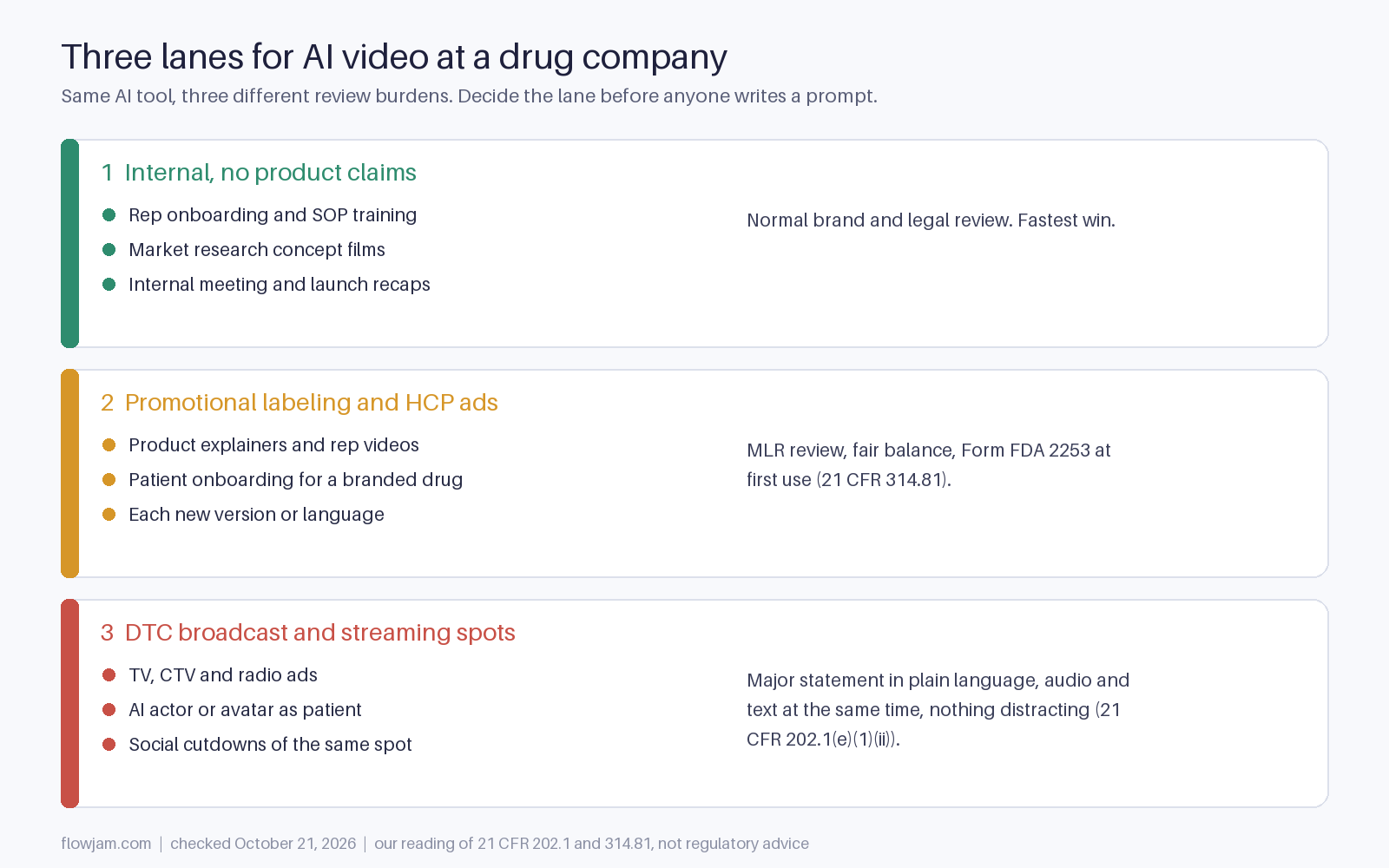
Anything that never leaves the building and never makes a product claim.
Rep onboarding and SOP training come first. A sales force relearns the same compliance module every year, and an AI presenter in six languages beats a reshoot. Our AI training video generator guide covers that workflow.
Market research stimuli come second. A concept film that shows physicians a future treatment scenario is cheaper to generate than to shoot, and it's tested with a recruited panel, not published.
Internal launch and meeting recaps come third.
None of these is advertising or promotional labeling, so they skip the FDA submission entirely. They still go through your normal legal review, and they should stay unbranded if there's any chance they'll be forwarded.
Does the FDA treat an AI-made drug ad differently?
No. The rules attach to what the video says about the drug, not how it was made. An AI explainer for a branded product is promotional labeling or advertising like any other, and it needs fair balance between benefit and risk.
What changes is volume. Every cut, aspect ratio and language a generator produces is a new piece, and the review queue doesn't get faster because the edit did.
Does every AI variant need its own Form FDA 2253?
The rule is in 21 CFR 314.81(b)(3)(i): the applicant submits specimens of any labeling or advertising "devised for promotion of the drug product" at the time of initial dissemination or publication, on Form FDA-2253. The FDA's Office of Prescription Drug Promotion is the office that reviews it.
So yes, plan for each distinct piece to be submitted. That includes the Spanish version, the 9:16 cutdown and the version with a different presenter.
The practical fix is modular content. Get a library of approved claims, risk language, scenes and presenters through review once, then let the AI tool assemble only from that library. Whether an assembled output still counts as a new piece is a call for your regulatory affairs team, and we'd ask it before building the pipeline, not after.
What does a TV or streaming drug ad have to get right?
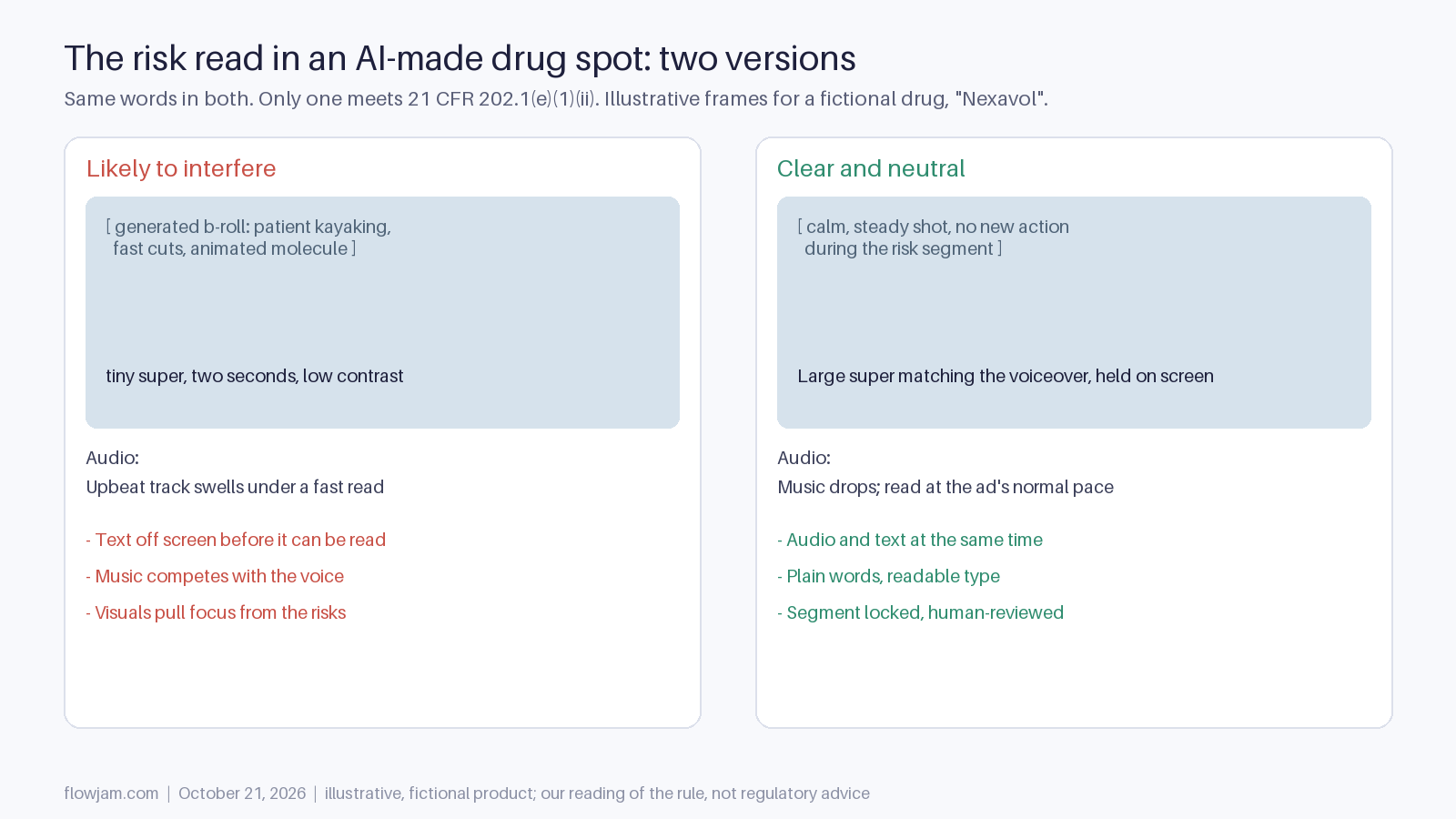
The major statement, the spoken summary of the most important risks. Under 21 CFR 202.1(e)(1)(ii), added by the FDA's 2023 rule, it has to meet five standards:
- Plain, consumer-friendly language.
- Audio at least as clear as the rest of the ad.
- On TV, presented in audio and text at the same time, with the text on screen long enough to read.
- Readable type size, contrast and placement.
- No audio or visuals that are likely to interfere with understanding it.
That last one is where AI spots go wrong. Generated b-roll is cheap, so editors pile it on: a smiling patient kayaking, an animated molecule, music swelling under the risk read. If those pull attention from the major statement, the ad fails standard five no matter how accurate the words are.
Two habits help. Lock the risk segment as a fixed, human-reviewed block the generator can't touch. And check the supers against the voiceover frame by frame, because AI captioning drifts out of sync. Our video ad specs guide lists safe zones for each platform so supers don't get covered by the interface.
Is the FDA actually watching AI content?
Yes, more closely than at any time in years. After a presidential memorandum on September 9, 2025, the FDA sent more than 100 enforcement letters, including roughly 100 cease-and-desist letters, according to Latham & Watkins. By the same reports, the agency had issued one warning letter on drug promotion in 2023 and none in 2024.
The agency said it would monitor influencer partnerships, algorithm-driven targeted ads and "AI-generated health content and chatbot interactions", and that it would use AI tools of its own to surveil promotion. Ropes & Gray's summary covers the memo itself.
What happens to "adequate provision"?
Today a broadcast ad can carry the major statement and point viewers elsewhere for the full risk information, usually a website, a phone number and a print ad. The FDA wants to end that option. A proposed rule is on its 2026 regulatory agenda, with publication expected around December 2026.
If it's finalized as described, broadcast ads would need a brief summary of all the side effects and contraindications, which commentators say would make most TV spots impractically long. The FDA Law Blog walks through the argument. For AI video the takeaway is simple: don't build an expensive DTC pipeline around a 60-second format that may not survive.
Can an AI avatar play the patient or the doctor?
It can, with the same care an actor needs and a bit more. Drug ads have long labeled actors as portrayals, and an AI patient should be labeled as AI on screen. Don't give a generated patient outcome claims a real patient population didn't show, and don't present a generated face in a white coat as a physician who stands behind the drug.
Patient testimonials are the hard line. A testimonial from someone who doesn't exist is a fake review under the FTC's 2024 rule, whatever the FDA thinks of the claim. Our AI video for healthcare guide covers the clinic side of the same question, and the AI avatar tools roundup compares how vendors handle consent.
For the production steps, see our guide to making AI videos.
Is unbranded disease awareness video safer?
Safer, not safe. A help-seeking video that never names the drug sits outside the brief-summary rules. Put the brand's colors, music or tagline on it, or run it next to the branded spot, and the line blurs fast. AI makes it trivially easy to reuse the brand kit by accident, so strip it from the workspace those videos are made in.
That separation is also how we'd start with Flowjam: lane-one training and research videos first, built from modules your MLR team can review once before anything branded goes near the tool.
AP
About the author
Adam Petty
Founder, Flowjam
Adam is the founder of Flowjam, where he helps startups turn ideas into launch videos, product demos, and ads with AI video. He writes about AI video production, creative workflows, and go-to-market for early-stage teams.
Frequently asked questions
Can pharmaceutical companies use AI-generated video?
Yes. Internal training, rep onboarding and market research stimuli carry no FDA submission requirement. Promotional and direct-to-consumer videos can also be made with AI, but they face the same rules as any drug promotion: fair balance, MLR review and Form FDA 2253 submission at first use.
Does an AI-generated drug ad need to be submitted to the FDA?
Yes, if it promotes a prescription drug. Under 21 CFR 314.81(b)(3)(i), specimens of promotional labeling and advertising are submitted on Form FDA-2253 at the time of initial dissemination or publication. Plan for each distinct version, language and cutdown to be a separate piece.
What is the major statement in a TV drug ad?
It is the spoken presentation of a drug's major side effects and contraindications. Under 21 CFR 202.1(e)(1)(ii) it must be in consumer-friendly language, as clear as the rest of the audio, shown in audio and text at the same time on TV, readable, and free of audio or visuals likely to interfere with comprehension.
Is the FDA enforcing rules on AI-generated pharma content?
After a September 9, 2025 presidential memorandum, the FDA sent more than 100 enforcement letters and said it would monitor social media, influencer content, targeted ads and AI-generated health content, using AI tools of its own.
What is the adequate provision rule change?
The FDA plans to remove the option for broadcast drug ads to direct viewers to other sources for full risk information. A proposed rule is on its 2026 agenda and expected around December 2026. If finalized, broadcast ads would need a brief summary of all side effects and contraindications.
Can a drug ad use an AI-generated patient?
It can if the portrayal is labeled as AI and makes no claims the real patient population didn't show. AI-generated patient testimonials should be avoided, because a testimonial from someone who doesn't exist is a fake review under the FTC's 2024 rule.
What should a pharma team make with AI video first?
Rep onboarding and SOP training, then market research concept films, then internal recaps. These involve no product promotion, so they move fastest and teach the team the tools before anything goes through MLR review.





Launch videos for
moon-shot founders.

About
We're a video production studio partnering with AI founders and startups. We make launch videos to show the world what you're building.
London / San Francisco
Made with love from London / San Francisco. Collaborating with clients worldwide.
Contact
Adam Petty
Founder
adam@flowjam.com
Founder
adam@flowjam.com