
Viral launch videos for moon-shot founders 
Flowjam partners with AI founders and startups aiming for the moon, to create story-driven launch videos to build hype and show the world what they're building.

Full PortfolioBlog
Flowjam works with some of the most successful AI founders in the world after only launching in 2023.
Copyright 2026. Flowjam Ltd.
Copyright 2026. Flowjam Ltd.
Building in Public on X: Six Myths That Waste the Run-Up to Launch
How to build in public on X without posting revenue or daily logs: ask questions, answer every reply, keep links in replies, and make the launch the last post.

Building in public is supposed to hand you a launch day where the first replies come from people who watched you build. For most founders it hands them a launch post with four likes, two of them from cofounders.
On X, it means posting the work while you make it: the problem, the decisions, short clips of the product running. Most of the advice comes from founders who already had big followings. Here are six beliefs that waste the run-up, and what we'd post instead.
Myth 1: building in public means posting your revenue
Revenue screenshots are the most visible kind of build-in-public post, so people assume they're the price of entry. They aren't. Open numbers are a company choice, not a rule of the format. Buffer has published its salary formula since 2013 because transparency is one of its values, not because it was building an audience.
Before launch you probably have no revenue to show anyway. What you do have is more useful to a stranger: the problem you're solving, the trade-offs you're making and the product taking shape. Post those. Share numbers later if you're comfortable, and skip them if they'd hand a competitor your pricing.
Myth 2: you have to post every day
The "day 47 of building X" log is a habit, not a strategy. What counts on X is whether people reply. In the ranking weights X published in 2023, a reply was worth 13.5 and a like 0.5, and a reply that the author then engaged with was worth 75 (the-algorithm-ml). The platform has changed since, but the direction is the same: conversation beats volume.
So three posts a week that each end on a real question, followed by answering everyone who replies, will do more than seven status updates nobody answers. A good question is one only your target customer can answer: "how do you chase late invoices today?" beats "thoughts?"
Three posts to model
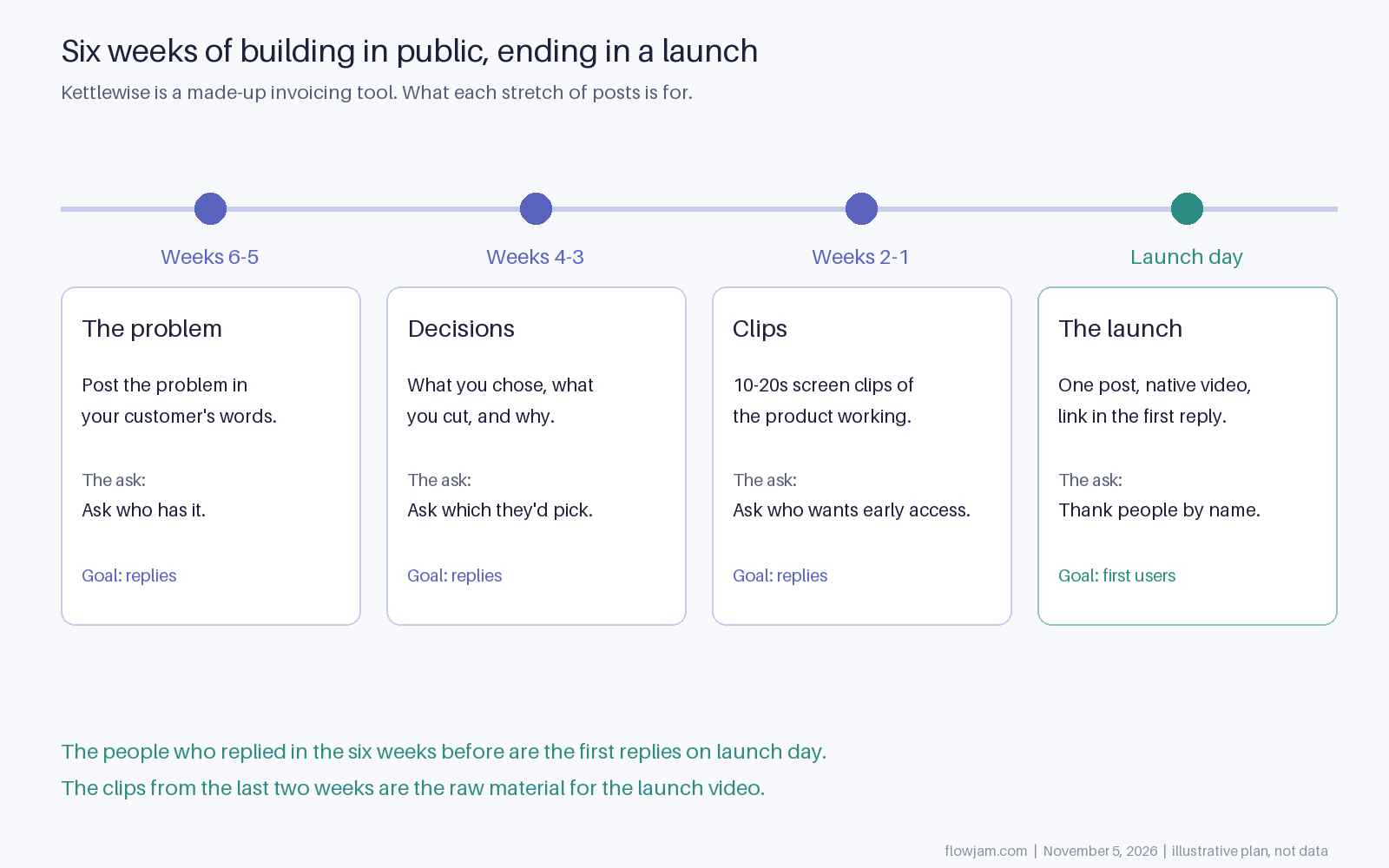
Written for Kettlewise, the made-up invoicing tool in the diagram. Each one is short, says one thing and ends on a question.
Problem post: Freelancers I talked to this month chase late invoices by hand. Calendar reminder, awkward email, repeat. One said she just writes the money off after 60 days. How do you handle an invoice that's three weeks late?
Decision post: Cut automatic late fees from v1. Every freelancer liked the idea, none wanted to send one to a client they like. Shipping a polite reminder sequence instead. Would you turn late fees on?
Clip post: [15-second screen clip, captioned] Reminder number two going out on its own. The client sees a pay button, not a lecture. What would make you trust a tool to email your clients for you?
Notice what's missing: no link, no "day 23", no thread. The decision post is the one that usually gets the most replies, because people like arguing about a trade-off they have an opinion on. It's also the post you'll quote on launch day.
Myth 3: you need an audience before it's worth doing
Small is fine. Small is the point. The 200 people who follow a pre-launch account because of the problem it's solving are closer to first users than 20,000 followers picked up from viral threads.
With no audience, the first job isn't posting, it's replying. Find the people already talking about your problem on X, in search and in the relevant X Communities, and add something useful to their threads. Your own posts start getting replies once a few of those people recognise your name.
When replies do come, answer in public. A public answer is visible to everyone who reads the post later, and it's the reply the author engages with that X's published weights counted highest. Move to DMs only when someone asks for help with their own account or data. If a reply is hostile but has a real point, answer the point once and plainly; if it's just hostile, leave it.
If there's no conversation about your problem on X at all, that's worth knowing too. Your buyers may live on Hacker News, LinkedIn or a forum instead, and that's where the run-up should happen. We compared the HN route in Hacker News vs X.
Myth 4: every post should link to your waitlist
Pre-launch, the only link you have is a waitlist, and it's tempting to put it everywhere. Don't. Musk said in November 2024 that X deprioritises posts with links (Business Today). X's stance has shifted since, but a link still pulls people off the platform before they reply.
Your profile does the linking for you. The bio says what you're building and for whom, in words the customer uses ("building an invoicing tool that chases late payments for freelancers", not "founder, building the future of finance"). The header can be a frame from the product. The pinned post is your best clip, with the waitlist link in its first reply, and the bio carries the same link. When someone asks where to sign up, answer with the link in a reply. Everything else stays link-free and ends on a question. If you need a waitlist page worth pinning, here are waitlist page examples.
Myth 5: the launch is a separate event
This is the one that costs the most. Founders build in public for two months, then write a launch post as if nobody has seen the product before. The people who followed along get a generic announcement, and the launch reads like an ad.
Treat the launch as the last post of the run. Name the decision you asked about in week three and say what you picked. Reply to the people who answered your early questions by name. If someone gave you the idea for a feature, say so in the thread. Those are the first replies, and on X the first replies are the launch.
The video works the same way. The 10 to 20 second clips you posted in the last two weeks are rough cuts of the launch video. Followers have already seen the product move, so the launch video's job is to show it end to end, cleanly, with captions for people watching muted. That's what Flowjam makes: a 30 to 60 second launch video built from your product, cut in the shape X's feed rewards and ready before launch day. See how our launch videos work, and see our X launch video guide for specs.
For the post itself, our launch tweet guide goes line by line, and the launch thread template covers the replies underneath it.
Myth 6: in public means everything is public
Some things should stay off X however open you're trying to be.
- Customer names, emails and data in screenshots. Blur them, or use a demo account.
- Security details: how auth works, what you haven't patched yet, internal URLs.
- A launch date you aren't sure of. Missing a public date costs more than never giving one. Say "this month" until you're certain.
- Fights with competitors. They get replies, but not from buyers.
The useful test: would a future customer be glad you posted this? A decision explained, yes. A screenshot with someone's invoice total in it, no.
For the launch day itself, from the first post to the first hour of replies, see the guide to launching on X. For the wider pre-launch plan beyond X, see pre-launch marketing.
AP
About the author
Adam Petty
Founder, Flowjam
Adam is the founder of Flowjam, where he helps startups turn ideas into launch videos, product demos, and ads with AI video. He writes about AI video production, creative workflows, and go-to-market for early-stage teams.
Frequently asked questions
What does build in public mean?
Posting the work on a product while you make it: the problem, decisions, progress and sometimes numbers. On X it usually means short posts and clips that invite replies from the people you're building for.
How do I start building in public on X with no followers?
Start by replying, not posting. Find people already discussing your problem on X search and X Communities and add something useful. Post your own updates a few times a week, each ending on a question only your target customer can answer.
How often should I post when building in public?
Two or three good posts a week is enough if each one ends on a question and you answer every reply. Daily logs that nobody replies to don't help.
Should I link my waitlist in every post?
No. Pin one post with the waitlist, put it in your bio and drop it in a reply when someone asks. Keep the other posts link-free so people reply instead of leaving.
How long should I build in public before launching?
There's no fixed number. Around six weeks gives time to post the problem, a few decisions and some product clips. Launch once the people replying would be your first users.





Launch videos for
moon-shot founders.

About
We're a video production studio partnering with AI founders and startups. We make launch videos to show the world what you're building.
London / San Francisco
Made with love from London / San Francisco. Collaborating with clients worldwide.
Contact
Adam Petty
Founder
adam@flowjam.com
Founder
adam@flowjam.com