
Viral launch videos for moon-shot founders 
Flowjam partners with AI founders and startups aiming for the moon, to create story-driven launch videos to build hype and show the world what they're building.

Full PortfolioBlog
Flowjam works with some of the most successful AI founders in the world after only launching in 2023.
Copyright 2026. Flowjam Ltd.
Copyright 2026. Flowjam Ltd.
Most Founders Copy the Wrong Part of Cluely's Launch Video
A teardown of Cluely's April 2025 launch video on X: the product inside a story, the news behind it, and the revenue claim that didn't hold.

When founders copy Cluely's launch, they copy the provocation. The part that worked was a product shown inside a story, with the founder in the lead role.
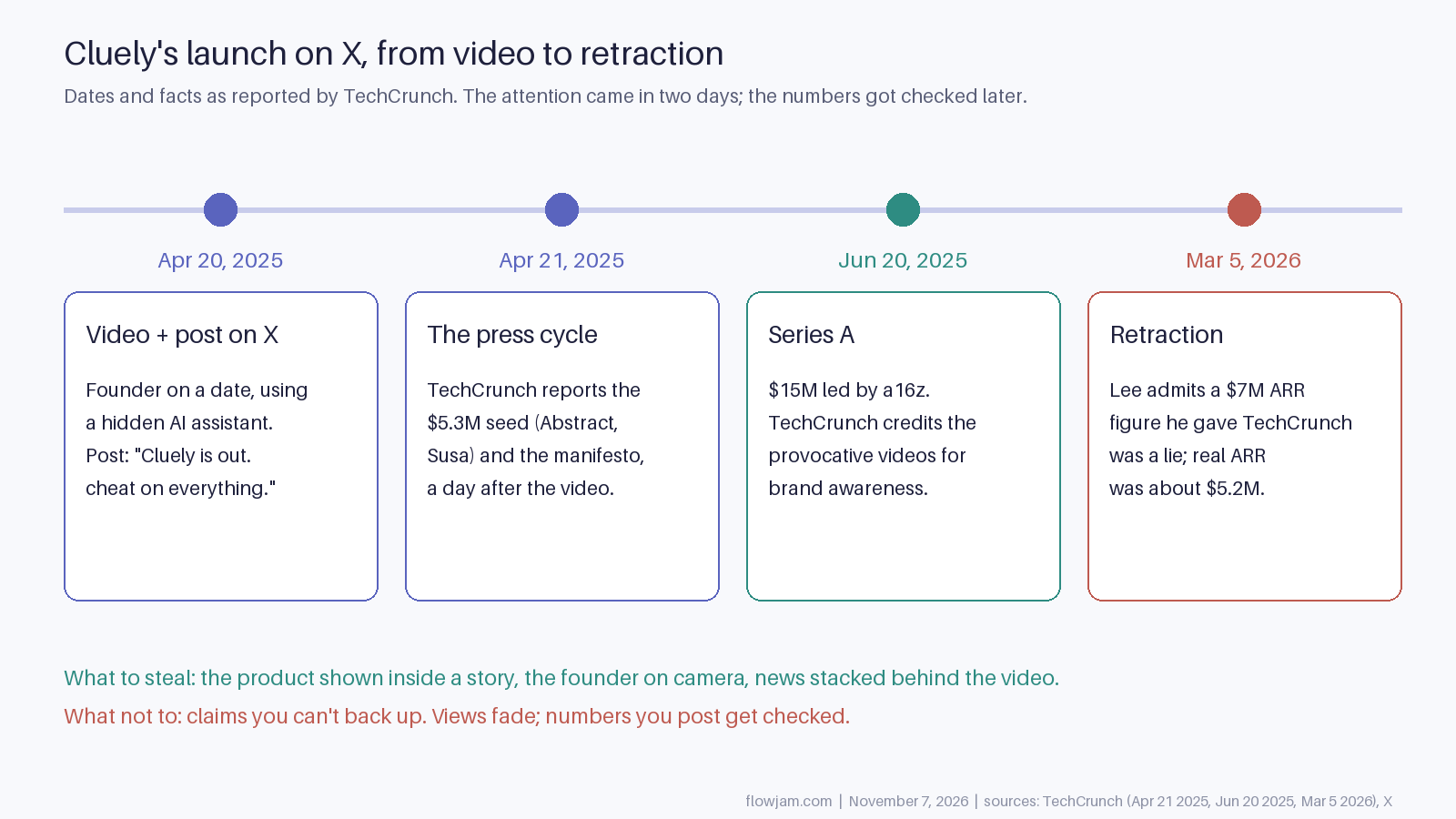
On April 20, 2025, Roy Lee posted one line and a video on X: "Cluely is out. cheat on everything." In the video, Lee is on a date at an expensive restaurant, using a hidden AI assistant to lie about his age and his knowledge of art, and failing. TechCrunch called it "slickly produced, but polarizing" (TechCrunch).
Copy this: the product is the plot
The video doesn't pitch the product. You watch it being used in a situation where using it is the joke, and you understand what it does without a feature list. Steal that. It needs no restaurant and no scandal.
To find your scene, ask one question: what is the user doing in the ten seconds before they need you? For an invoicing tool, it's reading a "just checking in" email from a client who hasn't paid. For a meeting-notes tool, it's being asked "what did we agree last week?" and not knowing. That moment is your opening shot. The product's job in the video is to change how it ends.
Two tests before you film. A stranger should get the product from the scene with the sound off. And the scene should only work with your product in it; if a competitor's logo would fit just as well, keep looking.
Copy this: the founder on camera, one line in the post
Lee is the lead, not an actor or a voiceover. On X the launch post comes from a person's account and the replies go to that person, so a founder on screen turns an announcement into something people answer. In the ranking code X published in 2023, a reply was worth 13.5 and a like 0.5 (the-algorithm-ml).
The post text was one line: the product name, the word "out" and the tagline, 35 characters in all. No feature list, no "we're excited to announce". The video did the talking. Our launch tweet guide makes the same case: line one is the product.
And the news was stacked behind it. TechCrunch's story the next day covered the $5.3 million seed from Abstract Ventures and Susa Ventures, Lee's suspension from Columbia over an earlier interview-cheating tool, and a manifesto comparing Cluely to the calculator and spellcheck (TechCrunch). Anyone who saw the video and searched the name found a story, not just a landing page.
Skip this: borrowed controversy
Cluely's controversy was its positioning. The product was sold as cheating, the founder had been suspended for building a cheating tool, and the video picked the exact fight the company wanted. Critics comparing it to Black Mirror were repeating the pitch. Lee's own summary: "the internet rewards the bold, not the polished" (Business Insider via AOL).
For most products, provocation is borrowed. An invoicing tool in a staged scandal gets replies about the scandal, not the invoices. Bold, for you, means a clear claim and a real scene. A screen recording of the product changing one moment beats a polished ad that could be for anything.
Skip this: numbers you can't back up
Two months after the video, Cluely raised a $15 million Series A led by Andreessen Horowitz, and TechCrunch credited Lee's "provocative social media presence and highly produced controversial videos" with building awareness (TechCrunch). In March 2026, Lee admitted on X that the $7 million ARR figure he gave TechCrunch the previous summer was a lie, calling it the "only blatantly dishonest thing" he had said publicly online; his own figures put ARR at about $5.2 million (TechCrunch).
A viral launch buys a few days of attention and a long tail of scrutiny. Every number you post that week is one a reporter, investor or competitor can check. Launch with claims you can prove and let the scene do the persuading.
The same shape for a normal product
Here it is for Kettlewise, a made-up invoicing tool for freelancers (it isn't a real product). The founder plays the freelancer. A phone on a tripod and a screen recording are enough.
- 0 to 3 seconds: the founder, at a kitchen table, reads a client email aloud: "Just checking, did you send that invoice?" She sent it three weeks ago. Her face does the work. Caption on screen, no logo.
- 3 to 20 seconds: cut to the screen recording. Kettlewise has already sent reminder number two on its own, politely. A notification slides in: paid.
- 20 to 30 seconds: back to the founder, who closes the laptop. One line on screen: "Kettlewise chases late invoices so you don't have to."
The post: "Kettlewise is out. Stop chasing invoices." Video uploaded natively, link in the first reply, the founder answering replies for the first hour.
The scene is the hard part. Anyone can film a kitchen table; knowing which ten seconds to film is the job. It's the only kind of video Flowjam makes: story-driven launch videos for AI and SaaS founders.
Ours have averaged over 100,000 views each, with no media budget and no boosting. HeyGen's Video Agent launch passed 7 million views in 48 hours (our launch work).
Get a launch video that people actually watch.
Before you export, check the X launch video specs.
For the rest of launch day, see our guide to launching on X.
AP
About the author
Adam Petty
Founder, Flowjam
Adam is the founder of Flowjam, where he helps startups turn ideas into launch videos, product demos, and ads with AI video. He writes about AI video production, creative workflows, and go-to-market for early-stage teams.
Frequently asked questions
What was the Cluely launch video?
A short film Roy Lee posted on X on April 20, 2025, with the line "Cluely is out. cheat on everything." It shows him on a date using a hidden AI assistant to lie about his age and his knowledge of art, and failing.
How long should a launch video for X be?
Most launch videos work at 30 to 90 seconds. If you plan to promote the post with X ads, cut a separate version of 15 seconds or less, which is X's own guidance for promoted video.
Can I make a Cluely-style launch video without a film crew?
Yes. The structure is one scene: the user's problem moment, the product changing it, one line on screen. A phone on a tripod, a screen recording and the founder on camera are enough to shoot it.
Is a provocative launch video risky?
It can be. Controversy gets replies, but the replies argue about the stunt unless the controversy is your product's actual positioning, and a viral launch brings scrutiny to every claim you make that week.





Launch videos for
moon-shot founders.

About
We're a video production studio partnering with AI founders and startups. We make launch videos to show the world what you're building.
London / San Francisco
Made with love from London / San Francisco. Collaborating with clients worldwide.
Contact
Adam Petty
Founder
adam@flowjam.com
Founder
adam@flowjam.com