
Viral launch videos for moon-shot founders 
Flowjam partners with AI founders and startups aiming for the moon, to create story-driven launch videos to build hype and show the world what they're building.

Full PortfolioBlog
Flowjam works with some of the most successful AI founders in the world after only launching in 2023.
Copyright 2026. Flowjam Ltd.
Copyright 2026. Flowjam Ltd.
Soft Launch vs Hard Launch: Which Should Your Startup Run?
A soft launch opens your product to a small group first; a hard launch opens it to everyone on one day. Rules for picking one, and how each looks on X.

Most startups that say they are soft launching are really just avoiding the launch. A soft launch is a test with an end date. Without the end date, it's a product nobody has heard of.
The difference is simple. A soft launch opens the product to a small group first, quietly, so you can fix what breaks before anyone important is watching. A hard launch opens it to everyone on one day, as loudly as you can manage. If you can't say what would make you go loud, go loud now.
Soft launch vs hard launch, side by side
| Soft launch | Hard launch | |
|---|---|---|
| Who gets in | A waitlist, invite batches, one market or one community | Anyone, from the first minute |
| What you post on X | Build updates, a "we're letting people in" post, DMs to people who asked | The launch post with a video, pinned, with your replies ready |
| What you're measuring | Do people come back? What confuses them? What will they pay? | Sign-ups, replies, who shared it |
| What goes wrong | It drags on for months and the product never gets a moment | The product breaks or confuses people in front of everyone, once |
| Can you redo it? | Yesthat's the point | Not really. You get one launch day per product |
The last row is the one that matters. A soft launch buys you retries. A hard launch spends your one chance at attention. So the question isn't which is better. It's whether you have anything left to learn before you spend it.
Rules for picking one
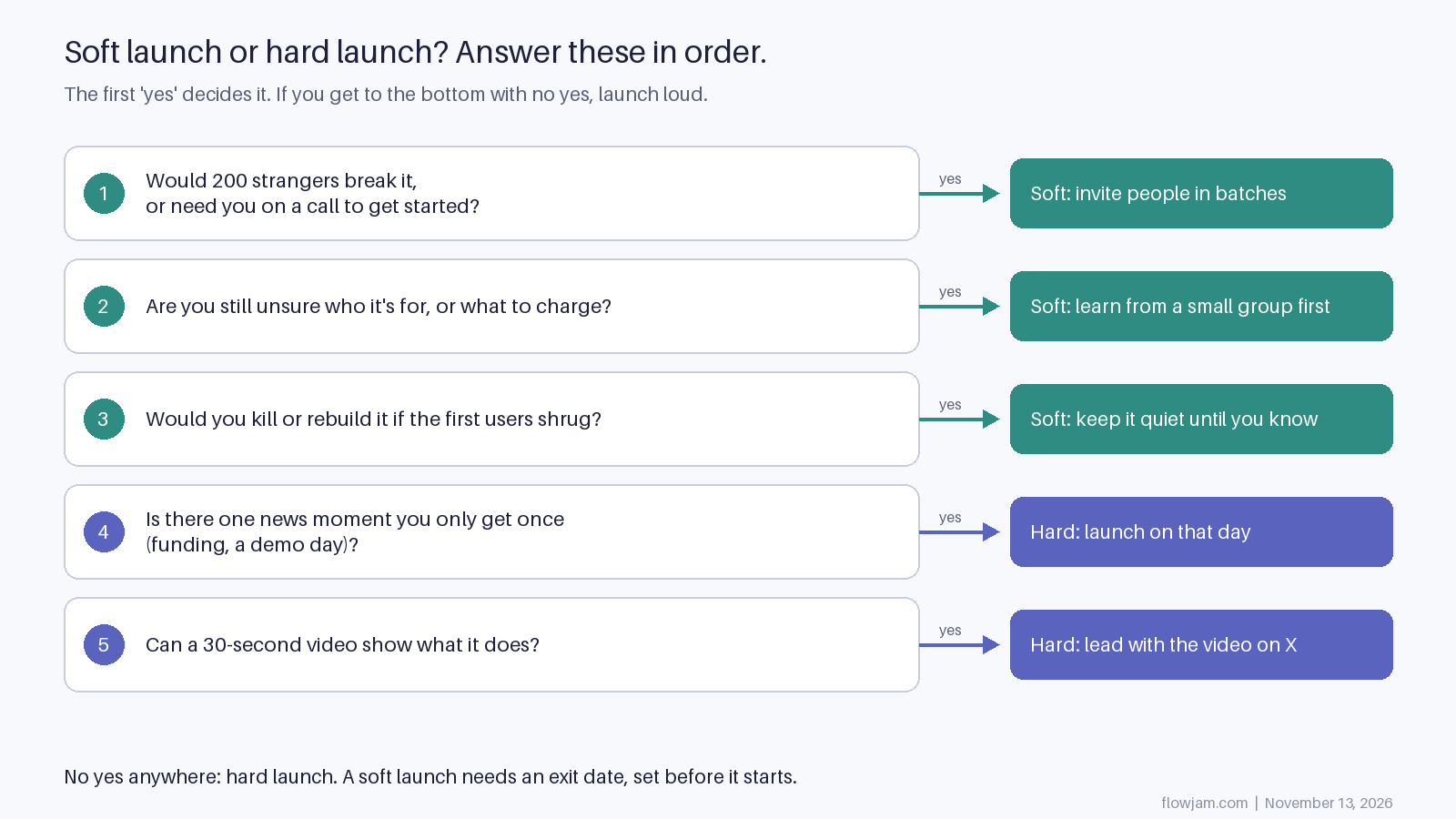
- If 200 strangers would break it, or most of them would need a call with you to get going: soft. Invite them in batches you can handle.
- If you can't yet say who it's for or what it costs: soft. A launch post that hedges on both gets scrolled past.
- If you'd kill or rebuild it after a lukewarm first month: soft. Don't spend the launch on a version you might throw away.
- If there's a news moment you only get once, like a funding round or a demo day: hard, on that day. Splitting the news from the launch wastes one of them.
- If a 30-second clip makes people get it: hard. Products that show well on video are the ones that spread on X, and the clip is the part we make at Flowjam.
- If none of the above applies: hard. Waiting feels safe, but nobody is learning anything from a product they can't see.
One case people get wrong: no audience. Founders with 300 followers often soft launch because a hard launch would be quiet anyway. That's backwards. Your hard launch will be quiet either way. What changes things is having 30 people who already use the product and will reply on launch day. A soft launch is how you get those 30 people.
What a soft launch that worked looked like: Linear
Linear is the example people point to, and the details are worth getting right. In April 2019 the founders published an announcement and opened a waitlist. The announcement was loud. Access was not.
By November, Karri Saarinen wrote that thousands of companies had joined the waitlist and hundreds were using Linear every day. The same post announced a $4.2M seed led by Sequoia and still ended with a link to the waitlist.
So Linear's soft launch wasn't silent. They made the announcement loud and let people in slowly. You can do the same. The two decisions are separate: how loud you are about it, and how many people you let in.
What a soft launch is actually for: finding out it shouldn't ship
Mobile game studios soft launch more than anyone, usually in a few smaller countries, and treat it as a test the game can fail. Supercell soft launched Clash Mini in November 2021. After more than two years, it stopped development in March 2024 because the game didn't meet its bar for a global launch, and folded parts of it into Clash Royale (Mobilegamer.biz).
That's a soft launch doing its job. The test said no, and the company listened. If you aren't willing to act on a bad result, you aren't soft launching. You're stalling.
So write the exit criteria down before you start. Something like: when 40% of invited users are still active after four weeks, we go loud. Or: if we don't hit that by the end of March, we change the product before we launch it. Pick your own numbers. What matters is picking them in advance.
What the hard launch day needs on X
When you do go loud, X gives you one post to carry it. Put the product on screen in the first few seconds of a short video, a single line on what it does, and one link. Pin it the moment it's up, because most people who find you that day tap through to your profile and see the pinned post first. Wording for the post is in our launch tweet guide, and timing and the first hour of replies are in our guide to launching on X.
The video is where most teams stall. Editing isn't the hard part. Choosing the one scene that makes a stranger get the product is, and it's the decision that sets how loud your hard launch can get. That's our whole job at Flowjam: our story-driven launch videos have averaged over 100,000 views with no media budget. See how we'd make yours.
One edge case to plan for. Sometimes a soft launch gets loud on its own: a user posts a clip and it takes off. At that point you're having your hard launch whether you planned it or not. Have the launch video and the pinned post ready before you send the first invite, so you aren't making them while it's happening.
AP
About the author
Adam Petty
Founder, Flowjam
Adam is the founder of Flowjam, where he helps startups turn ideas into launch videos, product demos, and ads with AI video. He writes about AI video production, creative workflows, and go-to-market for early-stage teams.
Frequently asked questions
What is a soft launch?
Releasing a product to a limited group first, such as a waitlist, invite batches or one market, to find and fix problems before opening it to everyone.
What is a hard launch?
Opening the product to everyone at once on a set day, with as much noise as you can make: the launch post and video, Product Hunt, email and press.
Is a soft launch the same as a beta?
No. A beta tells users the product is unfinished. A soft launch can be the finished product shown to fewer people. Many startups do both at once by running an invite-only beta.
How long should a soft launch last?
Long enough to hit the exit criteria you set at the start, usually a few weeks to a few months for a startup. If you didn't set criteria, set them now and give yourself a date.
Should I tweet during a soft launch?
Yes, just not the big one. Post build updates and say when you're letting more people in. Hold the launch post and video back for the hard launch, or it won't read as news when the day comes.
Can I go straight to a hard launch?
Yes, and for most startups it's the right call. If the product holds up with strangers and you know who it's for and what it costs, a soft launch only delays the day you start learning in public.





Launch videos for
moon-shot founders.

About
We're a video production studio partnering with AI founders and startups. We make launch videos to show the world what you're building.
London / San Francisco
Made with love from London / San Francisco. Collaborating with clients worldwide.
Contact
Adam Petty
Founder
adam@flowjam.com
Founder
adam@flowjam.com