
Viral launch videos for moon-shot founders 
Flowjam partners with AI founders and startups aiming for the moon, to create story-driven launch videos to build hype and show the world what they're building.

Full PortfolioBlog
Flowjam works with some of the most successful AI founders in the world after only launching in 2023.
Copyright 2026. Flowjam Ltd.
Copyright 2026. Flowjam Ltd.
Viral X Launch Videos Prove One True Thing to the Right People
What viral X launch videos from Cluely, Rork, Devin and Friend actually show: who posted them, what spread, and what happened after the views.

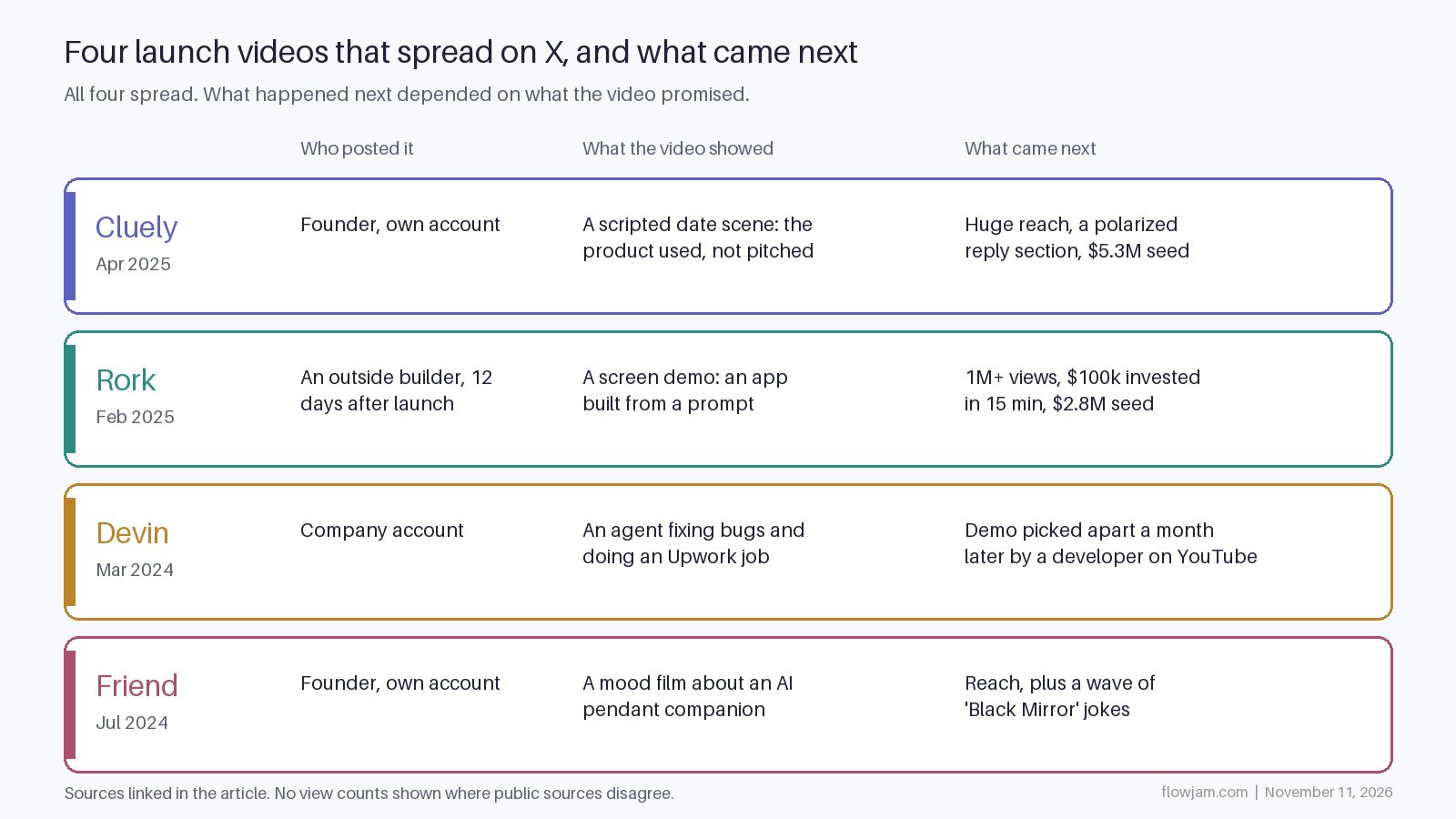
The best-known viral X launch videos break most of the rules founders follow. Rork's went viral twelve days after Rork launched, from someone else's account. Cluely's went viral from the founder's own account, with a video of him failing on a date. Devin's went viral and was picked apart a month later. Friend's went viral as a joke.
What the four share isn't production or timing. Each showed one true thing about the product, and it reached people who cared about that thing. Every myth below breaks on that.
Myth: a viral launch video needs a big production
Two of the four were barely produced. Rork's was a screen demo of an iOS app being built from a text description. Devin's was an agent hitting an error, adding print statements, finding the bug and committing the fix. Cluely's was the most filmed, and even that was one scene in one restaurant (Roy Lee's launch post).
What they share is a moment, not a budget. Each shows the product doing the thing in the first few seconds, so a stranger scrolling past understands it without the caption. Polish is table stakes. Nobody shares a color grade.
The moment is the hard part, and it's the part we do at Flowjam: find the one scene that shows your product, then make the video around it. Our story-driven launch videos have averaged over 100,000 views with no media budget, and HeyGen's Video Agent launch passed 7 million views in 48 hours (our launch work). See how we'd make yours.
Myth: it has to go viral from your account, on launch day
Rork launched on February 12, 2025. It hadn't taken off. On February 24 Matt Shumer, a builder with a large following, posted a video of Rork making an app and said it "blows Bolt out of the water". That post passed a million views, Austen Allred invested $100,000 within fifteen minutes, and the founders later closed a $2.8 million seed led by a16z's Speedrun (TechCrunch).
Two lessons. A launch video keeps working after launch day, so pin it and keep using it. And the account that spreads it doesn't have to be yours. Put the product in the hands of people with an audience who would genuinely use it, and let them post their own clip. Paying them or swapping likes to fake that is a different thing, and X's rules on platform manipulation ban the second.
Myth: any reaction is a good reaction
Cluely and Friend both drew a wave of hostile replies. Only one of them meant to.
Cluely's video is a joke at the founder's expense, and the product is the punchline: the hidden AI assistant feeding him lines that don't save him. People argued in the replies, but they were arguing about a product they now understood. Cluely announced a $5.3 million seed the next day. We broke the video down shot by shot in our Cluely launch video teardown.
Friend's video for its AI pendant was earnest: a lonely, quiet film about a device that texts you. X read it as an episode of Black Mirror, and the replies made the jokes the video didn't (Cointelegraph). Friend got reach, but the reach was about the reaction, not about the product.
If you want a polarizing launch, write the joke yourself. If the internet writes it for you, it's about you.
Myth: views are the point
A view is a scroll that paused. What the launch needs is replies, follows and signups, and X ranks for the first of those. In the ranking code X published in 2023, a reply was weighted 13.5 and a reply the author engaged with 75, against 0.5 for a like (the-algorithm-ml).
Look at who acted on Rork's video: angel investors and builders, the exact people who fund or use an AI app builder. A million views from them was worth more than ten million from anyone else. That depends on the video, but also on who you are on X before you post, which is why our build in public guide starts months before launch.
Three rules follow from that:
- Write the post for the person who would pay, not for the timeline.
- Send the video by DM to ten people with an audience of those buyers, before and after launch day.
- Spend the first hour answering replies yourself.
The rest of launch day is in our guide to launching on X.
Myth: the demo only has to work in the video
Cognition launched Devin in March 2024 as an AI software engineer, with videos of it debugging code and a claim that it had completed real jobs on Upwork (The Pragmatic Engineer). It spread fast. A month later a developer, Carl Brown of the YouTube channel Internet of Bugs, went through the Upwork video and argued it didn't do what the client asked and took far longer than the video implied (ITPro).
Cognition's business survived it. Most startups' wouldn't, because a viral video brings exactly the audience most able to check it. Every frame of a launch video should be something a viewer could reproduce in the product next week. Our X launch video guide covers the specs, and the launch checklist covers the night before.
AP
About the author
Adam Petty
Founder, Flowjam
Adam is the founder of Flowjam, where he helps startups turn ideas into launch videos, product demos, and ads with AI video. He writes about AI video production, creative workflows, and go-to-market for early-stage teams.
Frequently asked questions
What are some examples of viral launch videos on X?
Cluely's date-scene video (April 2025), the Rork demo posted by Matt Shumer (February 2025), Cognition's Devin demo (March 2024) and Friend's AI pendant film (July 2024) are four widely covered examples, with very different outcomes.
How long should a launch video for X be?
Short, with the product on screen in the first few seconds. A free X account can post up to 2 minutes 20 seconds and 512MB.
Can I pay creators to post my launch video?
You can work with creators, but paid posts need a clear disclosure, and coordinated likes, reposts or fake accounts break X's platform manipulation rules.
What if my launch video doesn't go viral?
Keep it pinned and keep using it. Rork's video spread twelve days after launch, from someone else's post. Reply to everyone who engages and send the clip to people who would use the product.
Is a Twitter launch video different from an X launch video?
No. Twitter became X in 2023, and people search both names. The specs, ranking signals and rules are the same.
Should a launch video be funny?
Only if the joke is about the problem your product solves. Cluely's humour showed the product; a joke viewers make about your video instead is reach you didn't want.





Launch videos for
moon-shot founders.

About
We're a video production studio partnering with AI founders and startups. We make launch videos to show the world what you're building.
London / San Francisco
Made with love from London / San Francisco. Collaborating with clients worldwide.
Contact
Adam Petty
Founder
adam@flowjam.com
Founder
adam@flowjam.com