
Viral launch videos for moon-shot founders 
Flowjam partners with AI founders and startups aiming for the moon, to create story-driven launch videos to build hype and show the world what they're building.












Flowjam works with some of the most successful AI founders in the world after only launching in 2023.
Copyright 2026. Flowjam Ltd.
Copyright 2026. Flowjam Ltd.
How to Go Viral on X: What the Published Algorithm Rewards
How to go viral on X, answered from the For You code X publishes: win your followers first, earn watch time inside 48 hours, and skip bought engagement.

X publishes the code that decides what shows up in the For You feed. It lives on GitHub at xai-org/x-algorithm, and X has updated it several times since August 2026, most recently on October 26. A lot of the advice about going viral on X was written before any of that, and some of it is now plainly wrong.
We make launch videos for startups that need one post to travel, so these are the questions founders ask us before launch day. The answers come from that code. Where the code says nothing, we say so.
Can you go viral on X with few followers?
Yes, but probably not from an account you opened this week. The code has two rules that pull in opposite directions. A New-Author Boost lifts posts from authors whose impressions are below a threshold. A filter in home-mixer/filters called NewUserMinEngagementFilter drops a new account's posts from strangers' feeds until they clear an engagement threshold.
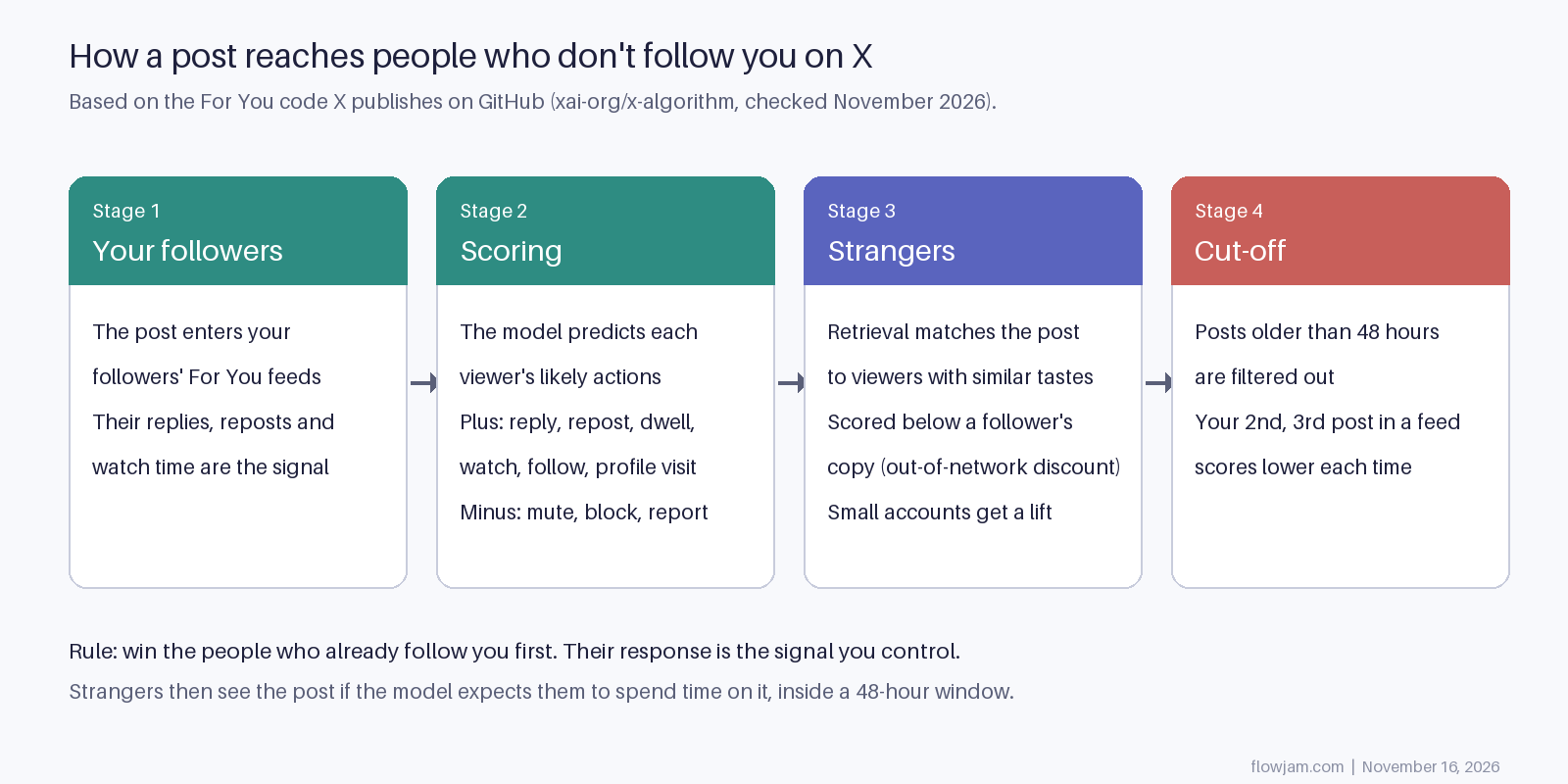
So a small account gets help, and a brand-new one has to prove itself to someone first. Posts from accounts a viewer doesn't follow are also scored lower than the same post from an account they do follow. Your followers are the first audience whatever your size. That is stage one in the diagram above, and nothing reaches stage three without it.
Our rule: launch from the founder's personal account, even with 400 followers, rather than a company handle made for launch week. Post there for a few weeks first so the people who'd care already follow you.
What X's algorithm actually rewards
The ranking model predicts how likely each viewer is to do each of a long list of things with your post, then adds those predictions up. The README puts it as "Final Score = Σ (weight_i × P(action_i))", and the weights sit in home-mixer/params/param.rs. Here is what the model predicts, as listed in the Scoring and Ranking section:
| Counts for the post | Counts against it |
|---|---|
| Like, reply, repost, quote, share, share by DM, copy link | Not interested |
| Click into the post, the profile, a link or a photo | Mute the author |
| Dwell time, video quality views, seconds of video watched | Block the author |
| Follow the author, time spent on their profile | Report, or scroll past without stopping ("not dwelled") |
Note the last one. A post people scroll straight past isn't neutral.
You've probably seen the claim that one reply is worth 27 likes. It comes from the 2023 Twitter release, where the published weights were 13.5 for a reply and 0.5 for a like. The current README now spells out that the weights multiply predicted probabilities, not raw counts. In its words, it would be "incorrect to see that a report has 468 times higher weight than a like and conclude that e.g. '1 report cancels out 468 likes'". Counting replies against likes tells you nothing.
What's changed is time. On October 8, 2026 X said the model now predicts time spent much better. On October 13 it said retrieval is "trained to surface posts that people read all the way through." A post that makes people stop, and that they can finish, is the one that travels. A long post nobody finishes is now a worse bet than it was a year ago.
How long a post has to take off
48 hours. The README's filter table lists AgeFilter as removing "Posts older than 48 hours", and it runs before scoring, in home-mixer/filters. That's the right edge of the diagram above. So a launch post gets two days at most, and the work you do early in that window counts for the most.
Two more rules shape launch day. Author Diversity means each post of yours after the first in someone's feed is scaled down, to a floor. Repeated reposts of the same post are removed, and posts a viewer has already seen are filtered out.
- If you have one big thing to say, put it in one post and put the rest in replies under it. Five posts in a morning compete with each other.
- If you want a second wave on day two or three, quote your launch post and add something new: a clip people asked about, a number you can stand behind. Reposting it again does nothing for people who saw it.
- If the post hasn't moved by hour six, don't delete and repost it. Fix the next post instead.
The full launch-day sequence, including what to pin and when, is in our guide to launching on X.
Do links hurt reach on X?
This one is disputed and the code doesn't settle it. Link click is listed as a positive action the model predicts, and we found no rule in the README that names a link penalty. But a link sends people off X, and dwell time is what the model has just got better at predicting. Plenty of creators still say their link posts do worse.
Our rule: put the video and the claim in the post and the link in the first reply. It costs you one tap per reader and removes the question.
How to make a video go viral on X
Video gets its own attention signals in the code: video opens, quality views and seconds of continued watching. Those are all about holding people, so the first two seconds decide most of it. Show the product working in those seconds, not a logo.
- Upload natively. A YouTube link is a link off X and gives the model no watch time to read.
- Burn in captions. Plenty of people scroll X with the sound off, and if a viewer can't follow the video they won't stay.
- Keep it to 30 to 60 seconds and cut anything that isn't the product doing its job. Our launch video script template has the five beats.
Specs, aspect ratios and upload settings are in the X launch video guide.
You can make this video yourself, and if your product shows well in a screen recording you should try. Founders hire us when they can't see which ten seconds will make a stranger stop. At Flowjam we find that moment, write around it and make the video. Our story-driven launch videos have averaged over 100,000 views with no media budget. See the launch videos we've made.
Does buying views or joining engagement groups work?
No, and the code shows why. X runs models that score accounts, including one for inauthentic behaviour (bdsm) and one, user-cred-v2, that runs PageRank over who follows and engages with whom. Bought likes come from exactly the accounts those systems are built to find. And the ranker predicts what each real viewer will do. A thousand bought likes don't make a stranger more likely to stop.
If you want paid reach, pay X for it. Boost and Ads Manager are covered in how to promote your launch post on X. If you've bought engagement or joined a like-for-like group in the past, check X's Under the Hood report before launch day. It's X's new tool showing visibility labels on your account and posts, and it's still being rolled out, so you may not have it yet.
AP
About the author
Adam Petty
Founder, Flowjam
Adam is the founder of Flowjam, where he helps startups turn ideas into launch videos, product demos, and ads with AI video. He writes about AI video production, creative workflows, and go-to-market for early-stage teams.
Frequently asked questions
Do hashtags help you go viral on X?
Nothing in the list of actions X's ranking model predicts treats a hashtag as a signal. Use one only if a real community follows it, such as a conference tag, and never stack several.
Is the code on GitHub what X actually runs?
Close to it, by X's own account. X says scripts set the code's defaults to the main production values, that it runs experiments on small slices of traffic, and that some files, including certain spam rules and its LLM prompts, are not published.
Should I reply to every reply on my post?
Reply to the real ones in the first few hours. The 2023 Twitter release gave a reply the author engaged with the highest positive weight of any action. The current release doesn't list that separately, but replies are still a predicted action and a live thread keeps people on your post.
What time should I post to go viral on X?
When your own followers are online, since they see it first and the post has 48 hours to spread. For a global or US tech audience that usually means a weekday US morning, but your own analytics beat any general rule.
How many views counts as viral on X?
There's no official number. For a startup launch, a better test is whether the post reached well beyond your follower count and brought sign-ups, not the view figure itself.





Launch videos for
moon-shot founders.

About
We're a video production studio partnering with AI founders and startups. We make launch videos to show the world what you're building.
London / San Francisco
Made with love from London / San Francisco. Collaborating with clients worldwide.
Contact
Adam Petty
Founder
adam@flowjam.com
Founder
adam@flowjam.com